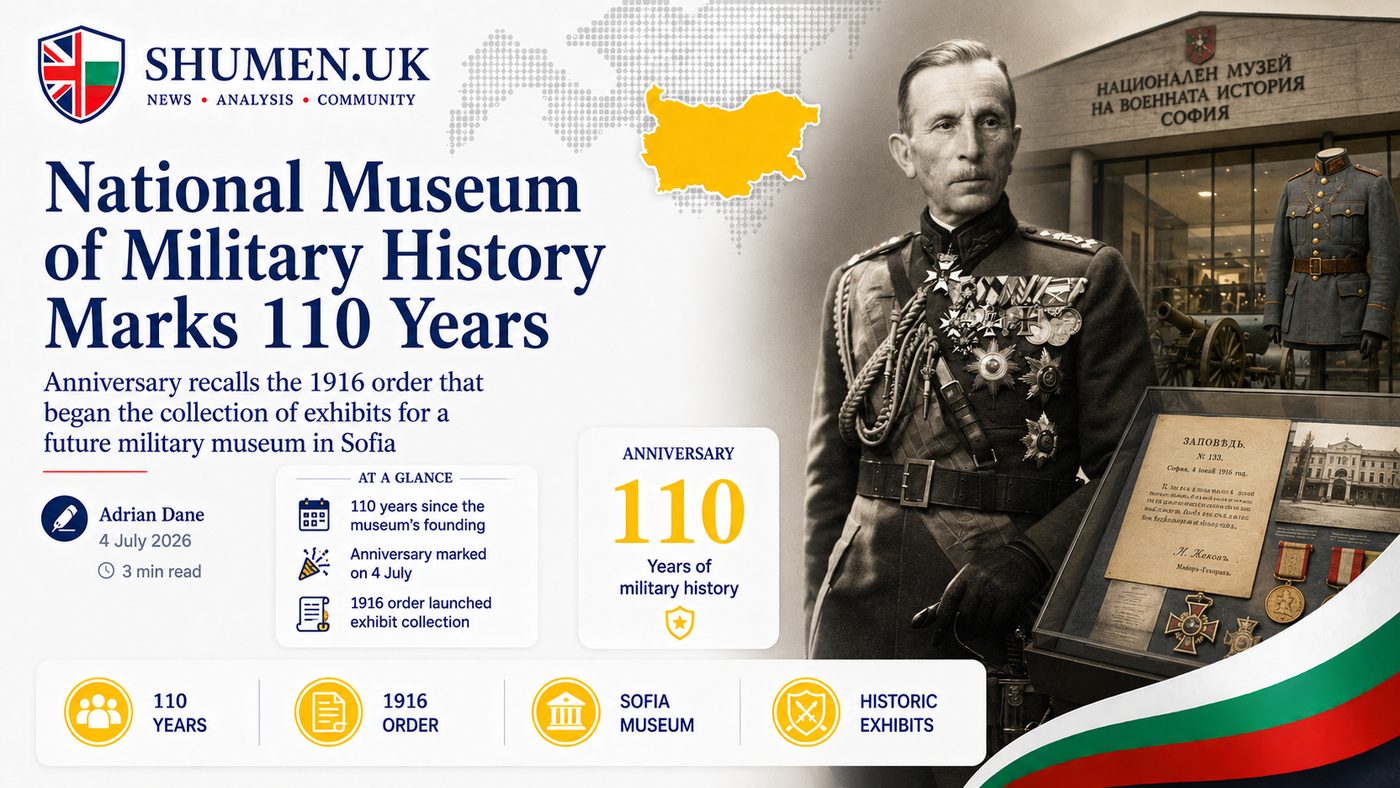
Bulgaria's National Museum of Military History turns 110 on 4 July, and its birth certificate is an unusual one: an order issued in the middle of the First World War. On 4 July 1916 the Active Army's Commander-in-Chief, Major General Nikola Zhekov, signed Order 391, which set the collection of exhibits in motion for the military museum the army intended to found in Sofia, as BTA recounts in an archives piece marking the anniversary.
The order set artillery chiefs to collecting and cataloguing valuable items for dispatch to the Military School in Sofia, with Captain Atanas Dimitrov appointed the museum's first curator and Dimitar Ilkov its clerk. The idea itself was older: according to the historian Diana Haralanova, writing in the museum's 1998 Proceedings, military circles had been pushing to collect and display artefacts of the Bulgarian army's history since the early twentieth century.
From One Order to a Museum With Halls
It took two decades for the collection to become something the public could walk through. The doors first opened to the public on 12 May 1937, at the Sofia Officers' Assembly building: roughly 1,900 items across two main halls, one for weapons and one for paintings, with smaller rooms for the technical, naval and cavalry sections, the years before Liberation, and the four wars that followed it: with Serbia in 1885, the Balkan War of 1912 to 1913, the Inter-Allied War of 1913, and the First World War.
In 1968, a Council of Ministers decree granted the institution national status and its present name. BTA's own bulletins tracked the museum's fortunes along the way: a 1945 dispatch describes students exchanging commemorative badges for donations towards a Central Military Museum on Army Day, and a 1952 report walks readers past the famous Samara Flag of 1877, then the centrepiece of a roughly 40,000-item collection at what was called the Central Museum of the People's Army.
What It Holds Today
From those 1,900 items in 1937, the collection has grown to more than one million: uniforms and decorations, flags and seals, weapons, orders and works of fine art among them. The museum also runs three branches beyond its Sofia home, two of them in Varna (the Naval Museum, plus the Park Museum of Combat Friendship 1444 Vladislav Varnenchik) and one at Krumovo near Plovdiv (the Museum of Aviation).
Why It Is Worth a British Expat's Afternoon
If you have ever wondered why nearly every Bulgarian village square has a monument carrying the same clusters of dates, 1885, 1912, 1913, 1918, this is the museum that explains them. The four wars in its 1937 floor plan are the same four wars on the plinths, and an afternoon here turns those roadside names and dates into a story you can actually follow.
For Brits on the coast, the two Varna branches put naval history and an open-air park within easy reach, and the aviation branch at Krumovo makes a natural stop for anyone passing Plovdiv. Practical visiting details are best checked on the museum's own site before you set out; for the wider itinerary, our visiting Bulgaria guide covers how to build a trip around stops like these.