Management Decisions Under Fire
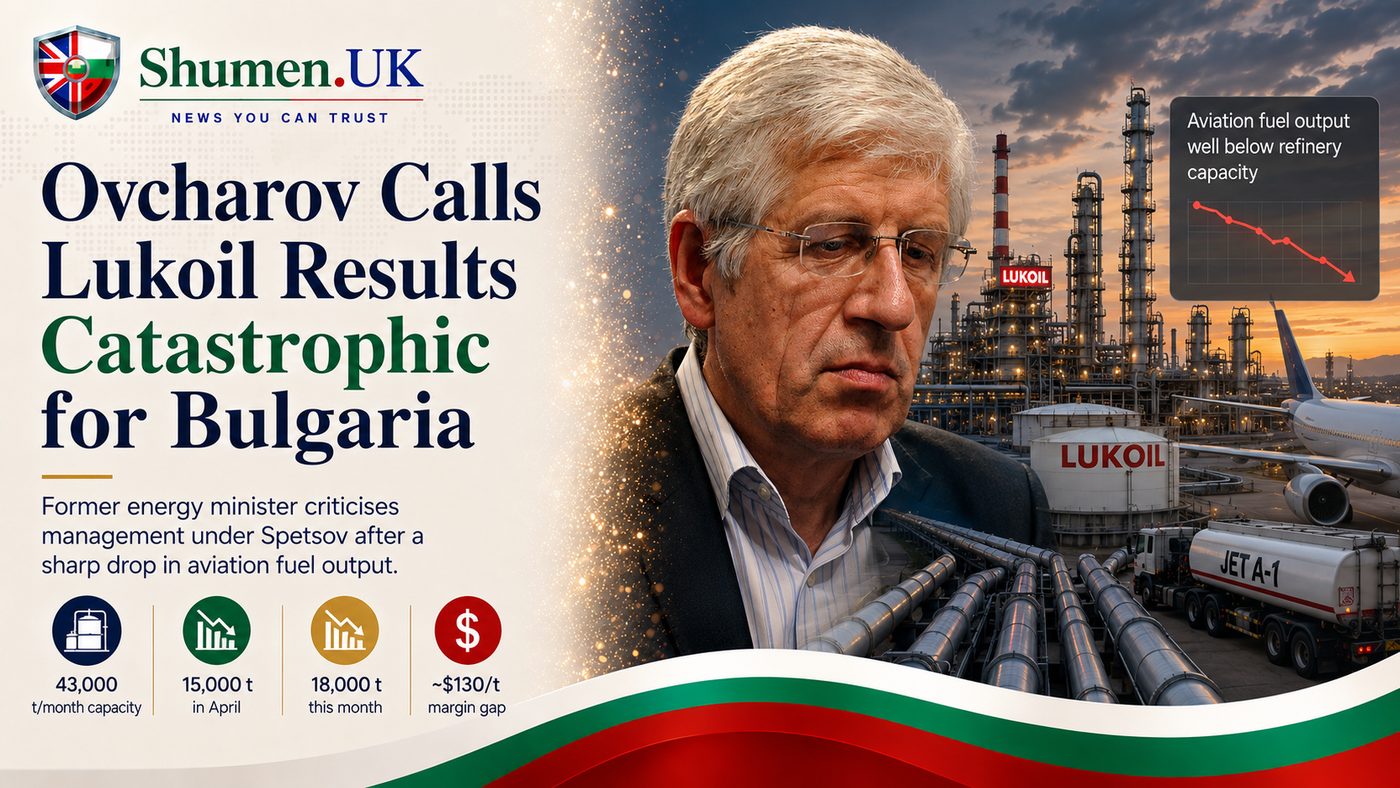
Bulgaria's handling of Lukoil's Bulgarian refinery has produced catastrophic results under state-appointed special manager Rumen Spetsov, according to former Economy and Energy Minister Rumen Ovcharov. Speaking on Bulgarian National Radio on 25 May, Ovcharov warned that production decisions at the refinery have caused serious financial losses and undermined Bulgaria's position in pending arbitration with the Russian oil company.
The criticism follows a parliamentary move to limit Spetsov's powers. Ovcharov, who served as energy minister during earlier coalition governments, said the refinery's most profitable product (aviation fuel) has been running at barely a third of capacity for two consecutive months. The facility can produce 43,000 tons of jet fuel per month, according to Ovcharov. In April 2026 it produced 15,000 tons. May output is projected at 18,000 tons.
Ovcharov claimed the profit margin gap between aviation fuel and diesel currently sits at around €120 per ton (converted from his quoted $130 figure). Selling diesel instead of jet fuel when the refinery has spare aviation capacity makes no economic sense, he argued. "The companies chosen for export cannot export aviation fuel, so they export diesel instead," Ovcharov said, suggesting the production policy serves the interests of middlemen rather than the Bulgarian state.
All production figures, profit margins, and export arrangements cited in this article are based on Ovcharov's statements and have not been independently verified.
Arbitration Risk
Lukoil launched arbitration proceedings against Bulgaria after the government imposed a special administrator on the refinery in response to sanctions complications. Ovcharov warned that Spetsov's management decisions have weakened Bulgaria's legal position. He criticised the dismissal of Lukoil representatives from company management and the removal of the refinery's production director at a time when the plant is operating under what he called "more complicated technological conditions".
"In a situation like this, experienced managers of the production process are needed," Ovcharov said. He added that the current administration has shown it cannot maintain working relations with the Russian side and called for someone to be appointed who could "at least help solve the arbitration problem".
The exact details and current status of the arbitration case remain confidential and have not been publicly disclosed.
The former minister identified three developments as critical indicators for Bulgaria's energy future: Kozloduy Nuclear Power Plant, Lukoil Neftochim (the refinery's formal name), and state gas operator Bulgartransgaz. All three are at varying stages of ownership disputes, infrastructure investment decisions, or regulatory overhauls.
Public Debt Warning
Ovcharov also used the interview to warn about Bulgaria's fiscal trajectory. The country paid nearly €1 billion last year to service existing debt obligations, he said. That figure could rise to €2 billion annually by 2030 if current borrowing trends continue. Bulgaria's public debt has increased from around 23% of GDP to approximately 29%, a shift Ovcharov described as part of a "constant cycle of rising expenses".
He questioned how the government plans to manage future salary and pension commitments. While defending the so-called Swiss rule for pension indexation (a policy that adjusts payments based on a mix of wage growth and inflation, used across several European countries to preserve purchasing power), he criticised what he called disproportionate increases elsewhere. Defence spending doubled last year, he said, while Interior Ministry spending rose 50%. "Are we going to continue like this?" he asked, suggesting that at minimum, the mechanism for automatic budget increases should be reconsidered.
These fiscal figures are based on Ovcharov's statements. Independent verification from Bulgaria's Ministry of Finance or international fiscal authorities was not available.
On prices, Ovcharov argued that calls for "fair prices" should not be interpreted as price caps. Instead, he said, greater transparency in markups and supply chains would naturally lead to lower consumer costs. "If everything becomes visible (the processes, the markups, the additional charges) then prices should fall and it will become clear where the biggest profits are being made," he said.
Parliamentary Reforms
Ovcharov also defended proposed changes to parliamentary procedure supported by Progressive Bulgaria (a liberal political party), rejecting claims that the reforms threaten democratic practice. He argued that Parliament had drifted away from normal legislative work during years of political instability and repeated elections. "They turned ministers into permanent guests in Parliament simply to fill time," he said, adding that the institution now needs to return to its traditional functions.
Asked about the political future of socialist figure Krum Zarkov, Ovcharov outlined three possible paths: stepping aside and waiting for others to solve internal party problems, seeking unity with Prime Minister Rumen Radev, or launching a direct internal struggle for influence within the socialist movement. Such a fight, Ovcharov said, would require breaking ties with controversial figures including Delyan Peevski, former prime minister Boyko Borisov, and Kiril Dobrev.
Ovcharov's broader assessment of the Radev government was cautiously positive. He said the cabinet was moving in the "right direction" on the budget, inflation, and state spending, though he cautioned against excessive political self-promotion.
What This Means for British Expats
Bulgaria's energy sector directly affects fuel prices, heating costs, and electricity tariffs. If Ovcharov's warnings about fiscal pressure prove accurate, British expats in Bulgaria could face indirect consequences through rising taxes, reduced public services, or increased costs for utilities as the state struggles to service debt. The Lukoil arbitration case, if lost, could add further strain to public finances, potentially leading to higher utility bills or cuts in public spending that affect day-to-day life.
For anyone following Bulgaria's slow movement toward greater EU energy integration and away from Russian dependence, Ovcharov's comments suggest the transition is proving messier and more expensive than official rhetoric admits. The former minister's criticism of parliamentary procedure changes may also signal broader tensions within Bulgaria's fractured political landscape, which has produced eight elections in five years.
While the immediate story concerns refinery management and state finances, the underlying thread is one of institutional strain: a country caught between competing interests (Russian energy assets versus Western alignment, fiscal discipline versus public spending pressures, coalition stability versus opposition criticism) with no clear resolution in sight.