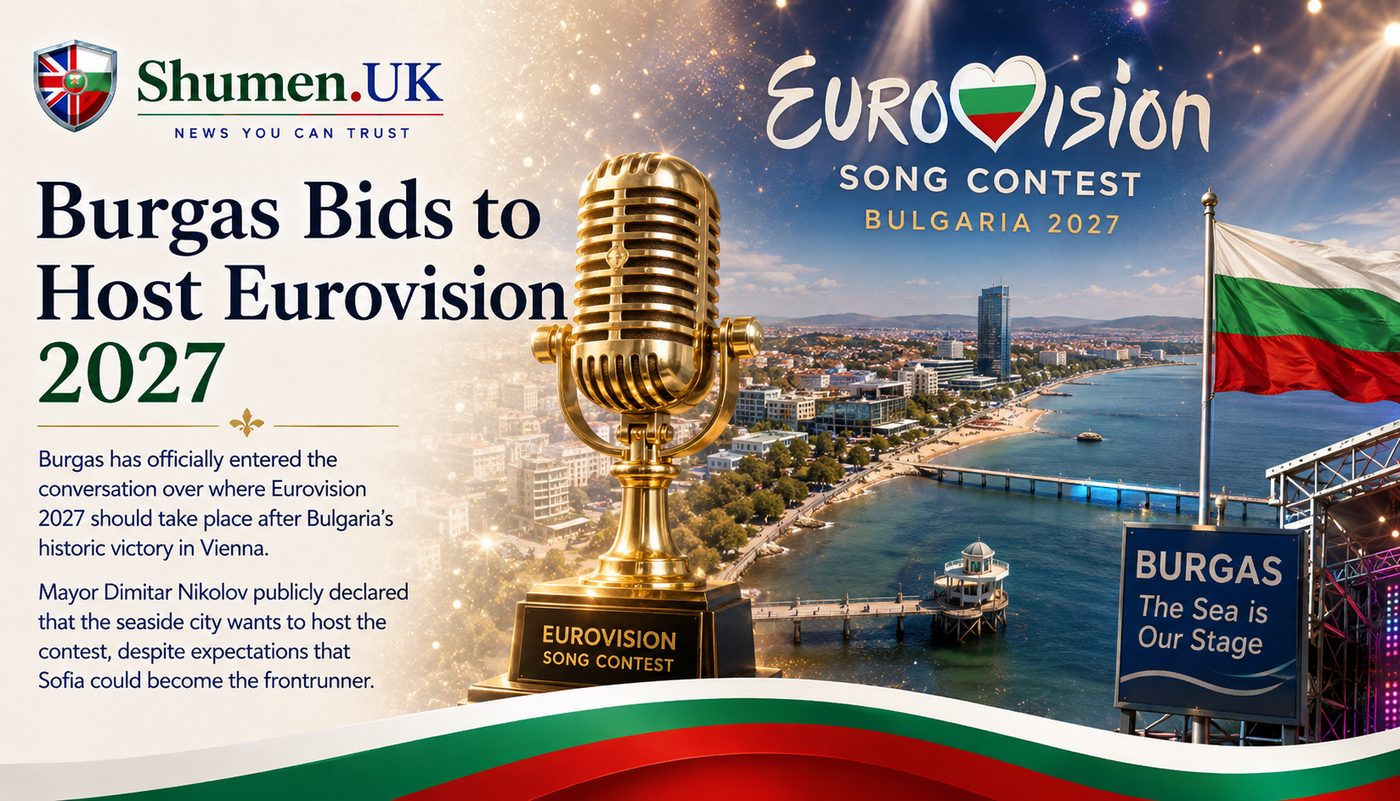
Burgas has thrown its hat into the ring for Eurovision 2027 following Bulgaria's first-ever victory in the contest, though the Black Sea city faces an uphill battle against Sofia for the right to stage next year's event.
Mayor Dimitar Nikolov wrote on Facebook that Burgas has a "categorical desire" to host. "I know Sofia will be a great host, but I declare Burgas's categorical desire to host," Nikolov said. "We will do our best to make it perfect. And it will be." No formal bid details or application timeline have been released.
The announcement came shortly after Bulgaria secured its historic win in Vienna with singer DARA's performance of "Bangaranga". Under Eurovision rules, the winning country receives hosting rights, but the host city is not automatically the capital.
Sofia Already Preparing
Bulgarian National Television Director General Milena Milotinova said during a press conference in Vienna that Sofia is preparing for the possibility of staging the event. The capital would be the natural frontrunner given its infrastructure and existing venues, though the final decision rests with broadcaster BNT and the European Broadcasting Union.
Varna, DARA's hometown on the northern Black Sea coast, has also entered public discussion, though city authorities have not made a formal bid. Before the grand final, Varna Mayor Blagomir Kotsev publicly backed the singer, writing that she represented "not only Bulgaria, but the spirit and energy of a new generation of Bulgarian talent".
What This Means for British Expats
Eurovision hosting decisions typically take three to six months and involve assessments of venue capacity (minimum 10,000 seats), hotel availability, transport links, and broadcast infrastructure. Bulgaria has never hosted the contest before, which means any winning city would need to demonstrate it can handle the logistical demands of a week-long event involving delegations from over 40 countries.
For British expats in Bulgaria, the hosting city decision could bring noticeable changes. A Eurovision host city typically sees significant infrastructure investment, increased international media attention, and a surge in tourism enquiries. Burgas, as a smaller city than Sofia, would face a steeper challenge meeting the venue and accommodation requirements, though the coastal location in May could prove appealing to delegations.
The formal selection process is underway but no announcement date has been confirmed. Past Eurovision winners have typically announced host cities within three to six months of their victory, which would put Bulgaria's decision somewhere between late summer and early autumn 2026.
Political Backing
Prime Minister Rumen Radev called the win "a Bulgarian victory with global resonance" and said DARA had overcome "all complex considerations and prejudices of the voting" through talent and professionalism. He added on Facebook: "Bulgaria awaits Europe and the world at Eurovision 2027."
Culture Minister Evtim Miloshev told BNT that the result was not surprising given the song's momentum before the final. "This is ultimately a song contest," he said. "Talent, emotion and the artist DARA were what mattered for this result." Miloshev described the success as a boost to international attention on modern Bulgarian culture and a unifying moment for Bulgarians inside and outside the country.
Metropolitan Nahum of Ruse also congratulated DARA after the victory, reflecting the broader national pride the win has generated.
What Happens Next
The formal host city selection involves technical assessments by the EBU and BNT, followed by political and financial negotiations. The decision will likely hinge on which city can demonstrate the strongest combination of venue capacity, hotel availability, and financial backing.
Burgas has the advantage of coastal appeal and a strong tourism infrastructure, but Sofia has the capital city status, larger venues, and better transport links. Varna remains a wildcard, though the absence of a formal bid suggests it may not proceed beyond public discussion.
For now, the hosting question remains open. What's clear is that Bulgaria's Eurovision victory has sparked a genuine competition between cities, all eager to capitalise on a moment of rare national glory.