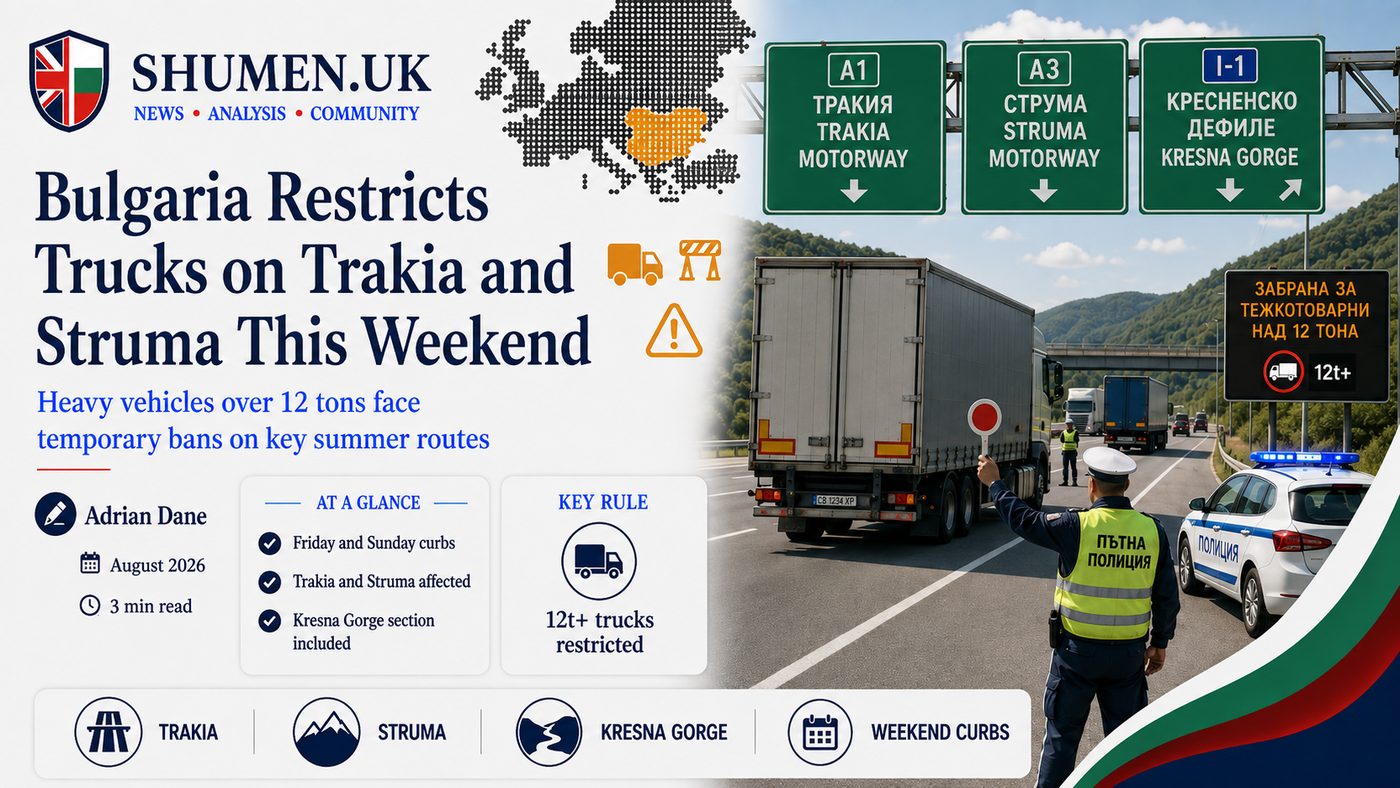
Bulgaria's Road Infrastructure Agency is pulling heavy lorries off the country's two busiest holiday routes at the weekend's peak hours. Trucks over 12 tonnes are banned from the Trakia motorway, the Struma motorway and the I-1 road through the Kresna Gorge on Friday 7 August between 16:00 and 23:00, and again on Sunday 9 August between 15:30 and 22:00, in both directions.
The agency calls this one of the busiest travel weekends of the summer, and its stated aim is plain enough: fewer long freight convoys, fewer risky overtakes, and a smoother run for everyone else heading to the coast or the Greek border.
Where and When the Bans Apply
The restriction covers the full length of both motorways and the stretch of the I-1 road through the Kresna Gorge between the Simitli checkpoint at kilometre 376 and the Kulata border crossing into Greece. The windows are:
- Friday 7 August: 16:00 to 23:00
- Sunday 9 August: 15:30 to 22:00
Lorry drivers have not been left without options. Freight heading to or from Burgas is directed onto the I-6 Sub-Balkan road. Traffic bound for Kulata is rerouted along Road II-19 between Simitli and Gotse Delchev, then Roads III-198 and III-1981, rejoining the I-1 near the border. Other routes on the national network remain open to them, within the usual traffic rules.
Why Kresna Is Always the Pinch Point
The two roads named in the order are the spine of Bulgarian summer travel. The Trakia motorway runs 360 km from Sofia through Plovdiv to Burgas and carries the bulk of the coast traffic. The Struma motorway runs south from Sofia towards Kulata and the Greek border as part of the E79 corridor, except that it has never been completed through the Kresna Gorge itself. Everything bound for Greece still funnels through roughly 18 km of steep river gorge on the old I-1 road.
Anyone who has crawled through Kresna behind a lorry convoy in August will not need the agency's reasoning explained to them. The safety background is not academic either: Novinite reported in July on the third truck barrier crash on Bulgarian roads in a matter of weeks, that one fatal.
What This Means If You Are Driving
The ban applies only to vehicles over 12 tonnes. Ordinary cars, vans, caravans and motorhomes are unaffected. The agency's stated aim is better traffic flow during exactly those hours, though it has not said what difference drivers should expect to see.
At Simitli, reversible lanes are being set up on the I-1: on Friday, two lanes run towards Kulata and one towards Sofia, and on Sunday the arrangement flips, two lanes back towards Sofia. In other words, the setup favours the outbound Greece run on Friday and the return leg on Sunday. The agency says traffic volumes will be monitored continuously and that further reversible arrangements may follow over the next holiday period if needed.
Two warnings from the agency are worth taking at face value. It has asked drivers to obey speed limits and avoid dangerous overtaking, and it has specifically told motorists not to use the emergency lane to bypass queues: that lane has to stay clear for police and ambulances to reach any accident. Separately, Novinite reported an orange code warning for dangerously high temperatures in eight regions of the country on Friday 7 August, so the queues, where they do form, will be hot ones.
If you have not driven the Greece run or the coast road before, our driving guide covers vignettes, speed limits and what to expect from a KAT roadside stop.
Who Is Exempt
The temporary ban does not apply to:
- buses providing public passenger transport
- vehicles carrying dangerous goods under ADR rules
- live animal transport
- perishable and temperature-controlled food cargo
- specialised carcass transport
- vehicles used by road maintenance companies
So the coach to Thessaloniki runs as normal, and the refrigerated lorry supplying the supermarket does too.