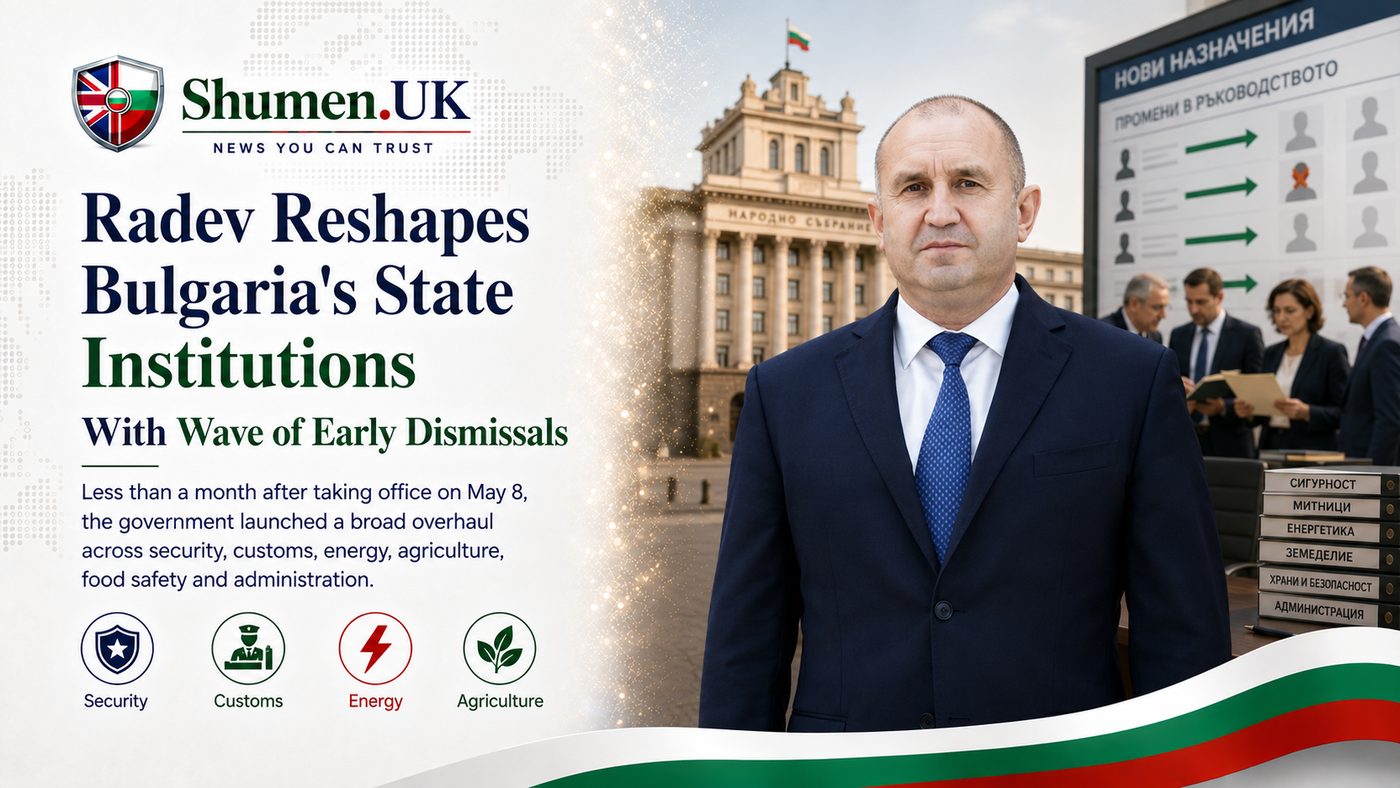
Rumen Radev's government has conducted one of the most extensive personnel overhauls in recent Bulgarian history, replacing senior officials across key state institutions within weeks of taking office on 8 May 2026. The changes follow Progressive Bulgaria's absolute parliamentary majority in the 19 April election, the first single-party majority since 2013 and the first government led by a former president.
British businesses operating in or trading with Bulgaria should note leadership changes at the Customs Agency and Bulgarian Energy Holding, both institutions critical to trade flows and energy cooperation. The Registry Agency, which oversees the Commercial Register and Property Register, is also under new management after the justice minister cited serious administrative and financial failures. British expats navigating property purchases, company formation or customs procedures should anticipate possible transitional delays as new officials settle into roles.
For weeks the queue at Kapitan Andreevo has been unusually tense, a visible sign of the behind-the-scenes shake-up playing out across Bulgaria's state machinery.
Security and Regional Governance
The government replaced Denyo Denev, acting head of the State Agency for National Security (SANS), with longtime security official Stancho Stanev. Stanev was also named deputy chairman of the agency for a five-year term.
The move is politically significant because Denev's original appointment sparked a dispute between Radev (while serving as president) and the previous Zhelyazkov government. Parliament amended legislation to transfer SANS appointment powers from the presidency to lawmakers after Radev refused to endorse Denev.
Critics have questioned Stanev's background, pointing to previous controversies around his security clearance, though it was later restored. Shortly after the leadership change, state-provided security protection for Delyan Peevski and GERB leader Boyko Borissov was withdrawn.
Former acting Prosecutor General Borislav Sarafov resigned from his leadership positions shortly after the elections, remaining within the judicial system as an investigator.
On 13 May, the government dismissed all 28 regional governors and appointed new representatives in every province. Regional governors implement central government policies locally. Many new appointees previously served under caretaker governments appointed by Radev during his presidency, have backgrounds in local government or the Interior Ministry, or held party affiliations with BSP, Ataka or other formations. Several were Progressive Bulgaria candidates in the April elections or had supported Radev's campaign financially.
Customs and Border Control
The Ministry of Finance removed Customs Agency Director Georgi Dimov on 18 May, replacing him with Nikolay Shushkov. Dimov, appointed in 2024, faced public scrutiny over property-related issues and asset declarations. Shushkov previously headed the Southwest Customs Directorate but resigned years ago amid allegations connected to smuggling investigations, which he denied.
The ministry also appointed Stefan Bakalov as deputy director and reinstated Georgi Gospodinov as head of the Kapitan Andreevo customs checkpoint.
For British importers and exporters, any disruption to customs procedures at this crossing point affects trade flows across the entire southeast EU corridor. Businesses relying on predictable processing times at Kapitan Andreevo should monitor whether inspection practices or enforcement priorities shift under the new leadership.
Energy Sector
Energy Minister Iva Petrova dismissed the Bulgarian Energy Holding (BEH) management board on 21 May, citing ineffective management and staffing expansion. BEH controls Bulgaria's largest state-owned energy assets and plays a central role in energy strategy and EU-funded reforms. Former Energy Minister Andrey Zhivkov returned to lead the holding.
British companies involved in energy cooperation with Bulgaria should note the change. BEH's leadership influences electricity pricing, renewable energy strategy and infrastructure development decisions affecting both business energy costs and household bills.
Agriculture and Food Safety
The Ministry of Agriculture removed State Fund Agriculture Director Iva Ivanova, who remained as deputy to new director Vladislava Kazakova. The fund distributes European agricultural subsidies. Both Ivanova and Kazakova previously held senior positions during caretaker governments associated with Radev.
The government dismissed Bulgarian Food Safety Agency (BFSA) Director Angel Mavrovski on 21 May. During his tenure, the agency uncovered irregularities in warehouses, slaughterhouses and food-processing facilities. Mavrovski later claimed his dismissal followed concerns he had raised about possible manipulation of food testing results at the Kapitan Andreevo border checkpoint. Agriculture Minister Plamen Abrovski responded that such allegations would constitute a criminal matter if proven. The claims remain unproven at the time of publication.
The Kapitan Andreevo checkpoint is a key crossing point for EU food import and export flows. British food importers and exporters relying on Bulgarian testing standards should monitor developments. If the allegations prove accurate, they would raise questions about food safety controls across the entire supply chain.
Directors at four of Bulgaria's six state forestry enterprises were also replaced.
Registry Agency
Justice Minister Nikolay Naydenov dismissed Registry Agency Executive Director Daniela Miteva on 20 May, citing "striking and unacceptable practices". The minister said more than 60% of administrative positions remained vacant, key functions lacked personnel, and the agency's finances were poorly managed. He pointed to reports involving discarded documents containing personal information and allegations of thousands of missing property deeds.
Lawyer Eliana Ilieva was appointed to lead the agency two days later. The Registry Agency oversees the Commercial Register, Property Register and BULSTAT system, databases critical for legal and commercial activities in Bulgaria. British legal, property and commercial professionals should be aware the institution is in transition.
Property buyers and company directors may face processing delays while the new management addresses administrative gaps. Anyone involved in property transactions should verify that registration documents are handled securely and that records are properly maintained during the transition period.
What This Means for British Expats
New governments installing their own teams in strategic positions is a familiar pattern in Bulgarian politics. Bulgarians who have watched multiple governments come and go tend to regard wholesale personnel changes with weary familiarity rather than alarm. The scale and speed of this particular overhaul is less common, enabled by Progressive Bulgaria's absolute majority, the first in over a decade.
British expats should anticipate potential transitional challenges in several areas:
Property and business registration: The Registry Agency manages databases critical for property purchases and company formation. While new leadership may eventually improve service, expect possible delays or inconsistencies during the transition. If you are buying property or registering a company, allow extra time and follow up proactively to ensure documents are processed correctly.
Customs procedures: Leadership changes at the Customs Agency and the reinstatement of officials at Kapitan Andreevo may alter enforcement priorities. British businesses importing or exporting through Bulgaria should monitor whether processing times or inspection practices shift. Companies with regular shipments may want to maintain closer contact with customs brokers during the adjustment period.
Energy policy: Changes at Bulgarian Energy Holding may influence electricity pricing and renewable energy strategy, potentially affecting household bills and business energy costs. If you run a business with significant energy consumption, stay informed about policy shifts that could impact your operating costs.
Food safety: The allegations around food testing at Kapitan Andreevo, if proven, would affect trade integrity across the EU food supply chain. British consumers and importers rely on effective border controls to prevent contaminated or substandard products entering the market. This is one to watch if you operate in food import, export or retail.
Institutional memory in Bulgaria often resides with lower-level civil servants rather than political appointees at the top. Services may continue largely unchanged, though decision-making priorities can shift. For British expats navigating Bulgarian bureaucracy for the first time, it is worth understanding that the pace of change at ministerial level does not always translate into immediate disruption at the counter. That said, this particular round of changes touches institutions that directly affect daily life for expats: property rights, customs processing, energy costs and food safety.
If you are dealing with any of these agencies in the coming months, patience and documentation will serve you well. Keep copies of everything, follow up on submitted paperwork and do not assume that processes will run as they did under previous management.