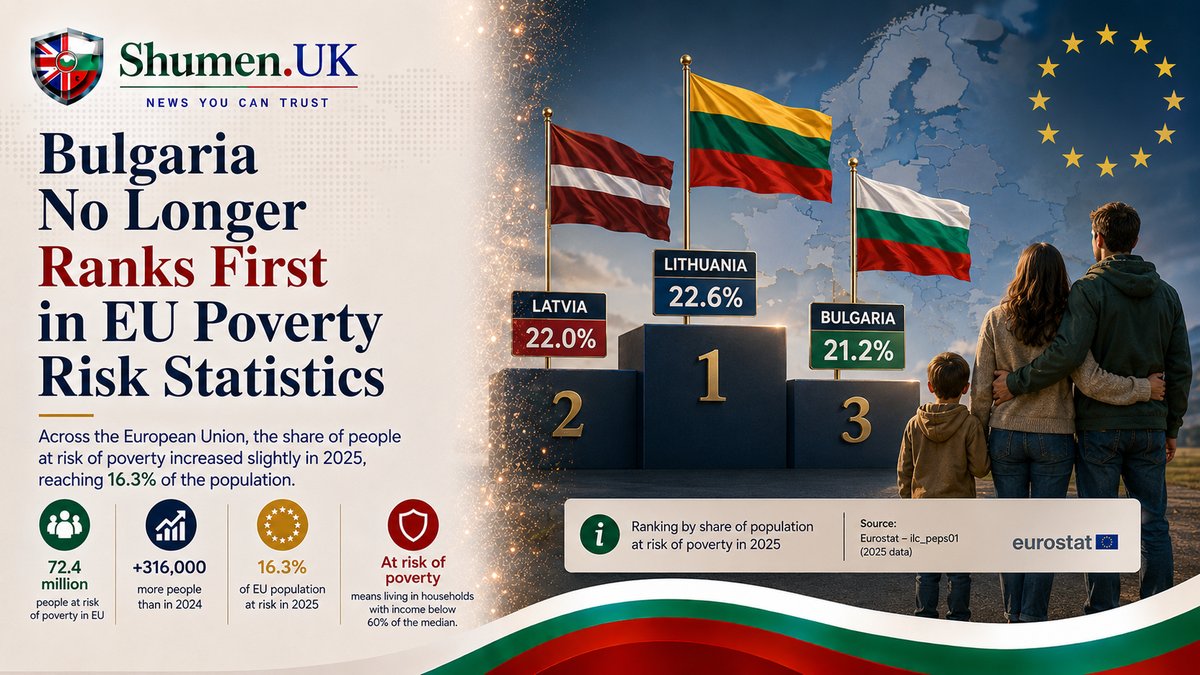
Bulgaria dropped from the highest to the third-highest poverty risk rate in the EU last year, according to Eurostat estimates for 2025. The change is modest, the underlying rate remains high, and the country still sits near the top of the bloc's social vulnerability table.
What the Numbers Show
Eurostat data for 2025 put Bulgaria's poverty risk rate at 21.2% of the population, down from 21.7% in 2024. That half-percentage-point reduction moved the country from the highest rate in the EU, a position it held in 2024, to third place. Lithuania now records the highest level at 22.6%, followed by Latvia at 22%.
Eurostat calculates poverty risk using a harmonised methodology across all EU member states: the share of people living below 60% of the national median income. This standardisation makes the rankings credible and the cross-country comparisons reliable, even as the underlying causes (wages, employment, regional disparities, social transfers) vary by country.
Wider Context
The rankings themselves shift year to year. Bulgaria topped the table in 2024. The latest data show Lithuania and Latvia now leading, with Bulgaria close behind. Anyone who's chatted over a coffee in a Shumen kafene knows that the poverty figures touch real lives beyond the stats.
Source reporting citing Eurostat indicates the share of people at risk of poverty across the EU as a whole increased slightly in 2025, though precise EU-wide aggregate figures await direct Eurostat confirmation. The direction of travel, a modest uptick in overall risk across the bloc, is consistent with recent economic pressures.
What This Means for British Expats
For British expats in Bulgaria, the poverty risk statistics are a structural indicator rather than a day-to-day concern. The metric measures the share of the population living below 60% of the national median income, a threshold that captures social vulnerability but does not directly reflect the cost of living experienced by someone on a UK pension or remote salary.
That said, high poverty risk rates correlate with weaker public services, regional economic imbalances, and infrastructure gaps, all of which affect the environment in which British nationals live and do business. The fact that Bulgaria remains third-highest in the EU despite the improvement underscores that social challenges persist. Public transport reliability, healthcare accessibility, and road maintenance all track, loosely, with the national poverty rate. The statistical improvement is welcome, but British expats weighing whether Bulgaria's economic fundamentals are improving will want to see this as one data point among many.
Why Bulgaria Dropped but Remains High
The half-point reduction in Bulgaria's poverty risk rate is progress, but it does not represent a structural transformation. The country's rate remains more than five percentage points above the EU average, and the gap between Bulgaria and mid-table EU member states is wide.
The consistency of Eurostat's data makes the rankings credible. Lithuania's 22.6%, Latvia's 22%, and Bulgaria's 21.2% are calculated on the same basis. What is clear from the data is that all three countries remain clustered at the high end of the EU's social vulnerability scale, and the margin between them is narrow.
The source material does not explain why Bulgaria's rate fell or why Lithuania and Latvia overtook it. Without such evidence, speculation would be unhelpful. What is clear is that the improvement is real but modest. Bulgaria's poverty risk rate has fallen by half a percentage point, and the country has moved down two places in the rankings. That is not cause for celebration, but it is also not a statistical fluke. The direction is correct, the distance to travel remains long.
Fair Context
For British expats weighing whether Bulgaria's economic fundamentals are improving, the Eurostat data offer one data point among many. The poverty risk rate is a useful structural indicator, but it sits alongside cost of living trends, currency stability, and the practical realities of accessing services. The 2025 figures suggest Bulgaria is edging in the right direction, slowly.