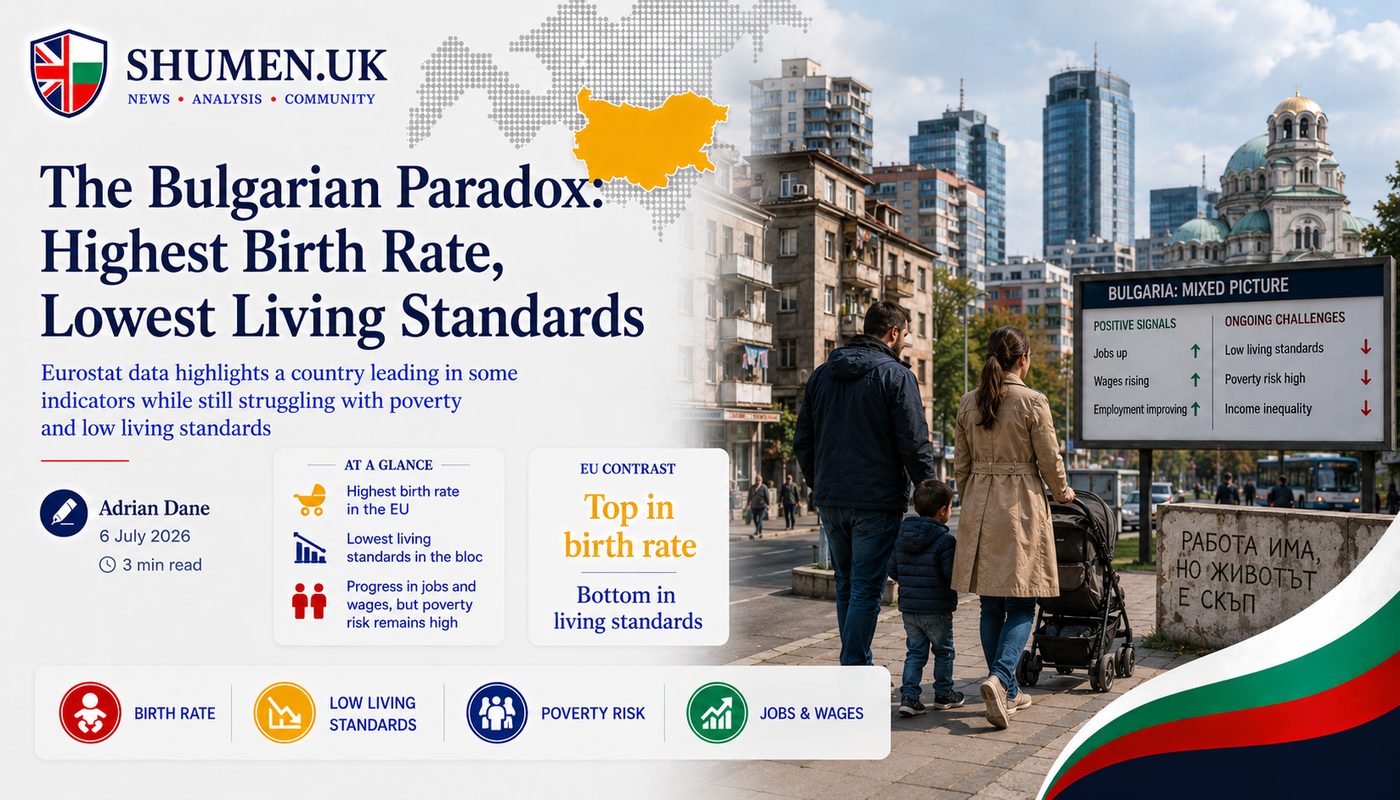
Bulgaria now has the highest fertility rate in the European Union, at 1.72 children per woman against an EU average of 1.34, and it is still shrinking faster than any other country in the bloc. Those two facts sit side by side in Eurostat's latest overview of the Union, reported by Novinite on 12 July, and they are the neatest summary available of the country's long-running demographic puzzle: more births per woman than anywhere else in Europe, and fewer people every single year.
The same dataset puts Bulgaria bottom of the EU for life expectancy and standard of living, near the top for the risk of poverty and social exclusion, and yet shows genuine progress on jobs. For British expats living here, or weighing up a move, several of these numbers touch daily life directly, so they are worth unpicking one at a time.
Most Births Per Woman, Fastest-Shrinking Country
On fertility, Bulgaria leads the Union outright. The 1.72 children per woman figure is well clear of the EU average of 1.34, with France and Hungary next in the ranking and Malta, Spain and Lithuania at the bottom.
And yet between 2015 and 2025 the population fell by 8.4%, the steepest decline of any EU member state. The explanation is arithmetic rather than mystery. A birth rate is births per woman, and Bulgaria has steadily fewer women of childbearing age, so a leading rate applied to a shrinking base still produces fewer babies each year. Add one of Europe's highest mortality rates and continued emigration, and the total keeps falling. Western European countries with far lower birth rates offset the gap through immigration; Bulgaria, so far, does not attract incomers in anything like the numbers needed.
The result, as Eurostat's figures make plain, is a country that is winning the fertility league and losing the population one at the same time.
The Shortest Lives in the Union
Life expectancy in Bulgaria stands at 75.8 years, the lowest in the EU and more than five years below the bloc's average. Spain, Italy and Malta, at the other end of the table, all exceed 84. The overview points to high mortality, chronic illness, an ageing population and limited healthcare access in some regions as the weights dragging the figure down, even after some recovery since the pandemic.
That last point is the practical one for anyone choosing where in Bulgaria to settle. Healthcare access here is uneven: solid in Sofia, Varna and regional centres like Shumen, thin in the deep countryside, where the nearest properly staffed hospital can be a long drive away. Our healthcare guide walks through how the NHIF system works, what it does and does not cover, and how to find an English-speaking GP before you need one in a hurry.
The Job Market Is the Good News, With a Catch
The employment figures read very differently. Across the EU, employment among 20 to 64 year olds hit a record 76.1% in 2025, and Bulgaria has been closing on the European average rather than falling further behind. Its unemployment rate fell by 0.7 percentage points over the past year, one of the three largest annual improvements in the bloc, behind only Greece (1.2 points) and Spain (0.9).
Eurostat attributes the tightening to persistent labour shortages, historically low unemployment, rising demand in manufacturing, construction and services, and steadily climbing wages. Anyone who has tried to book a builder in the Shumen region this summer will not need Eurostat to confirm the shortage; the diary that is full until autumn is the same statistic in the wild.
Here is the catch, though, and the overview is unusually candid about it: Bulgaria's labour market is tight largely because the population is shrinking, not because the economy is growing exceptionally fast. Fewer people enter the workforce each year, so unemployment drifts down while employers struggle to fill vacancies.
For British expats the tight market cuts both ways. If you work for a living here, and plenty do, a labour-short economy strengthens your hand on pay and conditions. If you are renovating a village house, the same shortage means the maistori cost more and take longer to pin down, and that is unlikely to reverse while the demographics point the way they do.
'Least Expensive' Is Not the Same as Cheap
The overview also confirms that Bulgaria remains the least expensive place to live in the EU, while recording the bloc's lowest standard of living and one of its highest risks of poverty and social exclusion. Those findings are not in tension; they are the same finding. Prices are lower than in twenty-six wealthier member states, and local incomes are lower still, which is precisely how a country ends up cheapest on paper and poorest in practice.
It is worth being blunt about what that ranking does not say. It does not mean life in Bulgaria is cheap in absolute terms, and anyone moving on the strength of a decade-old blog post about bargain living will find the arithmetic has moved on. Our cost of living tracker carries the actual prices, in euros, and updates as official figures land.
The honest reading of Eurostat's whole picture is this: the economy is genuinely improving, the job market is the tightest it has been in years, and the demographic hole underneath both is still deepening. How Bulgaria squares that circle will shape the hospitals, schools and services every expat here relies on for decades to come.