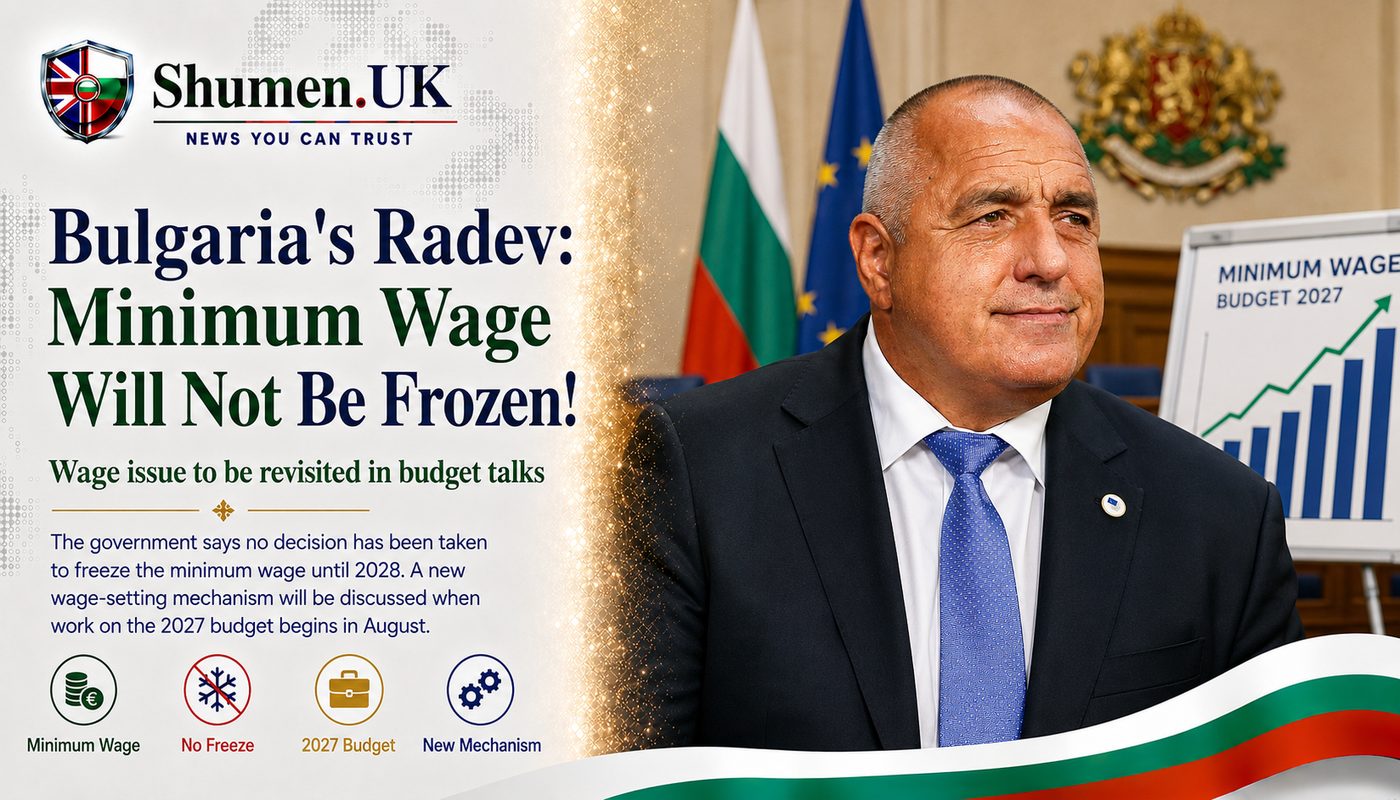
Bulgaria's prime minister has gone on the record to kill off a story that ran all weekend: that his government intends to freeze the national minimum wage until 2028. Rumen Radev told reporters on Tuesday 23 June that no such decision had been taken, and that the level of the minimum wage would be reopened once work on the 2027 budget begins.
"The minimum wage will not be frozen," Radev said, according to the Sofia News Agency (Novinite). "So no, it will not be frozen."
The denial matters because the figure being argued over is not abstract. Bulgarian media reports, including one carried by Novinite itself, had put the frozen level at €620 a month and tied it to a multi-year suspension of wage growth. For anyone in Bulgaria who pays a wage, is paid one, or budgets against the minimum insurance thresholds that track it, whether that number moves or stands still is a real question, not a political parlour game.
Ask the maistori you hire to point a wall, or the cleaner who does the holiday-let changeover, and you will hear the minimum wage discussed with more precision than most Westminster pay debates manage. It sets the floor that everyone else negotiates up from.
What Radev Actually Said
Radev, who stepped down as Bulgaria's president in 2026 to lead a government built around his own Progressive Bulgaria coalition, framed the reports as premature rather than wrong on substance. He said the mechanism for setting the wage would be discussed afresh when the 2027 budget process opens in August, inside the tripartite council, the standing forum where government, employers and trade unions bargain. The number, in other words, is not frozen. It is unresolved, and the argument over how it should be calculated is about to restart.
That distinction does real work. A freeze would mean the figure is fixed until 2028 regardless of inflation or average earnings. What Radev describes is a renegotiation of the formula, with the outcome still open.
The source's own back-catalogue is worth flagging here. Novinite had earlier run a piece headlined to the effect that "Radev's Government Freezes Bulgaria's Minimum Wage Until 2028", stating the freeze as settled fact. Radev's Tuesday remarks directly contradict that framing. We are pointing out the gap rather than picking a side: the government now says nothing is decided, while at least one widely read report treated the freeze as done. The August budget talks are where it actually gets settled.
What This Means for British Expats
If you employ anyone in Bulgaria, this is your story. A Brit running an OOD or EOOD with even a single employee on or near the minimum wage feels every change to it directly in payroll. A genuine freeze would have made budgeting simple for two years. An unfrozen, renegotiated wage means you should pencil in the possibility of an increase from 2027 and stop assuming costs hold flat.
It reaches further than headline pay, though. Bulgaria's minimum wage also anchors the minimum social-security and health-insurance contribution thresholds that the revenue agency, the NAP, applies. Many self-employed Brits and small-company owners pay their monthly social-security and tax contributions on a base linked to that minimum. If the floor rises, the minimum you owe each month rises with it, even if your actual earnings have not moved. That is the concrete reason to watch the August round rather than file it under Sofia politics and forget it.
What to actually do: nothing urgent today, because nothing has changed yet. But if you are drawing up employment contracts or setting your own self-insured contribution level for 2027, do not bank on a frozen €620. Build in the possibility of a rise and revisit the figure once the tripartite talks report.
For Brits paid a Bulgarian wage rather than a UK pension or a remote salary, the uncertainty cuts the other way. A renegotiated formula is more likely to lift the floor than hold it, which is the better outcome for take-home pay.
Radev Also Addressed the Nevzorov Case
In the same exchange, Radev turned to a separate and politically hotter matter: the case of Ukrainian businessman Oleg Nevzorov, founder of KYB Corporation, linked to alleged illegal construction near Varna that Bulgarian media have dubbed the "Baba Alino" affair. Reporting by Euractiv and others has described roughly a hundred buildings going up in a protected coastal zone.
Radev said Bulgarian services had advance information that Nevzorov planned to re-enter the country and intercepted him at the border, after which he was taken to Sofia for questioning and then to Varna, where his testimony was still being collected. He stressed the legal limits involved: the Interior Ministry can hold a suspect for only 24 hours, while any charges or coercive measures are for the prosecution service to decide. Asked whether Ukraine's embassy had exerted influence, Radev said only that the embassy had earlier contacted the Foreign Ministry seeking information, and declined to call it political pressure. He added that he had met Ukrainian president Volodymyr Zelensky briefly in Brussels, but said the talks covered bilateral cooperation in energy, the economy and technology, not the Nevzorov case.
The reason this belongs on a British-expat site at all: the Baba Alino scandal is a live reminder that a finished-looking building on the Bulgarian coast is no proof that its paperwork is in order. Anyone buying property in Bulgaria, particularly near the sea, should treat construction permits, protected-zone status and the full chain of approvals as things to verify with an independent lawyer, never to assume.
The Bottom Line
Nothing about your pay, your payroll or your monthly contributions changes today. The minimum wage stands where it was, and Radev's message is simply that the door to changing it has not closed. The decision that matters lands later, when the 2027 budget and the wage formula go back on the tripartite table in August. That is the date to mark.