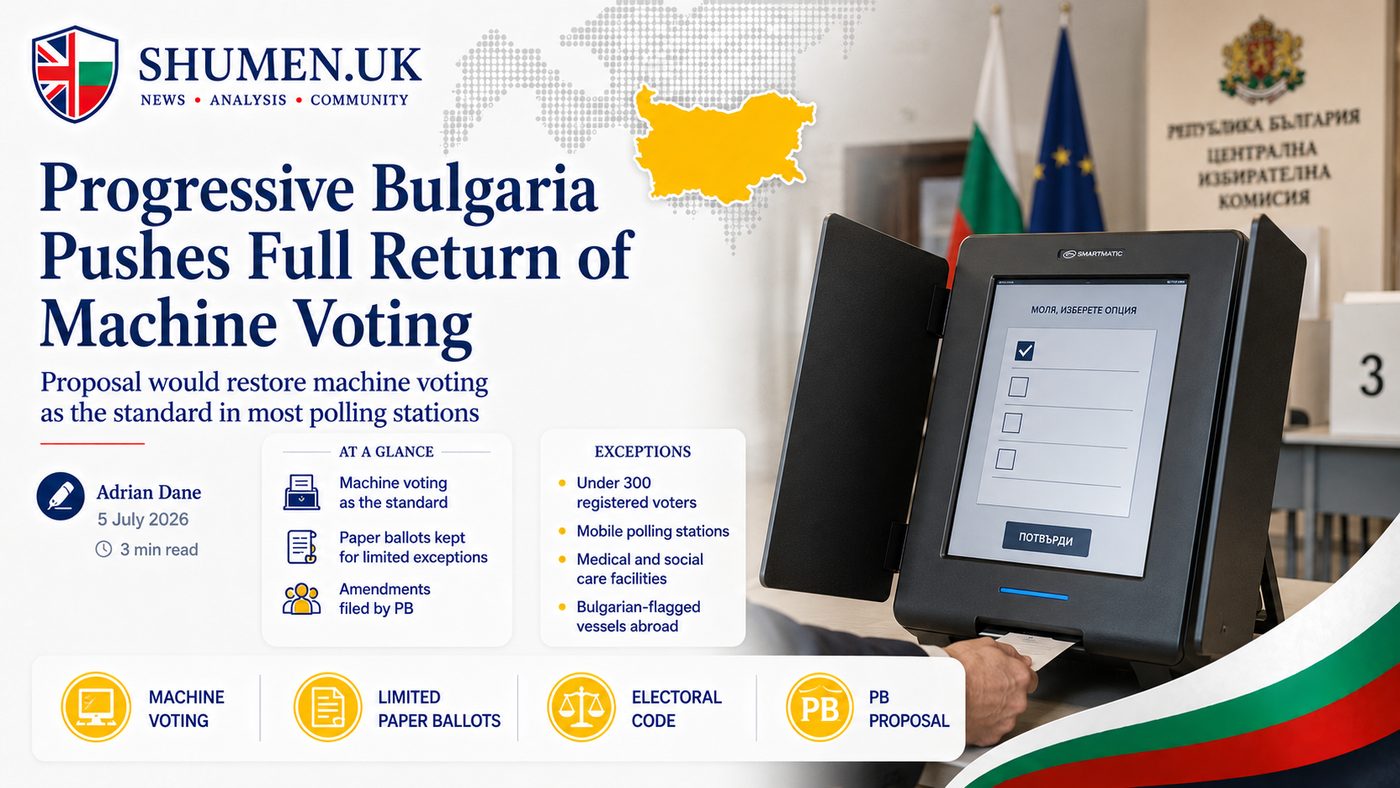
A group in Bulgaria's parliament wants to make machine voting the standard way of casting a ballot again, in time for the presidential election expected this autumn. The Progressive Bulgaria (PB) group has tabled amendments to the Electoral Code that would put voting machines back in most polling stations, leaving paper ballots only for the smallest and most specialised places.
If you have been in Bulgaria for more than an election cycle or two, and lately that has not taken long, you will have watched this particular argument go round before. The country has swung between paper and machine voting more than once in recent years, and this is the newest attempt to swing it back.
One thing to clear up first. As a British expat, you do not have a vote in any of this: since Brexit, UK nationals are not EU citizens (our Brexit guide covers what that changed), and cannot vote in Bulgarian national or even local elections unless they have also taken Bulgarian citizenship. But how the country around you votes is worth understanding, and this bill has a British thread we will come to.
What the bill actually changes
Under PB's proposal, machine voting would again be the default. Paper ballots would survive only in a defined set of places: polling stations with fewer than 300 registered voters, mobile stations, hospitals and medical facilities, nursing homes, social-care institutions, and stations on Bulgarian-flagged ships abroad. Everywhere else, you would vote on a machine.
The party's case, as put by its parliamentary leader Petar Vitanov, is one of efficiency: machine voting, PB argues, speeds up the process, does away with invalid ballots, simplifies the counting protocols and cuts the errors that come from mixing paper and machine results in the same station. As a safeguard, election commissions would still count the machines' printed control receipts once voting closes. Vitanov said the party wants the new rules in place ahead of the autumn presidential vote.
Can the machines be trusted?
That is the question that has dogged machine voting in Bulgaria from the start, and the bill tries to answer it with paperwork. It proposes what Vitanov called "double control" over the devices: both the Ministry of Interior and the Ministry of Innovation and Digital Transformation would sign off on the software and certify the machines. The Interior Ministry would additionally check the software modules that actually count the votes, while the Bulgarian Institute for Standardization and the Bulgarian Institute of Metrology would help verify the equipment.
Whether that reassures the machines' critics is another matter, and not one this proposal can settle on its own. But the layered checks, plus the receipt count, are PB's answer to the trust problem.
The British thread: voting from the UK
Here is where it touches Britain. The current rules cap the number of polling stations outside diplomatic and consular missions in non-EU countries at 20. Post-Brexit, the UK is a non-EU country, so Bulgarians living in Britain, one of the larger Bulgarian communities abroad, are squeezed into a handful of voting sites. PB wants that cap scrapped, arguing it unfairly restricts the constitutional voting rights of Bulgarians in the UK, Turkey and Canada.
If you have ever wrestled with voting in a UK election from Bulgaria, by post or by proxy, this is the same friction running the other way. The bill would also do away with the separate electoral district that currently exists for voters abroad and restore the previous system of 31 districts, which PB says would make administering the vote simpler.
The smaller print
A few other changes ride along with the headline one. The bill would spell out the powers of the chair of the Central Election Commission, strengthen its training arm, and bring in certification for commission members, with those who pass an exam listed on a public register. And in a nod to the internet age, it would widen the definition of "media services" to cover Facebook, X and personal blogs, so that the existing ban on publishing exit-poll results before polls close at 8 p.m. would apply to them too. Penalties would rise.
None of this is law yet. Vitanov said PB has common ground with We Continue the Change and the DPS, and that the electoral-code changes would be examined jointly, but the bill still has to get through a parliament that agrees on very little.
What it means for British expats here
Practically, for a non-voting Brit, very little changes on the day itself. When the presidential election comes this autumn, your local school or chitalishte will most likely turn into a polling station for a Sunday, there will be a bit more coming and going than usual, and by Monday morning someone will be peeling the posters off the noticeboard. You are a spectator, not a participant.
The value in following it is understanding, not action. The long back-and-forth over how Bulgaria votes is not a technical footnote; it is one of the clearer symptoms of how unsettled the country's politics has been these past few years. Knowing that the machines are back on the table, and why, is a small piece of reading the place you have chosen to live in.