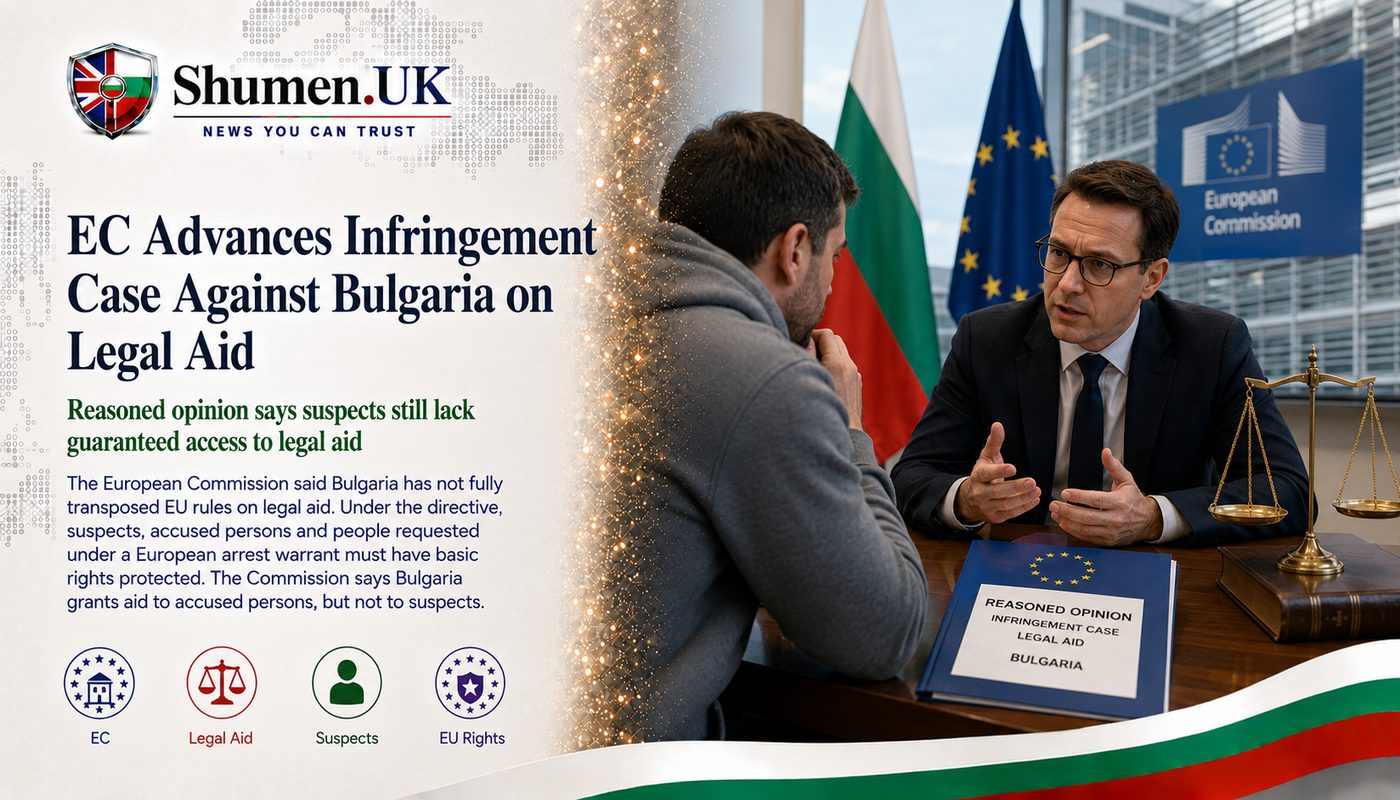
The European Commission advanced infringement proceedings against Bulgaria on 4 June 2026 for failing to implement EU legal aid rules into national law. The Commission sent Bulgaria a reasoned opinion (the second formal stage of the infringement process) regarding Directive (EU) 2016/1919 on legal aid for suspects and accused persons.
Bulgaria's legal aid framework currently grants assistance only to accused persons (those formally charged with an offence), not to suspects (individuals under investigation but not yet charged). This contradicts the directive's requirements.
Anyone who has sat through questioning at a Sofia police station will recognise the gap this oversight exposes.
Suspects vs Accused: What the Difference Means
The distinction is procedural but significant. A suspect may be questioned, detained, or have their movements restricted before formal charges are filed. Under EU law, legal aid must be available at this earlier stage.
Under Bulgarian law as it stands, if police question you as a suspect, you have no automatic right to state-funded legal representation. That right only kicks in once you are formally charged. For someone who does not speak Bulgarian fluently, that creates a practical problem: you may be questioned without understanding your rights or the questions being put to you.
What the Directive Requires
Directive (EU) 2016/1919 mandates that EU member states protect the basic rights of both suspects and accused persons during criminal proceedings. The protection extends to individuals requested under a European arrest warrant, the EU's cross-border extradition mechanism.
The directive is part of the EU's broader effort to harmonise procedural rights across member states. It complements earlier directives on the right to information, the right to interpretation, and the presumption of innocence. The goal is to ensure that criminal proceedings meet minimum fairness standards regardless of which member state is conducting them.
The Infringement Process
A reasoned opinion is the second of three stages in EU infringement proceedings. The Commission first sends a formal letter requesting an explanation, which Bulgaria received previously. The reasoned opinion sets out the legal grounds for the Commission's position and gives the member state two months to comply.
If Bulgaria does not address the shortcomings within that timeframe, the Commission may refer the case to the European Court of Justice. A court ruling against Bulgaria could result in fines or other enforcement measures, though the exact amounts have not been disclosed. Court proceedings typically take 18 to 24 months from referral to judgment.
The Sofia Globe reported the Commission's announcement on 4 June 2026 as part of the EU's latest infringements package. Bulgaria is not the only member state facing infringement action over criminal justice standards.
What This Means for British Expats
British nationals involved in Bulgarian criminal proceedings, whether as suspects or under a European arrest warrant, are directly affected by the legal aid gap.
If a British national is detained or questioned as a suspect, Bulgarian law currently provides no automatic right to state-funded legal representation at that stage. Once formally charged, legal aid becomes available subject to eligibility criteria, though the quality of provision varies.
The practical advice for British expats is to have contact details for an English-speaking advokat before any interaction with police, not after. The legal services page lists English-speaking advokatsi who can assist with criminal defence.
The British Embassy in Sofia does not provide legal representation but can provide a list of English-speaking lawyers and notify family members if a British national is detained. Consular staff can visit you if you are detained, explain the local legal process, and contact family or friends, but they cannot get you out of custody or give legal advice. The Brexit guide covers consular assistance rights post-withdrawal, which remain unchanged.
Timeline and Next Steps
Bulgaria has two months from 4 June 2026 to respond to the Commission's reasoned opinion. That puts the deadline in early August 2026.
If Bulgaria does not amend its legal aid legislation or provide satisfactory explanation by that date, the Commission will decide whether to refer the case to the European Court of Justice.
Bulgaria's response will determine whether the legal aid gap is closed quickly or becomes a protracted court case. Until then, the queue outside the Shumen judicial services office tells its own story about access to legal help once you actually need it.