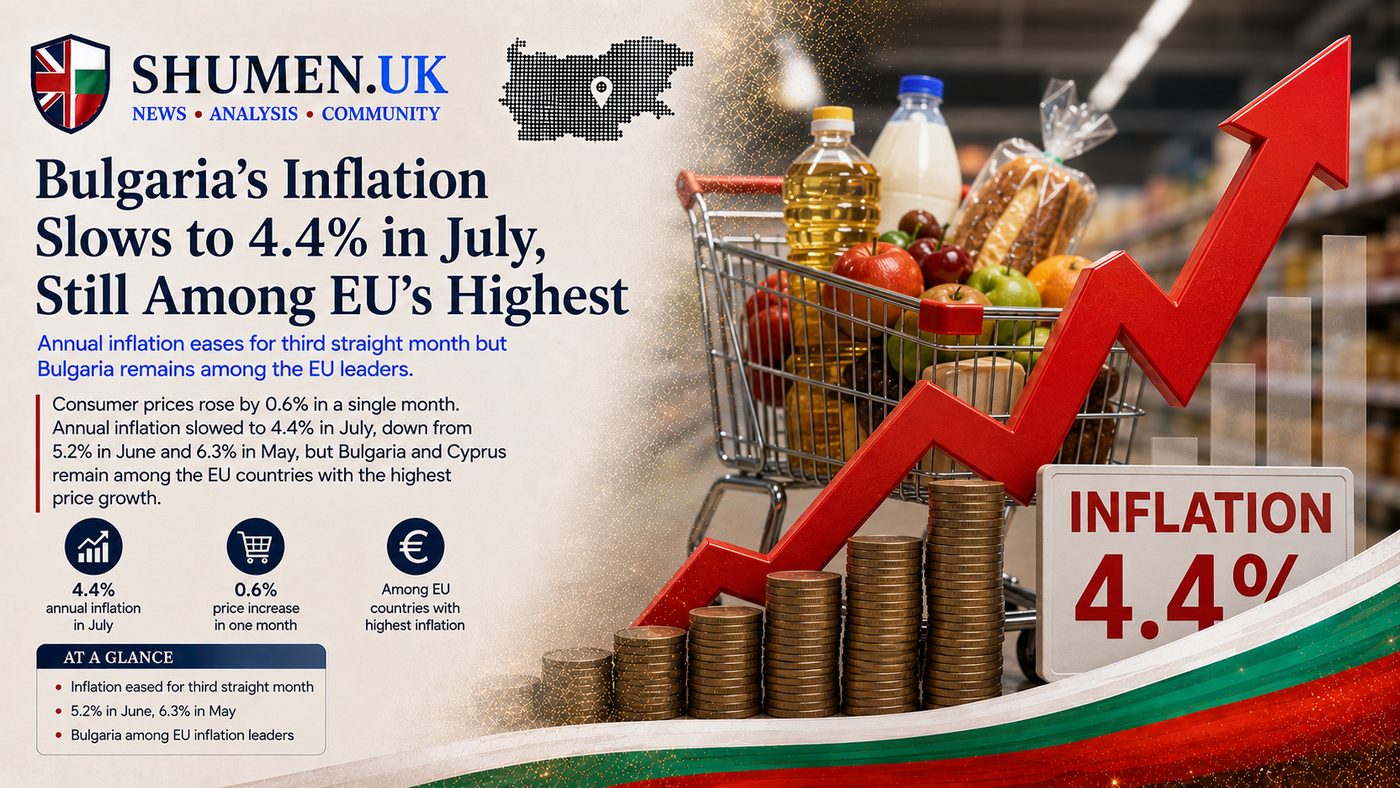
Bulgaria's annual inflation rate slowed to 4.4% in July 2026, according to Eurostat's final harmonised figures, after readings of 6.3% in May and 5.2% in June. That is the right direction, but it still left Bulgaria and Cyprus with the EU's joint third-highest rate, behind Romania at 8.2% and Lithuania at 5.4%.
Prices also rose 0.6% between June and July. The supermarket receipt may be climbing more slowly, but it has not developed a sudden fear of heights.
What 4.4% Means for Your Bulgarian Budget
For a British expat trying to work out whether the monthly budget is genuinely improving, the first distinction matters: 4.4% is the change from July 2025 to July 2026, while 0.6% is the change from June to July 2026. Slower annual inflation does not mean prices returned to last year's level. It means the measured rate of increase eased.
Put plainly, if Eurostat's representative basket had cost €100 in July 2025, the same basket would cost €104.40 in July 2026. That calculation explains the index, but it is not a promise that every household, every supermarket aisle or every electricity bill moved by precisely 4.4%.
Eurostat builds its comparable consumer-price gauge, better known as HICP, from weighted household spending on goods and services. The measure covers purchases made within Bulgaria by households regardless of nationality or legal status, and the product weights are updated to reflect spending patterns. It is designed for comparison across countries. Your own bank statement is designed for you, and is usually rather less diplomatic.
Why the Earlier Figure Said 4.1%
The final 4.4% annual HICP was higher than the 4.1% flash estimate published at the end of July. The monthly figure also moved from an estimated 0.4% to a final 0.6%.
That revision is worth noticing rather than treating the first number as carved into stone. Bulgaria's National Statistical Institute said its flash calculation used about 90% of the planned price registrations, with the remaining observations added for the complete data. Flash estimates are early readings. Final figures have a fuller set of prices behind them.
There was another potential source of confusion in the preliminary Bulgarian release. It put the national Consumer Price Index at 4.4% annually and 0.7% monthly, while the internationally comparable HICP estimate was 4.1% annually and 0.4% monthly. Two inflation headlines can therefore carry different numbers without either necessarily being a typo: check whether the label says CPI or HICP, and whether the figure is preliminary or final.
Your Shopping Basket Can Tell a Different Story
The NSI's preliminary HICP breakdown suggested a very uneven July. Compared with June, restaurants and accommodation were estimated to be up 4.6%, recreation, sport and culture up 3.3%, and housing, water, electricity, gas and other fuels up 1.6%. Clothing and footwear were estimated down 2.9%, transport down 1.1%, and food and non-alcoholic drinks down 0.7%.
Those were flash category estimates, not the final Eurostat contribution table, but they show why one household can feel considerably more squeezed than another. A family paying for summer accommodation and high utility use has a different July from someone buying discounted clothing and driving less. National inflation averages those lives together and produces one neat decimal. Life declines to be quite so tidy.
For practical budgeting, compare your own spending in broad categories over several months rather than adding 4.4% to every line. Separate recurring commitments such as rent, utilities and insurance from variable spending such as food, transport and eating out. Our cost of living guide gives that exercise a Bulgaria-specific starting point and can be used alongside the new official releases.
The Euro-Area Breakdown Is Not Bulgaria's Breakdown
Eurostat reported that services contributed 1.55 percentage points to euro-area inflation in July, followed by energy at 0.94 points. Industrial goods and the combined food, alcohol and tobacco category each added 0.23 points.
Those contributions describe the euro area as a whole. They should not be quietly relabelled as an explanation of Bulgaria's 4.4% rate, and neither Eurostat's figures nor the Novinite report supplied a Bulgaria-specific account of the causes. The honest reading is narrower: Bulgaria's inflation slowed, remained high relative to most EU countries, and was revised upwards from the flash estimate.
What to Watch Next
The useful household response is not to panic over one decimal or celebrate a single fall. Keep the July total as a baseline, compare the same categories when August's figures arrive, and pay attention to whether the expenses carrying most weight in your own budget are moving with or against the headline rate.
The NSI release calendar lists Bulgaria's August flash estimate for 31 August 2026 and the fuller August release for 15 September 2026. Until then, 4.4% is best treated as a national warning light rather than a personal invoice. It tells you the pressure eased. Your receipts tell you where it stayed.