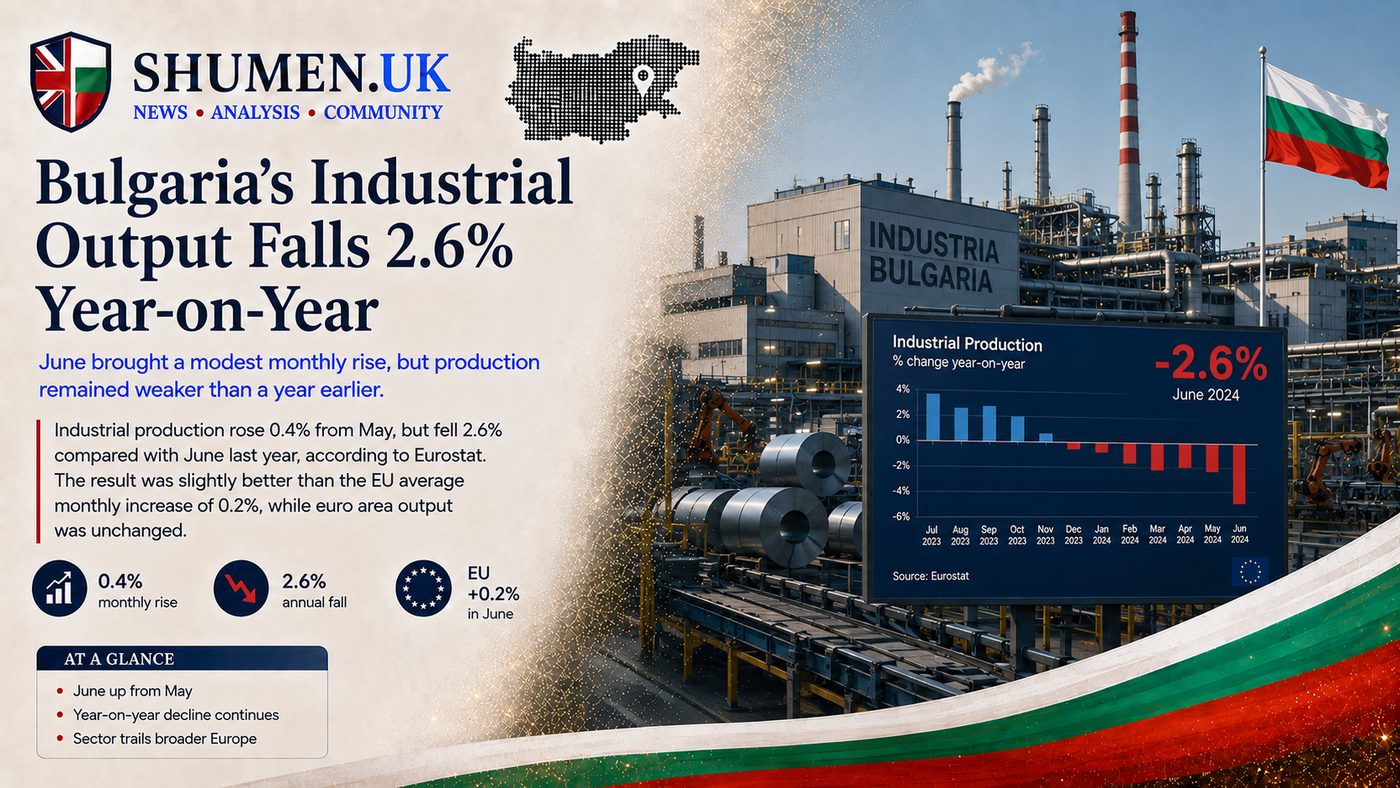
Bulgaria's industrial production increased by 0.4% in June compared with May, but remained 2.6% below June 2025, according to Novinite's account of the latest Eurostat figures. It is a small monthly improvement. It is not yet a recovery.
Bulgaria's National Statistical Institute, or NSI, independently records the same 0.4% monthly rise, while putting the annual decline at 2.5% rather than 2.6%. That tenth of a percentage point is not something to tidy away: the two published figures differ, and neither page explains the gap. Both are preliminary statistical readings, so this article shows both.
June's Rise Does Not Yet Make a Recovery
Is Bulgarian industry recovering? Not on one month's evidence. June ended a weak spring run and was better than May, but output was still lower than it had been a year earlier.
The distinction between the two comparisons matters. The monthly figure is seasonally adjusted, which is intended to remove recurring patterns within the year. The annual figure is calendar adjusted, accounting for differences such as working days and holidays. A positive monthly movement can therefore sit beside a negative annual result without either number being wrong.
NSI's series also shows how uneven 2026 has been. Total production fell 3.6% in January, rose in February and March, then dropped 4.6% in April and 0.5% in May before June's 0.4% increase. Against the same months of 2025, March was the only positive reading in the first half of the year. One better month has stopped the slide. It has not established a trend.
Manufacturing Rose While Mining Slumped
The national total hides a much less gloomy manufacturing result. NSI says manufacturing production increased 1.6% from May and 1.3% from June 2025. Mining and quarrying moved the other way, down 10.8% on the month and 49.1% over the year. Electricity, gas, steam and air-conditioning supply fell 2.7% from May but was 10.0% higher than a year earlier.
There were large differences inside manufacturing too. Computer, electronic and optical products rose 40.3% on the month and 39.3% on the year. Fabricated metal products increased 15.7% from May, while machinery and equipment rose 10.4%. Wearing apparel fell 6.5% on the month and 18.7% over the year.
Anyone passing a Bulgarian factory gate and counting the lorries outside should resist promoting themselves to national statistician. The aggregate is doing a great deal of averaging.
That sector split is the part British expats working in Bulgaria, applying for jobs or supplying local firms should keep. A national fall of about 2.5% does not mean every industrial employer contracted, just as June's monthly rise does not show that every factory expanded. The working in Bulgaria guide covers the employment rules and practicalities; this index is better used as background to a sector than as a verdict on a particular job.
What the Index Cannot Tell You
Industrial production measures changes in output, not the amount produced in cash terms. NSI says its index is built from a representative survey covering enterprises responsible for more than 97% of industrial turnover, using a constant base-year structure.
It does not publish the pay offer at a plant, the number of vacancies, an employer's order book, planned redundancies or the price a household will pay at the till. No filing deadline, employment right or household tariff changes because this index moved 0.4%. For a Brit weighing up an industrial job or contract, the sensible questions remain specific: which branch is the firm in, how has that branch moved, and what is the employer actually offering? The national headline is context, not due diligence.
The data are preliminary as well. Eurostat routinely revises earlier estimates when more information arrives, and Novinite notes that previous monthly readings changed after their first publication. That makes a run of several months more informative than treating June as a clean turning point.
Bulgaria Improved Monthly but Trailed Europe Annually
Novinite reports that EU industrial production rose 0.2% from May, while the euro area was unchanged. Bulgaria's 0.4% increase was therefore slightly stronger over the month.
The annual comparison was less cheerful. EU output increased 0.6% and euro-area output 0.1%, while Bulgaria contracted. Luxembourg, Romania and Estonia recorded steeper annual falls, at 7.9%, 5.6% and 4.6% respectively. Lithuania led at 7.7%. Next came Denmark on 6.1% and Poland on 4.9%.
Europe's own total was mixed by product group. Intermediate goods, capital goods and energy increased over the year, while durable and non-durable consumer goods declined. Bulgaria was not missing a continent-wide industrial boom because there was no broad boom to miss. It was, however, on the weaker side of a modestly positive EU result.
The Next Reading Needs to Confirm the Pulse
The next useful test is not whether one headline number stays above zero. It is whether monthly growth lasts, whether the annual comparison returns to positive territory, and whether manufacturing can remain stronger while the mining decline stabilises. Those are observations to make from later releases, not forecasts to smuggle into this one.
Neither Novinite nor NSI attributes a cause for June's pattern, so there is no honest basis here for a neat explanation involving exports, energy, politics or anything else that happens to fit. For now, 0.4% is the pulse, while the annual fall of 2.5% or 2.6% is the weight still sitting on the chart. Better than May. Not recovered.