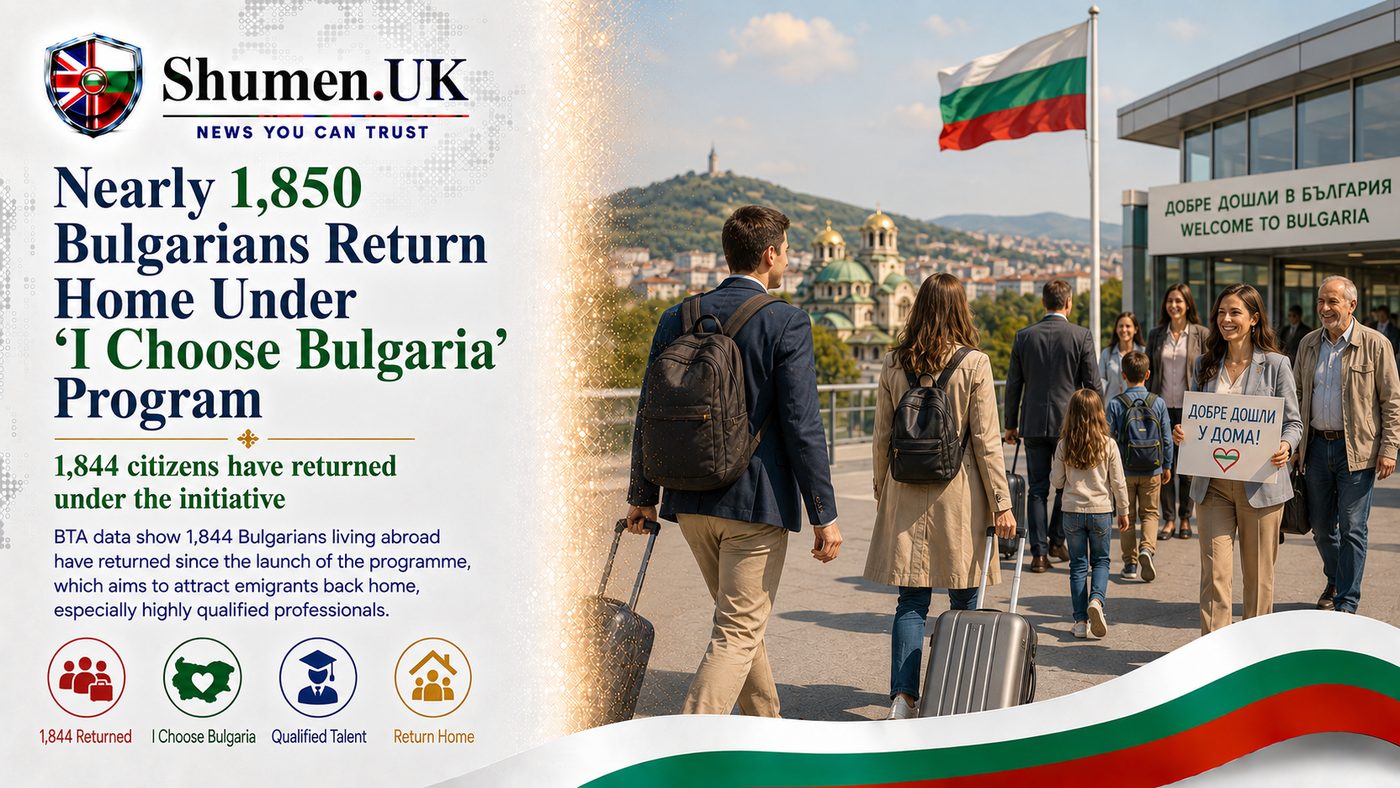
Bulgaria has persuaded 1,844 of its citizens to move back home under a state scheme called "I Choose Bulgaria", and the single biggest group of them came from the United Kingdom. The figures, reported by the state news agency BTA, cover the whole life of the programme so far.
The initiative is aimed squarely at skilled emigrants: teachers, doctors, IT specialists and the other professionals the country is short of. On the headline numbers, 4,142 people applied, 1,884 were approved for support (more than the government had expected), and 1,844 have actually made the move back. Anyone who spent the past decade being served coffee in London by an over-qualified Bulgarian graduate will recognise the reverse gear in those numbers.
Who is coming back
The returnees are overwhelmingly mid-career rather than retirees or fresh graduates. More than 1,500 of those approved are aged between 30 and 40, the stage where people have built a skill set abroad but still have a full working lifetime ahead of them in Bulgaria.
The professions named by the ministry track the country's labour gaps closely:
- teachers
- medical specialists
- information technology experts
- engineers
- staff in banking, accounting, construction and industrial production
That list is essentially a description of the same shortages British expats bump into themselves, whether it is the wait for a tradesman or the hunt for an English-speaking GP. Bulgaria's plan is to plug those gaps with its own people, many of them returning from English-speaking countries. If you want the wider picture of the jobs market they are coming back to, our guide to working in Bulgaria sets out the landscape.
Britain is the biggest source
The largest numbers are returning from the United Kingdom and Germany. After those two, significant groups are coming back from the Netherlands, France, Spain, Italy, Belgium, Austria and Ireland.
A smaller number are travelling a good deal further to get home, returning from the United States, Canada, Australia, Japan, China, the United Arab Emirates and South Africa.
What it means for British expats
For Brits who have settled in Bulgaria, this is the mirror image of their own move. The Bulgarian neighbour who spent ten years in Birmingham or Manchester may now be a colleague, a landlord, or the engineer who finally turns up to look at the boiler.
There is a quieter practical upside too. A steady trickle of returning doctors, teachers and IT staff, most of them used to operating day to day in English, is no bad thing for an expat who has struggled to find professionals able to work in their language.
The figures say nothing about the other side of that ledger, though. What 1,844 departures mean for the Bulgarian communities in cities like London and Manchester is not something this data can answer, so for now that half of the story stays untold.
The cost, and how long it runs
The Ministry of Labour and Social Policy says the scheme will keep running until 2028. The total public cost so far is put at below half a million euros, which by the standards of state labour programmes is modest, and the ministry is presenting it as one of its more cost-efficient efforts. That last point is the ministry's own assessment, mind, and there is no independent comparison in the figures to test it against.
There is one more thing the numbers cannot tell us. These are headline totals, not case studies, so they reveal nothing about how the returnees are actually settling back in, or how many find the reintegration harder than the move itself. Whether 1,844 people shifts the dial on a national labour shortage is another question again, and one these figures do not answer. What they do show is the direction of travel: for the first time in a long while, the arrows on Bulgaria's migration map are pointing inward.