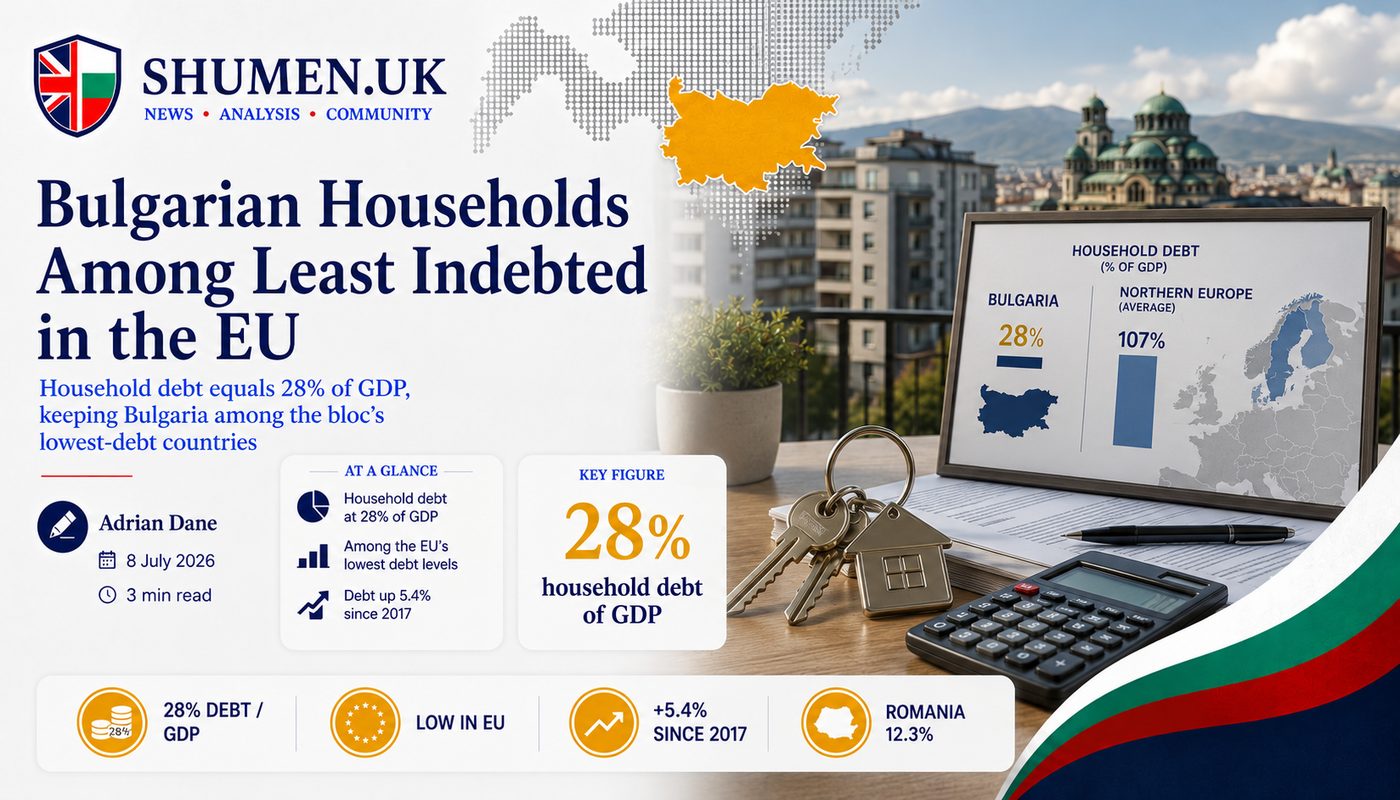
Bulgarian households owe the equivalent of just 28% of the country's annual economic output in mortgages, consumer credit and other household loans, according to the latest Eurostat data, placing Bulgaria among the least indebted populations in the European Union. Only seven of the bloc's member states report a lower household debt-to-GDP ratio, with Romania the lowest of all at 12.3%.
The ratio has moved only modestly over time: Bulgarian household debt rose by 5.4 percentage points between 2017 and 2025, a slow climb by EU standards. The figures also complicate a stereotype that dies hard: that southern and eastern Europe borrow freely while northern Europe stays cautious. Eurostat's own numbers say the opposite. The heaviest household debt in the bloc sits almost entirely in wealthy northern and western economies, not the south.
Where the Rest of the EU Sits
At the top of the table, the Netherlands has the EU's highest household debt-to-GDP ratio, at 93.5%, a level Eurostat links directly to Dutch housing policy: tax incentives that have historically let buyers borrow up to the full value of a property. Denmark follows at 84.1%, a figure Eurostat notes is partly offset by large Danish pension savings and valuable real estate assets, even as 2024 household debt reached around 177% of disposable income there. Sweden sits at 82.3%, where variable-rate mortgages are the norm and households are correspondingly exposed to interest-rate swings.
Finland (62.9%), Luxembourg (60.5%), France (59.5%), Belgium (56.4%), Cyprus (54.2%), Portugal (53.9%) and Germany (49%) round out the countries with the heaviest household borrowing, in that order. At the other end, Italy sits at 35.9% of GDP, Greece at 38% and Spain at 42.9%, all comfortably below the EU average of 49.4% and the euro area average of 50.7%. Both EU-wide averages have fallen every year since 2020, when household debt across the bloc topped 60% of GDP.
The scale behind some of the higher figures gives useful texture. Portugal's household debt, worth €171 billion at the end of 2025 and up 8.6% on the year, is driven mainly by mortgage lending against rising house prices, with more than 90% of Portuguese mortgages carrying floating or mixed interest rates linked to Euribor. Belgium's new mortgage lending rose to €40.7 billion in 2025 from €31.7 billion the year before, with 43.1% of Belgian households financing a property purchase through a loan, against an EU average of 24.3%. Luxembourg sits at the other extreme: around 90% of its household debt is mortgage-related, yet nearly half of Luxembourg households carry no debt at all, and median net household wealth there reached €676,000 in 2023. Cyprus, meanwhile, has cut its ratio sharply since the end of 2016, when it stood at around 62%, though roughly a third of Cypriot household liabilities are still tied to older non-performing loans still being worked through.
The European Commission treats household debt above 55% of GDP as a potential source of economic risk, a threshold rooted in the lesson of 2008: heavy private-sector borrowing, not government debt alone, was a central driver of the financial crisis that followed. Seven EU countries, Belgium, France, Luxembourg, Finland, Sweden, Denmark and the Netherlands, currently sit above that line. Bulgaria, at 28%, is nowhere near it.
A Pattern That Extends Beyond Households
This is not an isolated, household-only finding. Novinite reported on 16 July that Bulgarian companies also rank among the EU's least indebted, and Azərtac reported on 21 July that Bulgaria has returned to the EU's top three for the lowest government debt-to-GDP ratio. Put the three together and Bulgaria's public finances, corporate balance sheets and household budgets are all, independently, sitting near the bottom of the EU's debt tables this month. It is not a boast Sofia makes loudly, but the numbers are making the case three times over.
What the Numbers Mean for Brits Banking and Saving Here
None of this tells a British reader whether Bulgaria's low borrowing reflects a genuinely resilient system or simply an underdeveloped one; Eurostat's dataset measures the scale of debt, not the reasons behind it, and the source data does not break that down. But the practical read for anyone banking, saving or holding property here is a real one. The Commission's own 55% warning line exists for a reason the source itself gives: heavy private-sector borrowing, rather than government debt alone, has repeatedly played a role in major financial crises, including the one that began in 2008. Bulgaria completed its move into the eurozone on 1 January 2026 carrying a household-debt profile nowhere near that danger zone, one less systemic risk sitting under the currency Brits here now use for everything from a supermarket shop to a pension transfer.
Walk into a Bulgarian bank branch on any given morning and you are still more likely to queue behind someone opening a savings account than someone signing a mortgage; the Eurostat figures above are simply the country-level version of that queue. Anyone with a mortgage or loan through a Bulgarian bank is borrowing inside a system that currently carries less private-sector debt risk, by this measure, than most of its northern EU peers. Our banking guide covers how mortgage and loan products actually work for foreign residents here, and the cost-of-living tracker follows the day-to-day price side of the picture Eurostat's debt ratio doesn't capture.