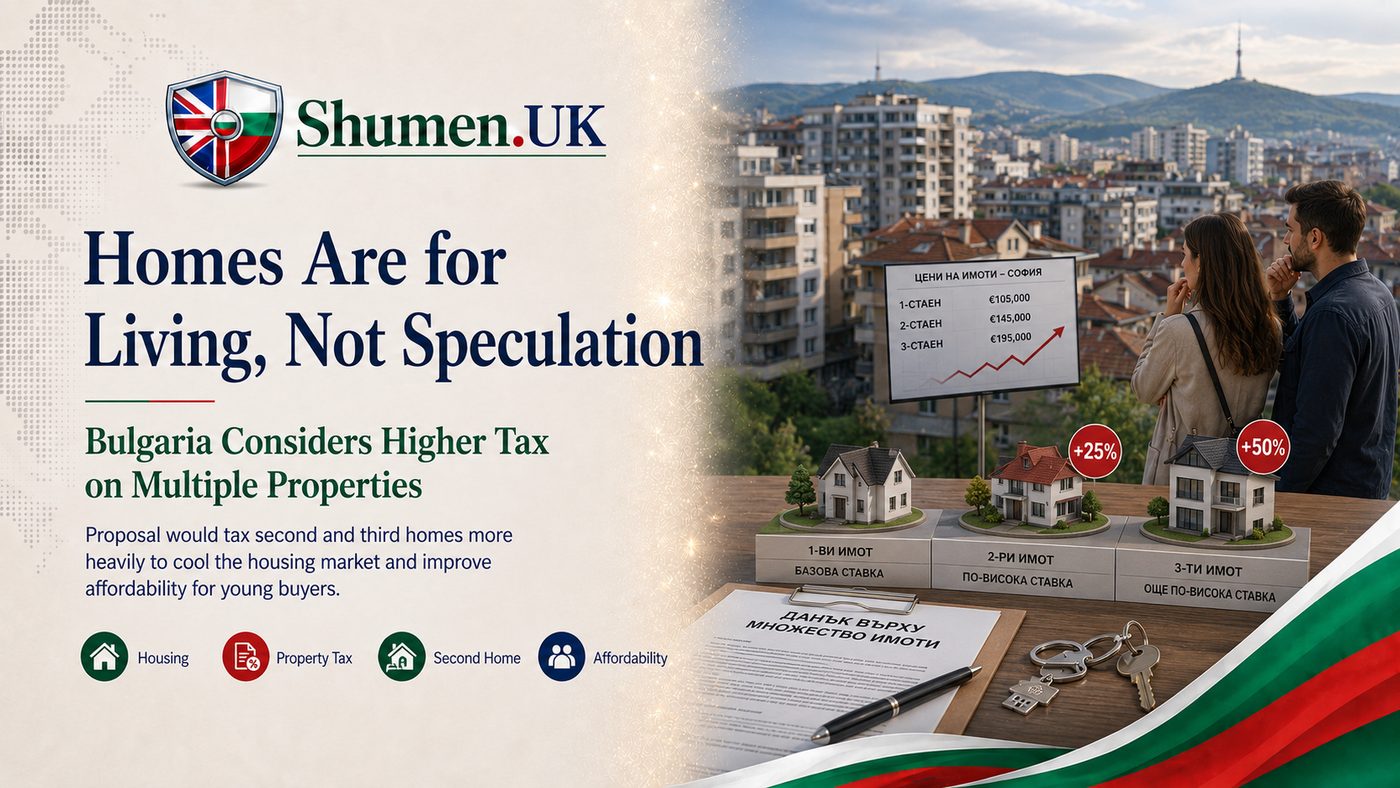
Bulgaria is debating whether people who own more than one home should pay progressively higher property tax, with each additional property charged at a steeper rate than the one before. The governing Progressive Bulgaria coalition frames the principle simply: a house should be somewhere to live, not somewhere to park money. For the British expat who keeps a flat in town and a village house up the road, that is not just a fiscal talking point. It is a question worth watching, even if nothing reaches the doormat before 2027.
A caveat up front, because it matters. None of this is law. It is a proposal being argued on national television and in parliamentary committee, and significant change is not expected before 2027.
What Is Actually Being Proposed
Konstantin Prodanov, who chairs Parliament's Budget and Finance Committee for Progressive Bulgaria, set out the idea on national television. A primary residence would stay under the current approach, he said, while additional homes would face rising rates. "If someone owns three or four homes not for living but as investments, the second property should be taxed more than the first, and the third more than the second," he argued.
His case is that a steeper tax on investment properties could cool a housing market that has run hot enough to price many young Bulgarians out of ownership. That is Prodanov's rationale as reported, not an independent finding, and no rates, thresholds or definition of a "second home" have been set.
Prodanov was also keen to head off a different worry. There would be no income freeze, he insisted, and no pensioner or worker would lose income, a line he repeated across the same interview and one a second Bulgarian outlet, fakti.bg, reported in the same terms. He stressed that Progressive Bulgaria intends to keep the current flat income tax system, citing an election promise, and that the property debate is separate from any move toward progressive income tax.
The Prime Minister Wants the Valuations Looked At Too
Running alongside the tax-rate question is an older one: how Bulgarian property is valued in the first place. Prime Minister Rumen Radev has signalled support for updating property tax assessments, which are, by Novinite's account, outdated after nearly two decades without a substantial revision. That "nearly two decades" figure comes from Novinite alone, so treat it as that outlet's characterisation rather than a settled fact.
Radev's own framing echoes Prodanov's. "The first home where a person lives should remain at the same value. The following ones can be taxed on an increasing scale," he said, while warning that policymakers must tread carefully because higher property taxes can eventually feed into rents.
It is worth knowing who is doing the proposing. Progressive Bulgaria is the coalition that won a majority in the 2026 election, and Radev moved from the presidency to become prime minister in May 2026. When both the committee chairman and the prime minister back an idea, it carries a governing majority behind it, which is reason enough to watch even at the proposal stage.
Where the Money Would Go, and the Catch
The tax debate sits inside a wider push to hand municipalities more cash. Local governments are lobbying for a larger slice of revenue, including a proposal to redirect one-fifth of income tax receipts to town halls, part of what the government calls fiscal decentralisation. The National Association of Municipalities says it has been assured the valuation work will move forward this year.
The catch is who absorbs the cost. Property assessments underpin not just local taxes but waste collection fees, so a clumsy overhaul reaches further than the second-home investor it is aimed at. Analysts quoted by Novinite warn that a poorly designed reform could land hardest on low-income households, people who inherited a property, and tenants. Renters and estate agents interviewed by Bulgarian media voiced the obvious fear: that landlords would simply pass part of any higher tax on as higher rent. It is the kind of arithmetic already being done over coffee by anyone here who lets out a flat. That worry is real, but it is a worry, not a confirmed outcome.
What British Expats Should Watch
Plenty of Brits in Bulgaria fit the profile this proposal is aimed at, perhaps without ever thinking of themselves as property investors: a primary home plus a village house, a holiday flat, or somewhere let out for a bit of income. If additional homes are taxed on a rising scale, that is the wallet it touches.
Two things temper the urgency. First, the market is already cooling, on Novinite's own account, with economists noting that demand has begun to slow, so any tax would arrive into a softening market rather than a boom. Anyone who watched village-house asking prices climb through 2025 will recognise the turn. Second, and more simply, this is not happening yet.
For now the practical advice is dull but honest: nothing to do, plenty to watch. If you are weighing a purchase, our guide to buying a property in Bulgaria covers the ground rules, and our cost of living tracker carries the household numbers as official figures land. The thing to keep an eye on is the valuation reform the municipalities expect this year, because a change in how your home is assessed would feed every local bill that follows, primary residence included.