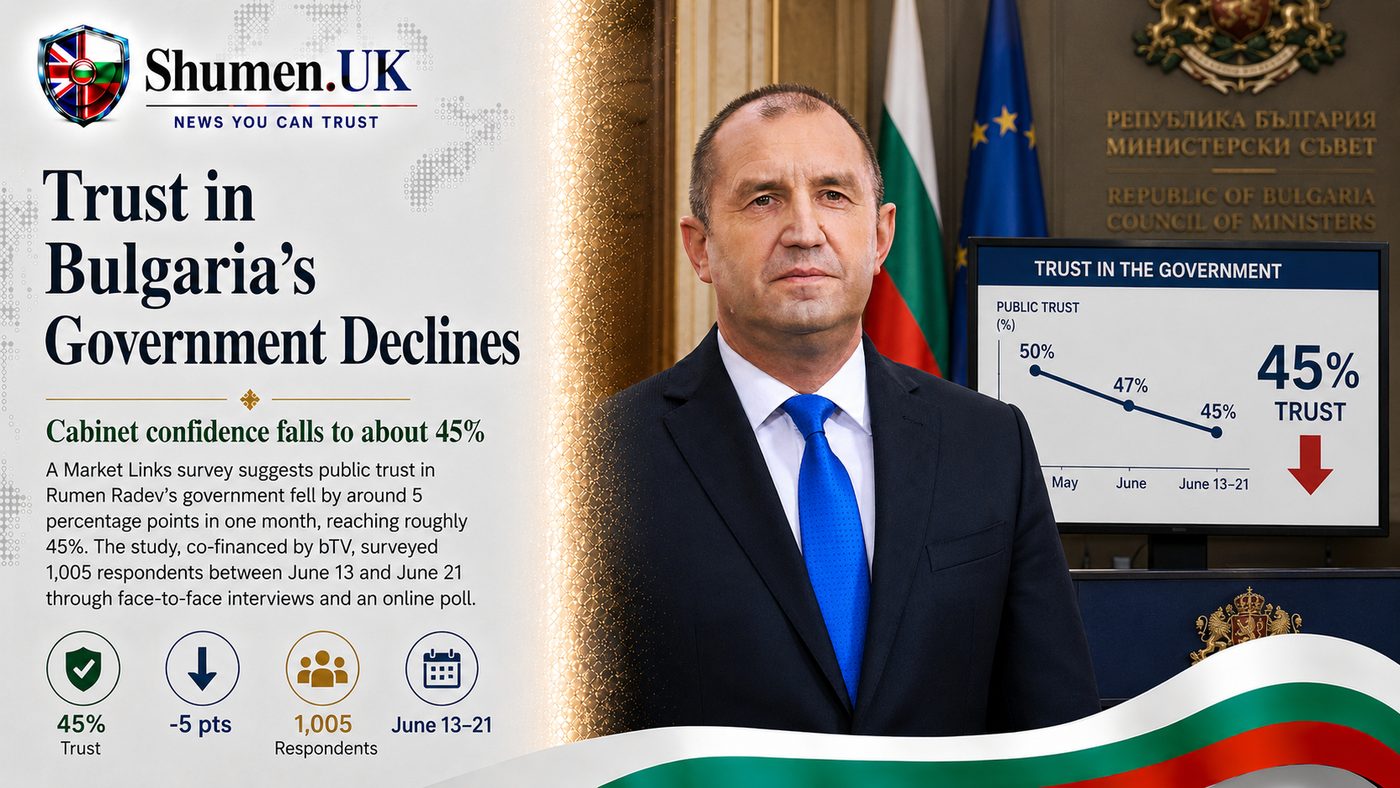
Confidence in Bulgaria's new government has slipped by around five percentage points in the space of a month, according to a nationally representative survey published on 27 June by the polling agency Market Links. Trust in the cabinet led by Rumen Radev now stands at roughly 45%, and the pollster's analyst was candid about the timing: the responses were gathered before the government had shown the country its draft budget for 2026.
Hold on to that last point, because it is the part the headline figure hides. A government that loses ground before its first budget lands has not yet faced the argument that usually does the real damage.
The poll was co-financed by bTV and ran from 13 to 21 June, combining face-to-face interviews and an online sample of 1,005 people. Sociologist Dobromir Zhivkov, presenting the results, put the shift plainly: distrust in the cabinet rose by six points while active confidence dropped by five. "There is a public reaction to what is visible in the first month and a half of this cabinet's work," he said. "The public reaction is not positive."
Down, but from a higher base than most
The striking thing, set against Bulgaria's recent run of short-lived governments, is how far the cabinet still has to fall. Around half of respondents either back the government or are willing to give it the benefit of the doubt. Some 41% think it is trying to restore order after a long stretch of political instability, and another 19% say it is making mistakes but that it is too early to judge.
The more sceptical half is not quiet, though. About 21% consider the government simply unprepared, and 11% say it has not changed the way the country is run in the manner it promised. Zhivkov read this as hesitation about the cabinet's potential rather than outright rejection, with support still the dominant mood.
Radev's own net confidence fell by about nine points, although he keeps stronger personal recognition than most other figures in Bulgarian politics. The one institution moving the other way is parliament: positive ratings of the National Assembly climbed to 22%, up from roughly 6% at the end of the previous legislature. After years in which the chamber was a byword for deadlock, Zhivkov called that a gradual normalisation.
The Care Basket is where this reaches your shopping
The policy the poll tested most directly is the one British expats will actually notice. The government's "Care Basket", a scheme meant to hold down the price of essential goods, splits opinion almost down the middle: 42% see it as proof the authorities are taking the cost of living seriously, while 38% dismiss it as a public relations exercise designed to draw attention away from the state's budget problems. That split, 42 against 38, is roughly the conversation you would overhear at any Kaufland checkout.
For a Brit doing the weekly shop, the question is not who gets the political credit but whether the prices on the shelf actually move. Bulgaria is no longer the bargain it was a decade ago, and grocery inflation has been one of the sharper squeezes on anyone living here on a fixed income or a Bulgarian salary. Whether the Care Basket changes the number at the till is the test that matters, and it is worth watching the receipts rather than the announcements. Our cost of living tracker follows the underlying prices as official figures land.
The budget nobody had seen yet
The timing is the real story. Zhivkov stressed that the figures were recorded before the cabinet presented its 2026 draft budget, and that the usual 100-day grace period may not survive contact with it. Voters, he suggested, want concrete results rather than symbolic gestures. Around 29% already believe the government is using "difficult inherited circumstances" as a catch-all justification for its decisions.
That budget will not be drafted in a vacuum. Novinite's own reporting notes that the EU has confirmed an excessive deficit procedure against Bulgaria, with multi-year limits on state spending, which leaves any government less room to be generous. For British expats, the place that surfaces is tax and public-service funding rather than the ballot box: our tax guide covers the flat-rate system and how the state's wider finances feed into it.
What it means for British expats
British nationals living in Bulgaria, unless they also hold Bulgarian citizenship, cannot vote in these elections, so the polling is not a call to do anything. It matters for a more practical reason. This is the government that sets the budget, runs the offices that process residency and health paperwork, and owns the Care Basket that is supposed to ease the cost of living. A cabinet losing public confidence before its first budget is one more reason to expect a noisy political autumn, and to keep an eye on prices and on any change to the services you rely on.
If an election were held tomorrow
The survey also asked the hypothetical. Among decided voters, "Progressive Bulgaria" led with about 39.1%, well ahead of GERB on 13% and PP-DB on 11.8%. DPS and "Revival" trailed on 4.9% and 4.2%. A large share of respondents stayed undecided or named smaller parties, so the figures describe a mood rather than a result. Taken together, the poll paints a mixed picture: an executive losing altitude, broadly stable support for the bigger parties, and a parliament slowly clawing back a little credibility.