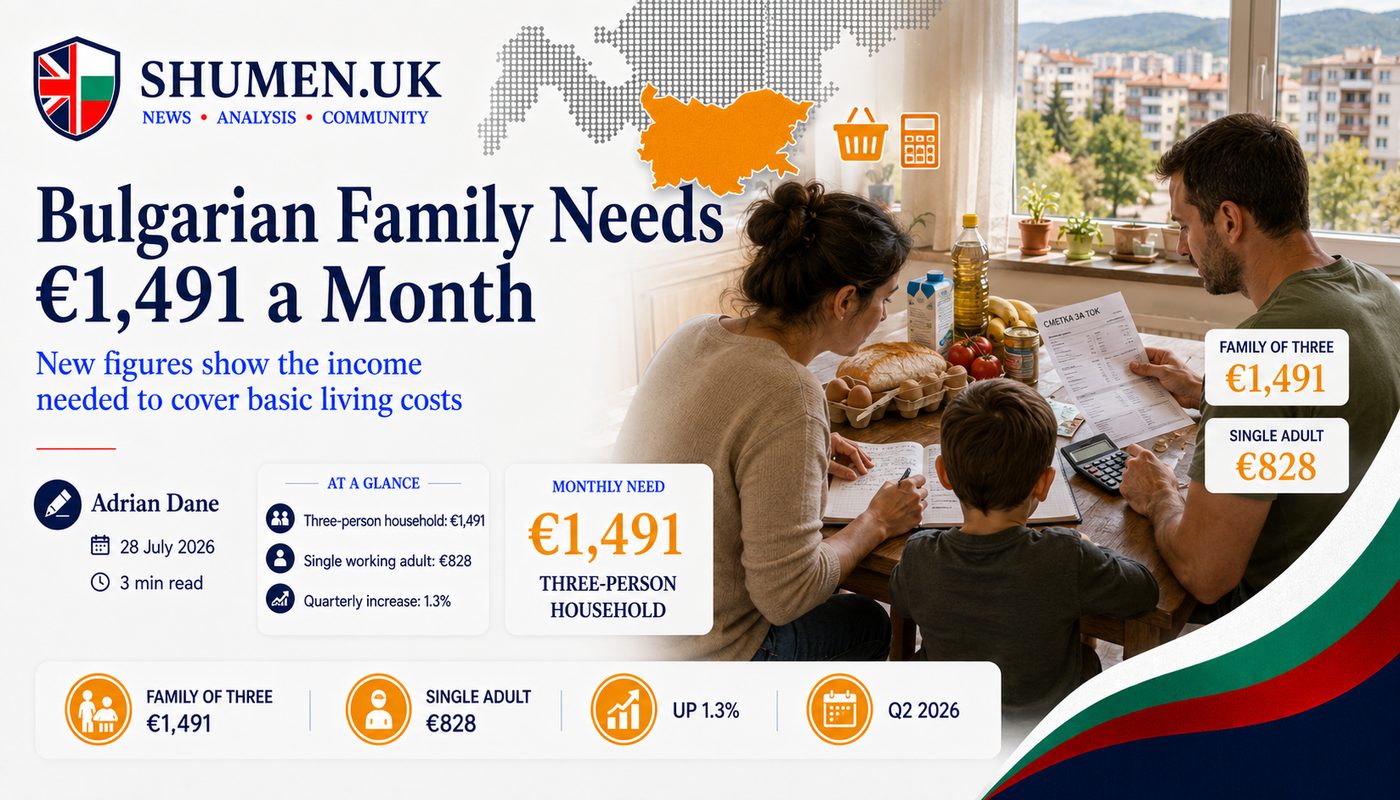
A family of three in Bulgaria needed a net monthly income of €1,491 to cover basic living costs in the second quarter of 2026, according to figures published this week by the Confederation of Independent Trade Unions in Bulgaria (CITUB), the country's largest trade union confederation. A single working adult needed €828 a month to meet the same basic standard.
The till receipts have been telling this story since the spring; the union has now put an official number on it. CITUB's second-quarter estimate, presented by its chief economist Lyuboslav Kostov, is 6.1% higher than a year ago. For the model family of three, that works out at an extra €84 a month; for a single worker, an extra €48. Quarter on quarter the rise was a more modest 1.3%, but the direction has not changed.
What CITUB's Numbers Actually Say
The union's model household is two adults and a child under 14. The €1,491 figure is the net income CITUB calculates that household needs each month to cover basic living expenses: a floor, not a comfort level.
Food remains one of the largest items in the basket. CITUB estimates a working adult now needs €332 a month for food and dining, after food prices rose 0.8% over the quarter, driven by increases in fruit, meat products, sugar, bread and bakery goods. On an annual basis food prices were up 5.6%, with increases recorded across nearly all major product categories. Anyone who has pushed a trolley round a Bulgarian supermarket this summer will recognise the pattern without needing the spreadsheet.
The cost of services continued to climb as well, particularly electricity, housing rents, education, leisure activities and healthcare, according to the union. CITUB attributes the broader rise in living costs to higher natural gas, electricity and oil prices, and to higher producer prices for metals, chemicals, vehicles and energy.
The figure that should worry policymakers most is this one: CITUB estimates that 56.5% of employees in Bulgaria earn less than the income required to meet basic living costs.
The Minimum Wage Arithmetic
Set against those numbers sits a minimum wage frozen at €620.20 under the 2026 state budget. Kostov said the current net minimum wage represents only 55% to 60% of the income needed to maintain a basic standard of living.
By the union's calculations, a single employee would need a gross monthly salary of more than €1,067 to stay out of poverty and cover essential expenses. In the model family of three, each working parent would need to earn around €961 gross a month.
The freeze has been politically contentious. President Rumen Radev said in June that the minimum wage would not be frozen, Novinite reported at the time. Parliament then adopted the 2026 budget in July, which did exactly that. On 24 July the Bulgarian Telegraph Agency reported that CITUB had asked the Ombudsman to refer the minimum-wage provisions of the 2026 Budget Act to the Constitutional Court. The union is also pressing Bulgaria to fully implement the EU Directive on Adequate Minimum Wages and to introduce a formal mechanism linking the minimum wage to the calculated living wage.
If the existing provisions of the Labour Code remain unchanged, Kostov said, the current formula would raise the minimum monthly wage to approximately €700 from 1 January 2027.
How Bad Is the Inflation, Really?
Officially, Bulgaria's annual inflation stood at 5.2% in June, the third-highest rate in the European Union, according to Eurostat figures reported by BTA. Kostov compared that with an average of 2.9% across the EU.
His argument is that the official rate understates what households actually experience, because the prices of essential goods and services, the ones a basic budget cannot avoid, have risen significantly faster. That is a union making a case, and it should be read as such: CITUB has a minimum-wage campaign to advance. But the food and services numbers in its own release are not obviously wrong, and the weekly shop tends to settle arguments like this faster than statisticians do.
What This Means for British Expats
For British expats working in Bulgaria on local contracts, the practical benchmark is the €1,067 gross figure for a single person. On CITUB's maths, that is roughly what a payslip needs to show before the basics are covered without going backwards. And on the union's own arithmetic, a worker on the net minimum wage is taking home between 55% and 60% of what a basic standard of living costs. The 10% flat income tax is genuinely simple, but it is not the whole payslip story on a labour contract: employees also lose 13.78% of gross to social and health insurance before the tax is worked out, so the real gross-to-net gap is wider than the headline rate suggests. Only some freelancers and the self-employed live in anything like a 10%-only world. Either way, no tax rate fixes a salary that starts below the subsistence line.
For households, the €1,491 net family figure is the number to budget against, and the €332 a month food estimate for one adult is a useful yardstick for the weekly shop, whether that is the supermarket or the pazar. Our cost of living guide carries the broader picture and is updated as official figures land.
For Brits still planning the move, the lesson of this release is the one we keep repeating: budget on the Bulgaria of 2026, not the Bulgaria of a decade ago. Prices are rising at well above the EU average rate, the minimum wage is frozen, and more than half of Bulgarian employees do not earn what their own union calculates a basic life costs. Arrive with a portable income, a confirmed salary, or savings that assume the gap.