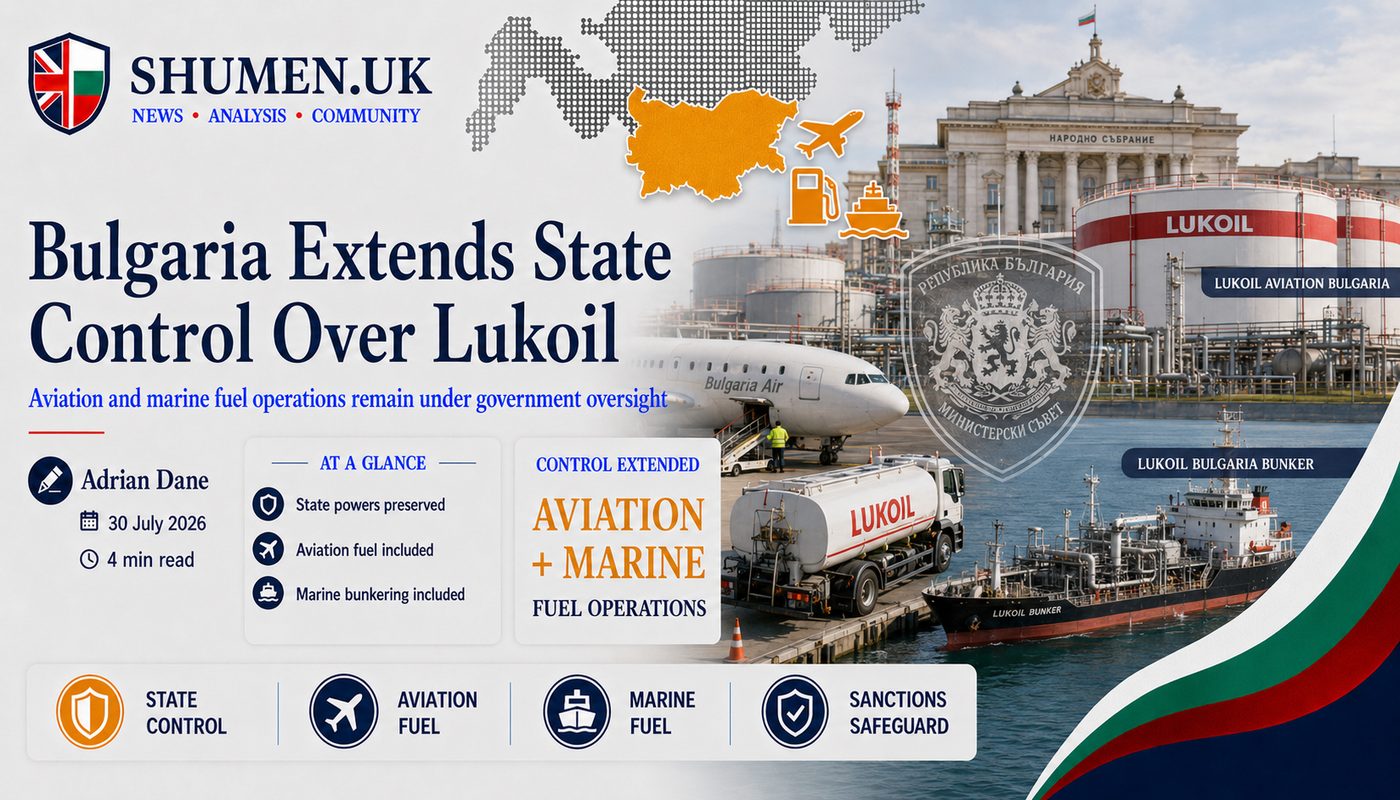
Bulgaria's parliament has pushed through emergency legislation that keeps the state's special administrator in charge of every major Lukoil operation in the country, and extends his reach to the aviation and marine fuel businesses for the first time. The amendments cleared their final vote on Wednesday, rushed through both readings in a single sitting after the Constitutional Court struck down parts of the earlier version of the law.
Anyone who has filled up at a Lukoil forecourt on the Varna road recently has, in effect, been buying from a company the Bulgarian state now runs. Wednesday's vote keeps it that way, and widens it.
What MPs Actually Voted Through
The amendments to the Law on the Administrative Regulation of Economic Activities Related to Oil and Petroleum Products were backed by Progressive Bulgaria, DPS and a single GERB lawmaker. Their practical purpose is to stop two companies, Lukoil Aviation Bulgaria and Lukoil Bulgaria Bunker, from slipping back under the control of their parent, Lukoil International, which remains under US and UK sanctions imposed over Russia's war in Ukraine.
The special administrator's portfolio was already considerable. He oversees Lukoil Neftochim Burgas, which operates the country's largest refinery, and Lukoil Bulgaria, owner of the nationwide petrol station network and the fuel pipeline. The Council of Ministers has now formally designated the aviation and bunker arms as part of Bulgaria's critical infrastructure, which under the revised law brings them under the same state management.
The government's reasoning, as presented to parliament, is supply security. Lukoil Aviation Bulgaria plays a vital role in fuelling the country's airports, while Lukoil Bulgaria Bunker provides most of the marine fuel used at Burgas, Varna and the ports along the Danube.
Why the Unseemly Hurry
The speed was the real argument in the chamber. The bill passed first and second reading in the same session, leaving no window for further proposals between the two stages. Progressive Bulgaria MP Slavi Vassilev defended the fast-track on the grounds that delay could leave Bulgaria without aviation and ship fuel altogether: "We have to vote on it. Tomorrow it may turn out that we don't have aviation and ship fuel. Airports and ports will stop functioning. It is critically important that we accept this."
Democratic Bulgaria was unpersuaded. MP Nadezhda Yordanova argued the new text hands the Council of Ministers too much discretion over what qualifies as critical infrastructure, and warned that the administrator's role remains too broad and short on safeguards against excessive state intervention. GERB's Hristo Gadzhev reached for the sharper line on the procedure itself: "The new ones are like the old ones, only new."
Economy Minister Alexander Pulev insisted the cabinet respects private property rights but is acting to protect the interests of Bulgarian citizens and consumers. The amendments take effect once published in the State Gazette.
The Sanctions Clock Behind It All
Some context the wire copy skips. The UK put Lukoil under an asset freeze on 15 October 2025, and the US Treasury's OFAC followed with blocking sanctions on 22 October 2025, designations that automatically catch any subsidiary Lukoil owns half or more of. That is how a Russian parent company holding Bulgarian fuel infrastructure became an urgent problem for Sofia rather than an abstract one.
Two deadlines now matter. The British exemption expires on 13 August and the US sanctions waiver runs out in October. Pulev told parliament that Bulgaria has already submitted documentation to the United Kingdom seeking an extension of the British exemption, and will ask Washington for an extension of the American waiver. Without those, the legal room for the refinery and its sister companies to keep trading shrinks considerably.
The personnel has changed too. In June the government replaced the first special administrator, former National Revenue Agency director Rumen Spetsov, with Evgeni Simeonov. His tenure has not been quiet. He told BTA in May that Bulgaria has a "historic opportunity" to re-acquire the Burgas refinery outright, and in June Sofia reached a deal with Lukoil's trading arm Litasco to restore full oil supplies to the refinery.
What This Means for British Expats
At the pump, nothing changes this week, and that is rather the point of the exercise. The Lukoil stations stay open and supplied under state management, which is the outcome Wednesday's vote was designed to guarantee. If you drive here, our driving guide covers the practical side of fuel, vignettes and the rest.
The aviation piece sits closer to home than it looks. Burgas and Varna are the summer gateways for most British holiday traffic to the Black Sea coast, and the country's airports depend on Lukoil Aviation Bulgaria for fuel. The government's argument, now voted through, is that letting that company fall back to a sanctioned parent risked airport disruption in the middle of the season.
The thing worth watching is not the forecourt price board but the two waiver deadlines. If London or Washington declines to extend in August and October, the story moves from parliamentary procedure to genuine supply questions, and those would eventually show up in the cost of driving and flying here. Our cost of living tracker carries the fuel price picture as the figures land.