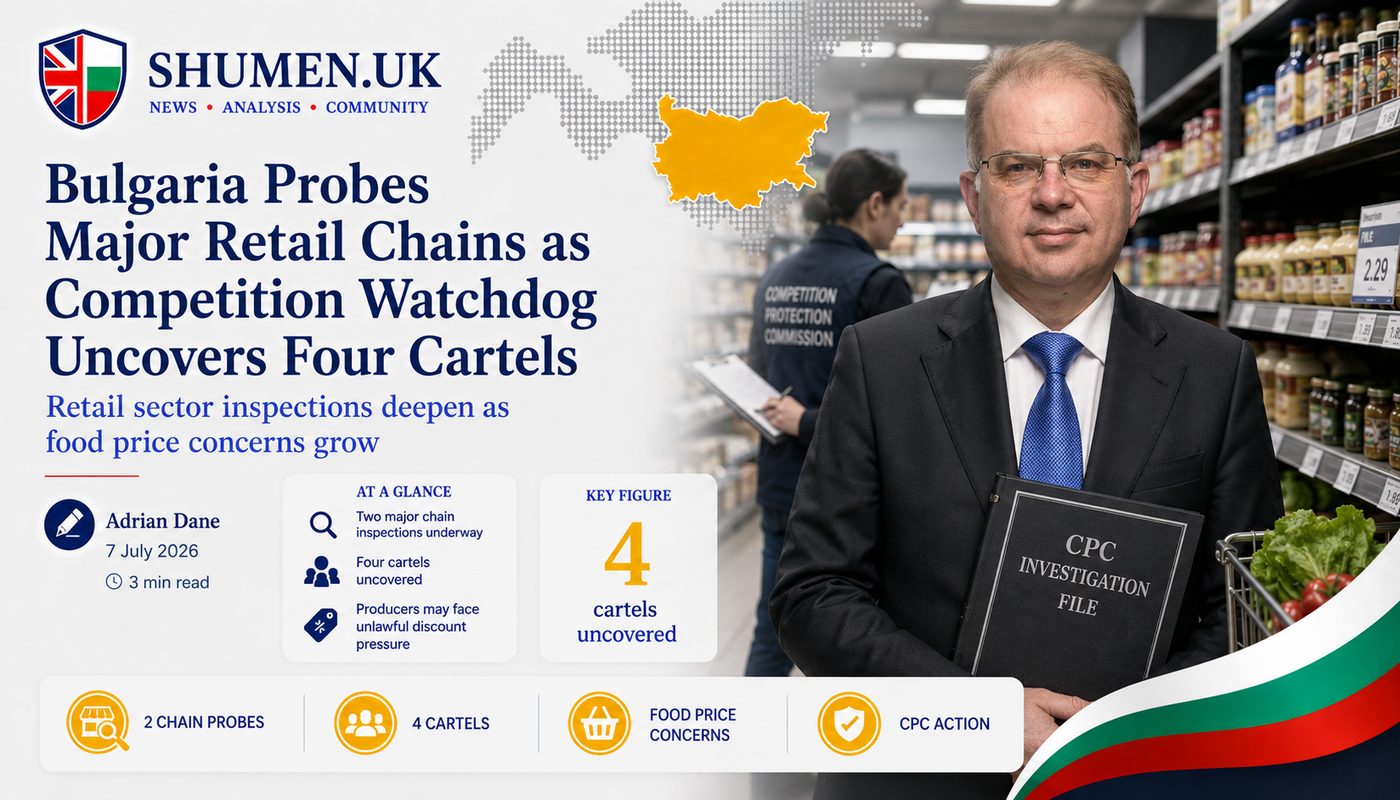
Bulgaria's competition authority has confirmed it is inspecting two major retail chains over allegations that they are squeezing Bulgarian food producers with unlawful discount demands, a practice it says could ultimately push shelf prices higher rather than lower.
Speaking on bTV, Radomir Cholakov, deputy chair of the Commission for Protection of Competition (CPC), said the two inspections are already under way. "There are concerns that retail chains are twisting the hands of Bulgarian manufacturers through illegally high discounts," he said. His argument is a little counter-intuitive: if a supermarket forces a producer to sell below a fair price, the retailer's own markup on top of that squeezed price can still leave the shopper paying more, not less.
Novinite, which first reported the inspections, did not name either of the two chains under investigation. Neither has the CPC, at least not yet.
The Fine Nobody Wants to Actually Use
The CPC's legal toolkit is blunt: fines of up to 10% of a company's previous year's turnover for unfair commercial practices or abuse of a dominant market position. Cholakov was candid about why the watchdog is wary of reaching for it. "If we use the 'atomic bomb,' a company with a dominant market position could decide to shut down its operations in Bulgaria," he said, citing the example of a dairy processor he said controls around 70% of the market. Neither the processor nor its market share were independently verified beyond his statement.
It is an unusual position for a regulator to state publicly: that its biggest weapon is one it is reluctant to fire, because the market is concentrated enough that punishing the dominant player could simply mean losing it.
Bulgaria's Vanishing Sheep
Cholakov's more striking claim was structural rather than punitive. Bulgaria, he said, had around nine million sheep in the late 1980s. Today the figure is well under one million. As domestic milk production has shrunk with the flock, processors have leaned harder on imported raw milk, which he argues limits competition among Bulgarian dairy processors rather than expanding it.
Cholakov did not spell out the sheep-to-milk link himself, but it is less of a leap than it sounds. Sirene, the brined white cheese on every Bulgarian table, and much of the country's yogurt tradition, has historically leaned on sheep's and goat's milk as much as cow's. A collapsing sheep flock is not a side issue for Bulgarian dairy, it is close to the source of it.
He described the resulting pattern as self-reinforcing: "The fewer Bulgarian products there are, the more imports are needed. The more imports increase, the less interest Bulgarian producers have in manufacturing. It becomes a vicious circle. The problem is structural." Fining a retailer, in other words, does nothing to rebuild a flock that has been shrinking for three and a half decades.
Four Cartels in a Few Months
Separately from the retail inspections, Cholakov revealed the CPC has uncovered four distinct cartel cases in recent months:
- Hospital food supplies, the first case identified.
- IT equipment procurement, a second collusion case.
- Construction machinery rental, referred to Brussels because it has a cross-border European dimension.
- Kindergarten food tenders, where Cholakov said one company operated through two separate legal entities to win public contracts: "It was established that one company, operating through two separate legal entities, participated in public tenders in order to secure contracts."
Public procurement, not the supermarket shelf, is the common thread. Hospitals, schools and kindergartens buying food and equipment through tenders, precisely the kind of contracts where collusion is hardest for an outsider to spot, since there is no competing shopper down the aisle to notice the price looks off.
What This Means for Your Shopping Bill
None of this is likely to move prices at the till this month. Competition investigations of this kind typically run for months, and Cholakov's own framing, that the CPC's biggest fine risks driving a dominant supplier out of the country altogether, suggests the watchdog is moving carefully rather than quickly. Anyone doing a weekly shop at Lidl, Kaufland or Billa already has a feel for which prices only move in one direction; the CPC's numbers just put an official name to that suspicion.
For British expats running a smallholding, a farm shop, or supplying produce to a Bulgarian retailer, the discount practices Cholakov describes are the more immediate concern: a squeeze on the supplier's price, not the shopper's. For everyone else, the practical takeaway is more modest: keep an eye on the actual retail-price data rather than the headlines about investigations, since a probe opening is not the same as a price falling. Shumen.UK's cost of living tracker follows the underlying numbers as official figures land, and the supermarkets guide has the practical detail on where prices tend to run highest and lowest across the main chains.
What the CPC Hasn't Said
To be clear about the gaps: the CPC has not named the two retail chains under inspection, has not said when either investigation might conclude, and has not disclosed which dairy processor it considers to hold that 70% market position. Novinite's report does not answer these either. Until the CPC publishes findings, the story is an investigation opening, not a verdict.