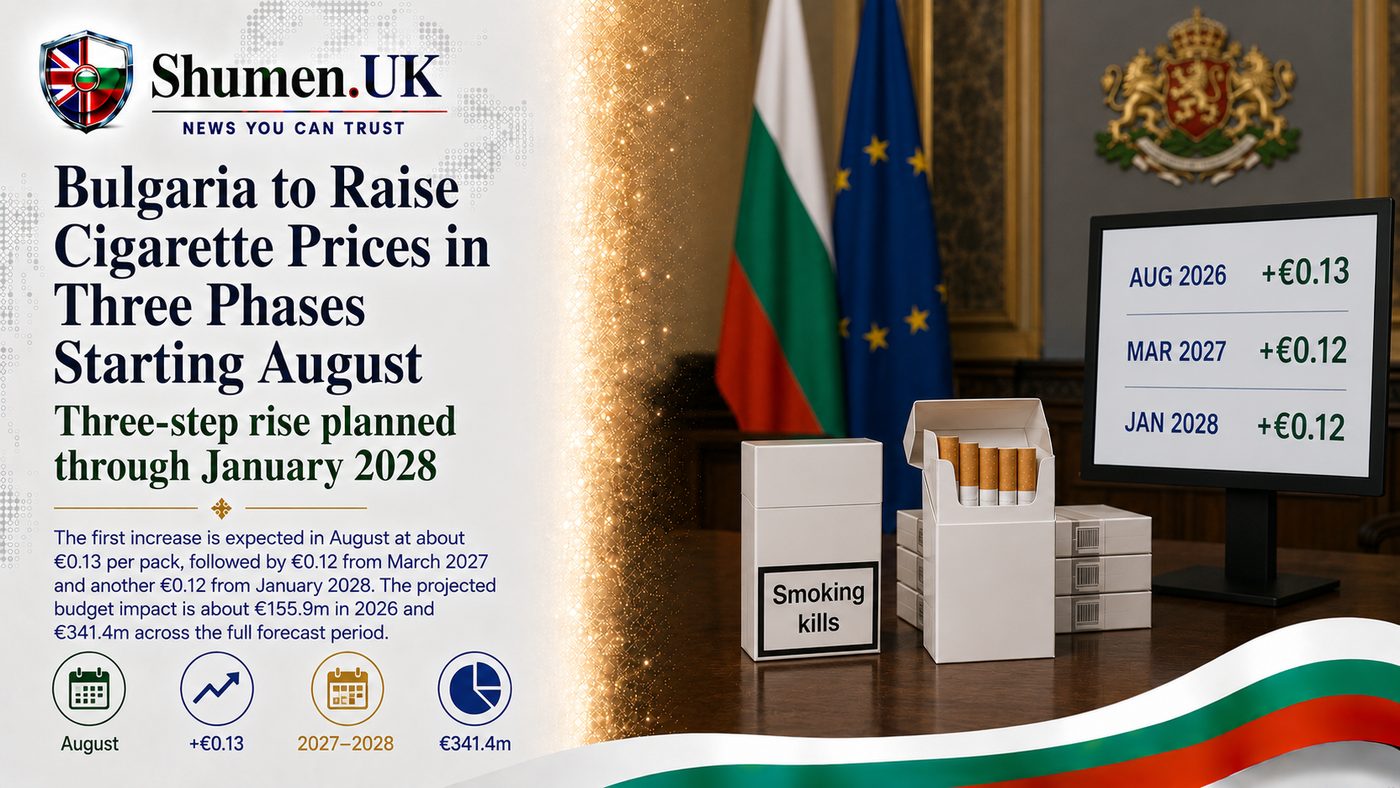
A pack of cigarettes in Bulgaria will cost about 13 euro cents more from 1 August, the first of three planned increases that will keep nudging the price upward into 2028. The rise comes from higher excise duty on tobacco, set out in the Ministry of Finance's medium-term budget forecast for 2026 to 2028, and it is one of the bigger revenue-raisers in a budget that is already drawing political fire.
Anyone who buys their cigarettes from the kiosk on the corner will see the new number at the till from August. The rest of us will feel the same budget's reach in other ways, which is rather the point of how it has been put together.
The three phases, in plain numbers
The duty does not jump all at once. The Finance Ministry has set out a staged path:
- From 1 August 2026: the excise on 1,000 cigarettes rises from €113.51 to €120, which works out at roughly 13 cents more per pack of 20.
- From March 2027: a further 12 cents per pack.
- From January 2028: another 12 cents per pack.
Added together, that is about 37 cents more on a pack by the start of 2028. The Ministry expects the tobacco measure alone to bring in around €155.9 million in 2026 and roughly €341.4 million across the full forecast period, making it one of the larger single contributors to the revenue side of the budget.
Still the cheapest pack in the EU, just less so
What the wire report does not spell out is the bigger backdrop: Bulgaria has long had the lowest cigarette excise in the European Union. According to Tax Foundation Europe, the duty on a pack of 20 here has sat at the very bottom of the table, below Cyprus and Croatia, against an EU minimum of €1.80 a pack. This August increase is not a one-off raid: it is the next step in a multi-year plan to bring Bulgarian tobacco duty closer to the EU average. The duty already rose from €107.57 to €113.51 per 1,000 cigarettes at the start of 2026, so August is the second move inside a year.
The practical upshot for the reader: even with all three increases banked, Bulgaria will still be among the cheapest places in the EU to buy a packet. The gap to Western Europe, where a pack routinely runs to double figures in euros, stays wide. This is a steady climb, not a shock.
What it means for British expats
If you smoke, the maths is easy to do for yourself. A pack-a-day habit costs you about €47 more a year once the August rise lands, climbing toward €135 a year extra by 2028 once all three phases are in. Not ruinous, but not nothing either, and worth folding into the household budget now rather than being surprised at the counter.
The more useful point is that the cigarette rise does not arrive on its own. It is bundled into a budget that quietly raises several everyday costs from the same 1 August start date. The most visible for anyone who owns a car is the 30% increase in vignette fees, the road-use charge every driver in Bulgaria has to pay. Our driving guide covers how the vignette works and where to buy it, and the new tariff is worth checking before your current one runs out. Taken together with rising prices elsewhere, it is another reminder that the old line about Bulgaria being cheap has not survived contact with 2026. We track the underlying figures in the cost of living tracker and update them as official numbers land.
The budget behind the rise
The tobacco duty sits inside the wider 2026 fiscal package presented by Finance Minister and Deputy Prime Minister Galab Donev, according to Novinite. Alongside the vignette increase, the draft lifts the maximum monthly social security income to €2,300 from 1 August 2026, a change the Ministry expects to raise just over €90 million, and sets higher minimum insurance thresholds for sectors with faster wage growth, worth around a further €40 million. Officials argue the combined measures are meant to shore up public finances over the coming years.
Not everyone is convinced. Former finance minister Asen Vassilev has called the draft budget "suicidal" and misleading, and a separate Novinite report cites an economist warning that inflation could reach 8% as deficit pressures mount. Those are contested political and forecasting claims rather than settled facts, and we flag them as such; the euro-denominated duty figures above come straight from the Ministry's own forecast. For the euro changeover itself and how prices are quoted since January, our money guide sets out the basics.
None of this changes anything you have to do tomorrow. But if you smoke, or drive, or simply keep an eye on what the weekly shop costs, the budget that takes effect on 1 August is one to read past the headline.