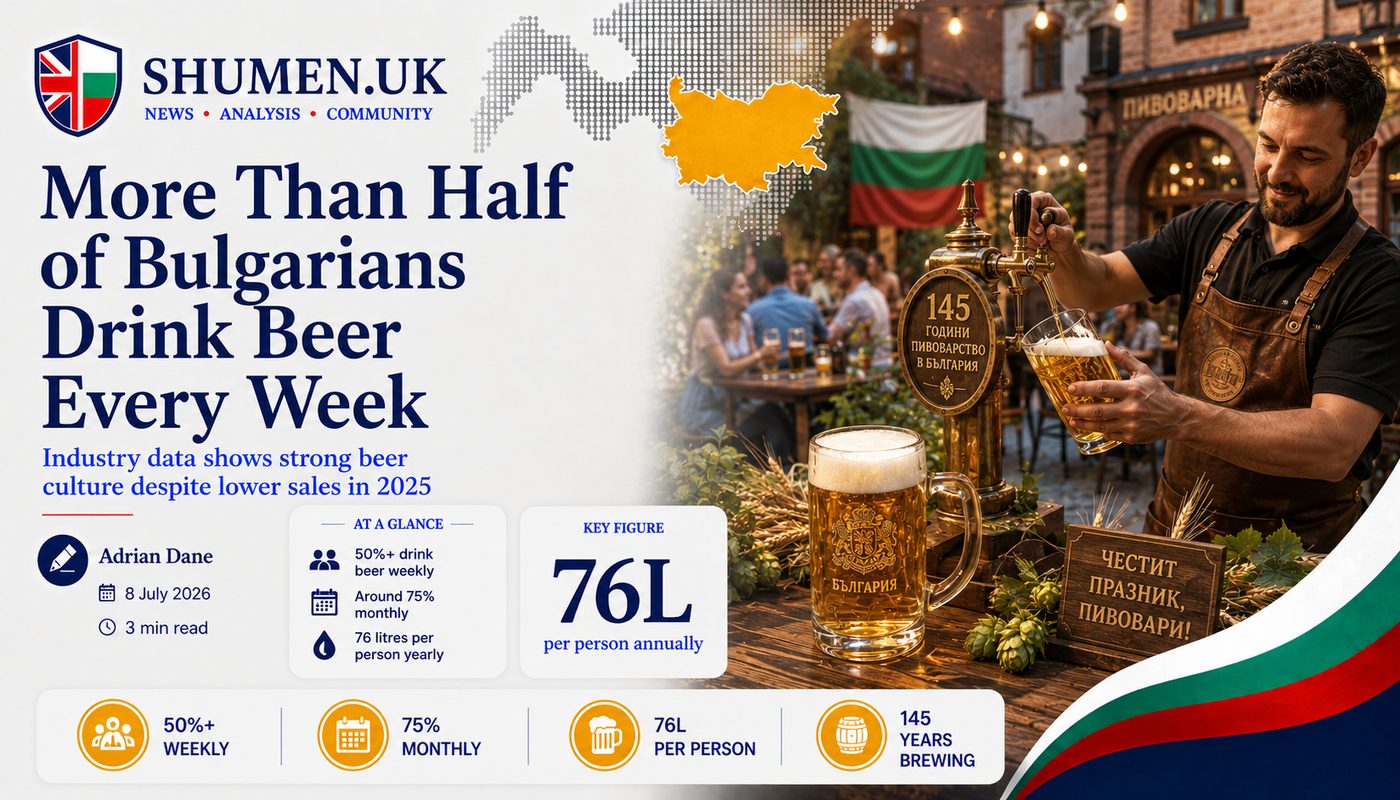
More than half of Bulgarians drink beer at least once a week, and around three-quarters have at least one a month, according to new figures from the Union of Brewers in Bulgaria. The data arrived as the industry marked its professional holiday, the 145th anniversary of Bulgarian brewing, 70 years of brewing science in the country and 35 years since the founding of the industry body, and it landed alongside a less cheerful number: beer sales fell by roughly 5% in 2025 against the year before.
Even so, annual consumption held at 76 litres per person, a figure covering both alcoholic and non-alcoholic beer, and Bulgarian breweries still turned out 4.42 million hectolitres last year against total sales of nearly 5 million hectolitres.
Investment Keeps Climbing Even as Sales Slip
Union of Brewers Chairman Vladimir Ivanov said the sector is continuing to invest heavily despite the sales slide. Since Bulgarian breweries began being privatised in 1994, total investment has reached roughly €831 million, including around €169 million poured into fixed assets over the past five years alone. Ivanov expects 2025 investment to hit €45 million, which he said would be the strongest single year in two decades, with more than 40% of the latest spending going into expanding malt production.
The country now has 42 beer producers: three large breweries responsible for more than 92% of output, seven small and medium companies, and 32 microbreweries. That last figure is worth pausing on. Anyone who has watched a new craft taproom open in Plovdiv or Sofia over the past couple of years has been watching this statistic build in real time; Bulgaria's beer scene no longer looks like the three-big-brand market it was a decade ago. The sector as a whole supports around 22,000 jobs across production, distribution and retail, and the roughly 9% who work directly in a brewery earn an average of more than €1,650 a month, the highest wage level in Bulgaria's food industry. Ivanov described the industry as one that "produces both dark and light beer openly, stands on the side of the law, is an honest taxpayer and remains extremely fair toward consumers and everyone working in the sector."
A 19th-Century Import Marking 145 Years
Brewing arrived in Bulgaria comparatively late. According to the historical record of Bulgarian brewing, beer only reached the country in the 19th century, brought in by foreign settlers to a place that had, until then, been overwhelmingly a rakia and wine-drinking country. A century and a half on, the industry now marking that anniversary employs a chemistry graduate's worth of brewing science too: the union's figures also mark 70 years of formal brewing science in Bulgaria, a detail that places the modern industrial brewery alongside, rather than replacing, older Bulgarian drinking habits.
Inflation, Younger Drinkers and the Rise of Alcohol-Free Beer
The Brewers' Union linked the 2025 sales dip to inflation, rising living costs, geopolitical uncertainty and changing consumer habits, particularly among younger Bulgarians drinking less often than earlier generations. Bulgaria is not alone in this: beer production and consumption have also fallen elsewhere in the EU, though Bulgaria still ranks 13th among member states in both categories.
Breweries are responding by widening the shelf rather than shrinking it. Around 20 new beer brands and varieties reached the Bulgarian market over the past year, including several non-alcoholic options, and sales of alcohol-free beer rose 6% in both Bulgaria and the EU during 2025. Compared with 2000, non-alcoholic beer consumption across the EU has grown by more than 38%, and one in every 12 beers drunk in the bloc now contains no alcohol. Each Bulgarian brewery employee produces an average of 232,000 litres of beer a year, a productivity level the union says is comparable with neighbouring countries.
The Industry's Push for a Bottle Deposit Scheme
The sector has also made environmental progress: all aluminium cans and glass bottles sold are now recyclable, and the share of beer sold in plastic packaging has fallen to 41%, down from 63% in 2020. Brewers say they support introducing a national deposit-return scheme for beverage packaging, the kind of system already running in a number of EU countries, where a small deposit is added to the purchase price and refunded when the empty container is returned. The union estimates that producers and importers would need to invest around €100 million to set the system up in Bulgaria.
During the same event, the Union of Brewers signed a new two-year sector-wide collective labour agreement with the Confederation of Independent Trade Unions in Bulgaria and the Podkrepa Labour Confederation.
What This Means for British Expats
If you are job-hunting rather than just drinking, brewery work is one of the better-paid corners of Bulgaria's food sector: an average monthly wage above €1,650 stands out in an industry not generally known for high pay. And if the craft-beer bug bites and you are weighing a microbrewery of your own, the 32 microbreweries already trading show there is room in the market; setting one up here typically means registering a Bulgarian OOD or EOOD, and our business in Bulgaria guide walks through what that involves.
For everyday drinkers, the industry's backing of a deposit-return scheme is worth watching. If it goes ahead, buying a beer, a fizzy drink or bottled water here would come with a small refundable deposit added at the till, much like schemes already running elsewhere in Europe, rather than the deposit-free system Bulgaria has now.
Sources and Further Reading
The historical detail on beer's 19th-century arrival in Bulgaria and its place alongside the country's older rakia and wine traditions draws on the Wikipedia entry for beer in Bulgaria.