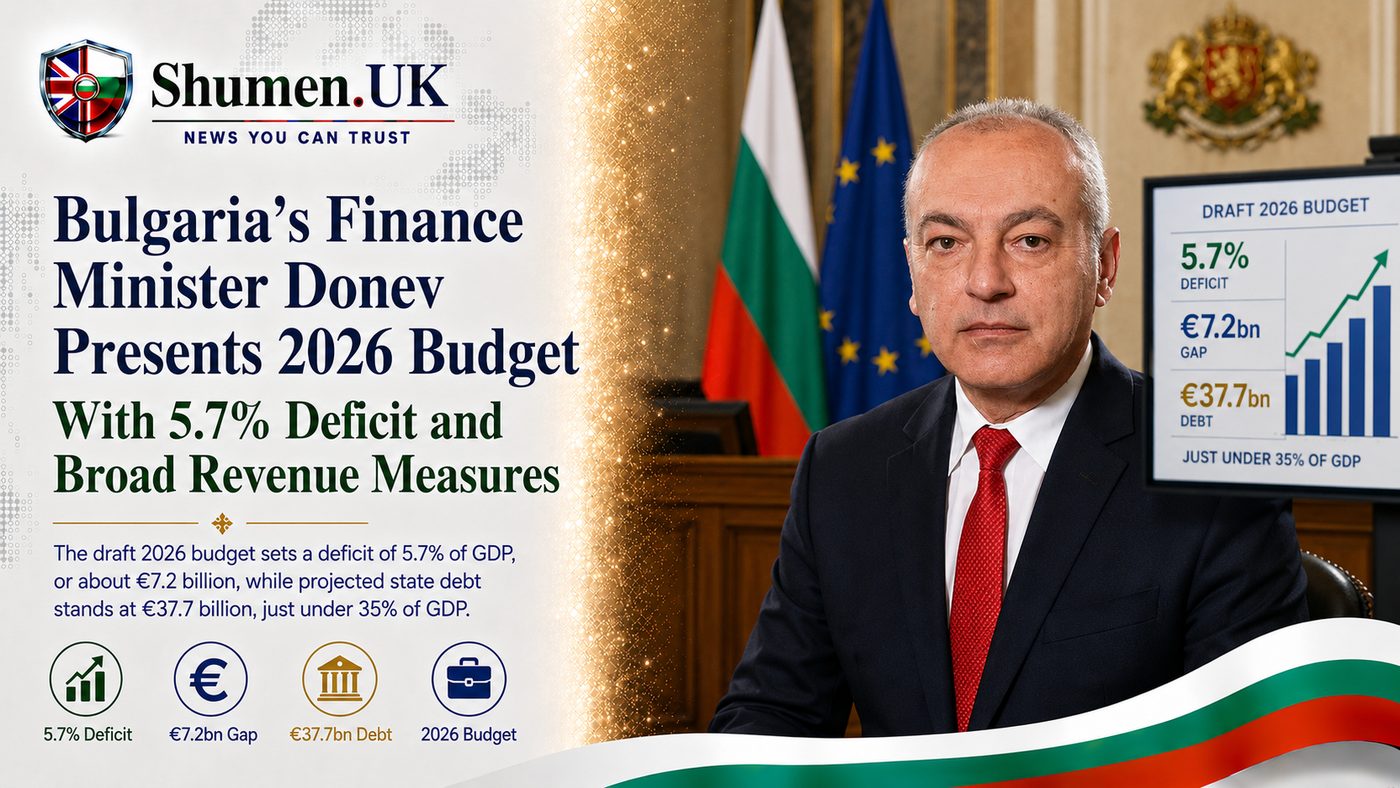
Bulgaria's finance minister has laid out a 2026 state budget that leans on borrowing, a wider tax net and a noticeably more expensive set of roads. Galab Donev, who is also deputy prime minister, presented the draft on Wednesday 24 June, setting the deficit at 5.7% of GDP, about €7.2 billion, and confirming the government will need to borrow more than €2 billion to cover the gap. He called the shortfall manageable. The detail that reaches most British expats first is smaller and more familiar: the cost of keeping a car legally on the motorway is going up.
Every Brit who runs a car here knows the small annual admin of the vignette, the electronic road pass you cannot legally use the motorways without. Under this budget it gets 30% dearer, and the network of roads you have to pay for gets wider.
The Headline Numbers, and the EU Problem Behind Them
Donev put state debt at €37.7 billion, just under 35% of GDP, and framed the whole package as fiscal consolidation: a plan to pull the deficit back down to 3% of GDP by 2028. That 3% figure is not arbitrary. It is the European Union's reference ceiling for government deficits, and a member state that breaches it can be placed under the bloc's excessive deficit procedure, a formal corrective process that comes with monitoring and pressure to cut. At 5.7%, Bulgaria's 2026 gap is nearly double that ceiling, and Donev said sustained consolidation is precisely how the country gets back out of the procedure.
He was blunt about how it got here, blaming previous governments' rising spending and weak revenue growth for what he called long-term imbalances, and saying the European Commission had effectively confirmed the scale of the problem. Those are the minister's characterisations, his case for the budget rather than neutral fact. All the figures, it is worth noting, are quoted in euros: Bulgaria adopted the single currency on 1 January 2026.
What It Costs You on the Road
This is the part of the budget with a price tag a driver feels directly. The headline measures are a 30% increase in vignette fees and an expansion of the toll system to cover more of the road network, meaning journeys that were previously free now carry a charge. The budget also tightens fiscal control over the fuel supply chain as part of a wider shadow-economy crackdown, though the source does not spell out what, if anything, that does to the price at the pump.
If you keep a vehicle in Bulgaria, the practical step is simple: budget for a higher vignette at your next renewal, and check whether a route you drive regularly now falls inside the expanded toll coverage. Our driving guide covers how the electronic vignette and toll system work, and how to buy and renew one without getting caught out.
What Changes If You Run a Business
For British expats running a Bulgarian company, the most consequential line sits inside the anti-fraud measures: mandatory electronic invoicing for all domestic transactions from 2027. That is a system change, not a tweak. Any OOD or EOOD that issues invoices will need compliant e-invoicing in place before it takes effect, and 2027 is close enough that it belongs on the planning list now rather than later.
The budget also widens fiscal oversight of e-commerce and high-risk goods, raises gambling-related taxation, targets intermediaries in that sector, and opens talks with banks to block payments to illegal gambling operators. For most expat businesses the gambling measures are background noise. The e-invoicing mandate and the e-commerce oversight are the parts to read closely.
Wages, Contributions and the Public Payroll
Two changes here reach beyond the civil service. From 1 August 2026, civil servants, including staff in the judiciary and public administration, will gradually start paying personal social security contributions, with compensation measures intended to preserve their net pay. It is a structural shift in who funds the contribution system, and the direction of travel on contributions is worth watching for anyone who pays in, including self-employed Brits who manage their own contributions through the NAP.
Donev also moved to cap pay at the top of state-owned enterprises, limiting board remuneration to the level earned by the president and the prime minister. And he explicitly rejected reports that the minimum wage would be frozen until 2028, saying talks with social partners on future wage levels are ongoing. That settles, for now, a claim that had been circulating as established fact.
The Politics
A budget built on more than €2 billion of fresh borrowing will not pass without a fight. Donev presented it as responsible consolidation, blaming previous governments for the imbalances he says he is now correcting. But it is a draft, and it still has to go through parliament: the deficit figure and the new borrowing are the obvious places for that argument to land.
The Bottom Line
Nothing here changes your costs the moment it is announced: this is a draft, and it still has to clear parliament. But the direction is set, and three lines are worth pulling out of the noise. The vignette and wider tolls will cost drivers more. Businesses face mandatory e-invoicing from 2027. And the minimum wage is not, despite the reports, being frozen. The number to track over the next two years is that 3% deficit target for 2028: hit it, and Bulgaria climbs out of the EU's excessive deficit procedure; miss it, and the borrowing story runs and runs.