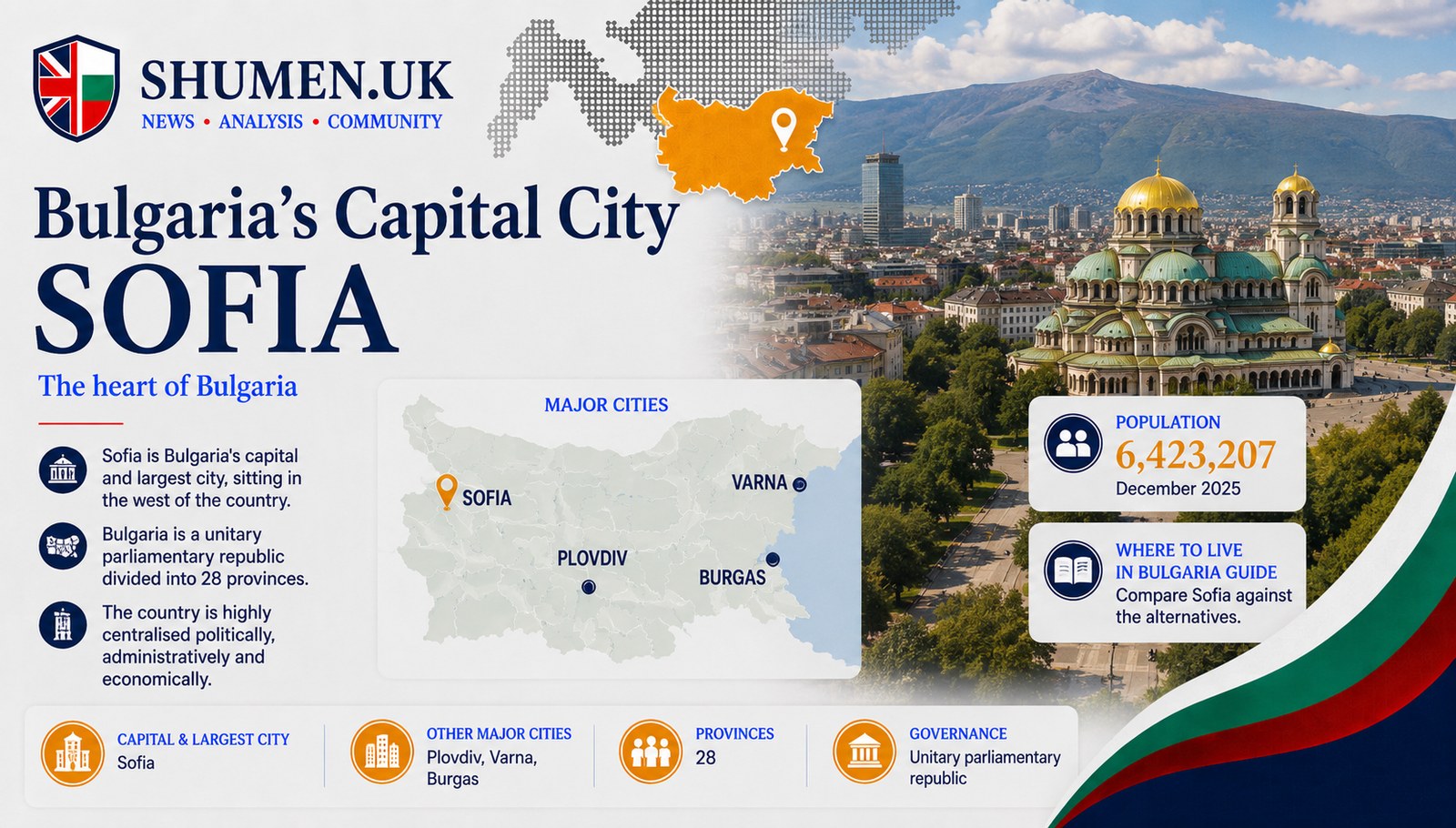
The short answer is Sofia. If that is all you needed, you can stop reading, but the longer answer is the one that affects daily life if you live here or are thinking about it. Bulgaria is a unitary parliamentary republic of 28 provinces with, in the careful wording of the reference sources, a high degree of political, administrative and economic centralisation. In practice that means the capital is not simply the biggest dot on the map. It is where the ministries sit, where the money concentrates, and where a good deal of officialdom still expects to see you in person. This article explains what Sofia's status actually means for British expats, and why it does not automatically make it the place to live.
Where Sofia Actually Is
Sofia sits in the west of the country, at roughly 42.7 degrees north and 23.3 degrees east. That places it closer to Bulgaria's western frontier than to the Black Sea coast, which catches people out if they assume a capital sits near the middle of its own country. Bulgaria covers 110,993.6 square kilometres, so the distance from Sofia to the coast is a genuine journey rather than a morning's errand. The city is also the largest in Bulgaria, and it functions as the main administrative, economic and transport centre. For anyone arriving from the UK, the first thing to remember is that "the capital" and "the coast" are not next door to one another.
The Bare Facts, in One Place
For anyone who arrived here straight from a search box: the capital is Sofia, and it is also the largest city. The official language is Bulgarian, written in Cyrillic. The country runs on UTC+2 in winter and UTC+3 in summer, which puts it two hours ahead of the UK all year round. The population was estimated at 6,423,207 in December 2025. Since 1 January 2026, Bulgaria has used the euro as its currency, so prices, rents and official fees are now quoted in euros rather than leva. The form of government is a unitary parliamentary republic, and the country is divided into those 28 provinces, each with its own local administration but with real power concentrated in the capital.
What Centralisation Means for British Expats
Centralisation is not an abstract term here. If you need a document from a ministry, a business registration, a property transfer, or a decision that only a national agency can issue, you will almost certainly end up dealing with Sofia, either in person or through an office that reports to Sofia. That shapes where people choose to live, especially if they run a business, buy property, or need repeated contact with officialdom. Many British expats settle in or near the capital for exactly this reason.
It does not mean the rest of the country is empty or uniform. The provinces have real local administration, and life outside Sofia can be cheaper, slower and warmer, depending on where you land. The trade-off is that the further you are from the capital, the more often a form, signature or permit will require a trip, a courier or a patient phone call. Digital services have improved, but plenty of processes still begin or end with a stamp in Sofia. For a longer comparison of locations and what the trade-offs look like in practice, see our guide to Where to Live in Bulgaria.
The Bigger Picture
Sofia is Bulgaria's capital and largest city, and its dominance is real. That does not make it the right answer for every British expat. If you are weighing location, budget and lifestyle, read our full guide to Where to Live in Bulgaria for the complete picture.