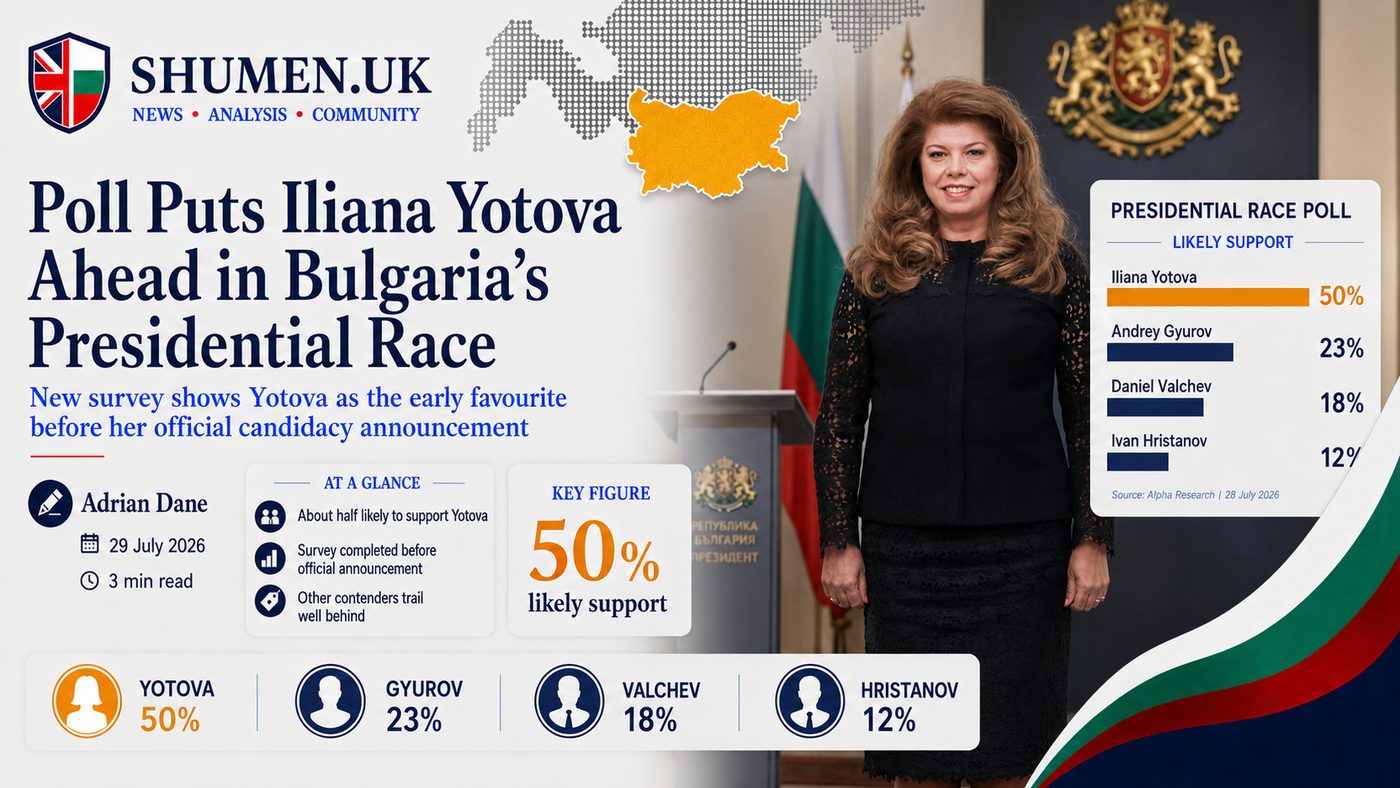
President Iliana Yotova would win Bulgaria's autumn presidential election comfortably if it were held tomorrow, according to a new survey by the polling agency Global Metrics. Around half of likely voters told the agency they were ready to back her, in results published on 28 July, days after she formally confirmed her candidacy.
The twist is that Yotova holds the job without ever having won it. She served as vice president to Rumen Radev and moved into the presidency in January when Radev resigned to lead his new party, Progressive Bulgaria, into April's snap parliamentary election. The autumn vote will decide whether she keeps an office she inherited rather than campaigned for. Anyone who watched Radev's televised farewell address in January suspected the succession was only the interval; the main act is still to come.
A Lead Measured Before the Campaign Began
Global Metrics interviewed 1,503 Bulgarian adults face to face, using tablets, between 23 June and 11 July 2026, on a nationally representative sample. Two details about the timing matter.
First, the fieldwork was completed before Yotova officially announced she would run, which she did in late July, and before Radev publicly confirmed that Progressive Bulgaria would back her. The roughly 50% figure is therefore a pre-campaign number, measured before any advertising, debates or formal endorsements had begun.
Second, none of her named rivals had confirmed they were standing when the interviews were done. Andrey Gyurov polled second on 23%, Daniel Valchev third on 18% and Ivan Hristanov fourth on 12%.
The cross-party detail, reported by the Bulgarian National Radio, is what makes the lead look structural rather than soft. 84% of BSP supporters and 78% of Progressive Bulgaria supporters approve of Yotova, and among voters who identify with no party at all, 37% say they are ready to support her.
Her Own Caretaker Prime Minister Is Her Nearest Rival
The name in second place carries its own story. Gyurov is the man Yotova herself appointed in February to lead the caretaker government that ran Bulgaria until the 19 April parliamentary election, a former deputy governor of the Bulgarian National Bank brought in to organise a credible vote. If he stands, the incumbent's main challenger will be her own appointment.
Valchev, on 18%, is a lawyer and former education minister, while Hristanov, on 12%, serves as agriculture minister in the caretaker cabinet. Whether any of the three converts polling interest into a registered candidacy remains an open question; the survey asked about potential contenders, not declared ones.
The Party Machine Behind the Numbers
Asked which party's nominee they would prefer, respondents put a Progressive Bulgaria candidate first on 39.7%, well ahead of a joint We Continue the Change and Democratic Bulgaria candidate and a GERB-UDF nominee, which the Bulgarian National Radio's report on the same survey put at 13.3% and 11.5% respectively.
That ordering mirrors April's parliamentary result, in which Progressive Bulgaria won 131 of the 240 seats, the first single-party majority Bulgaria has seen after years of deadlocked assemblies. Radev has since said the party will support Yotova, and the BSP has also declared for her, meaning her personal support of around half the electorate runs roughly ten points ahead of the party label behind her. She is pulling votes from the Socialists and the unaligned that no Progressive Bulgaria-branded candidate currently reaches.
What This Means for British Expats
British expats cannot vote in Bulgarian presidential elections unless they also hold Bulgarian citizenship, so this is a race to watch rather than join. But the office itself is worth understanding, because Bulgaria's presidency is not purely ceremonial.
When parliament cannot form a government, it is the president who appoints a caretaker cabinet and schedules the early election. Radev used that power seven times between 2021 and his resignation, meaning the ministries British expats actually deal with, the Interior Ministry behind the traffic police and the migration directorate, the Health Ministry behind the NHIF, were run for long stretches by presidential appointees rather than elected politicians. Gyurov's caretaker cabinet, for instance, was in office when the country was still bedding in the euro changeover earlier this year.
April's single-party majority makes another caretaker spell less likely in the near term, which is precisely why the autumn result matters: it decides who holds the insurance policy. If no candidate wins an outright majority in the first round, the top two go to a run-off, so even a 50% polling lead does not settle anything until the ballots are counted. A year that has already delivered a new currency, a presidential resignation and a landslide parliamentary election will end with one more vote, and on current evidence it is Yotova's to lose.