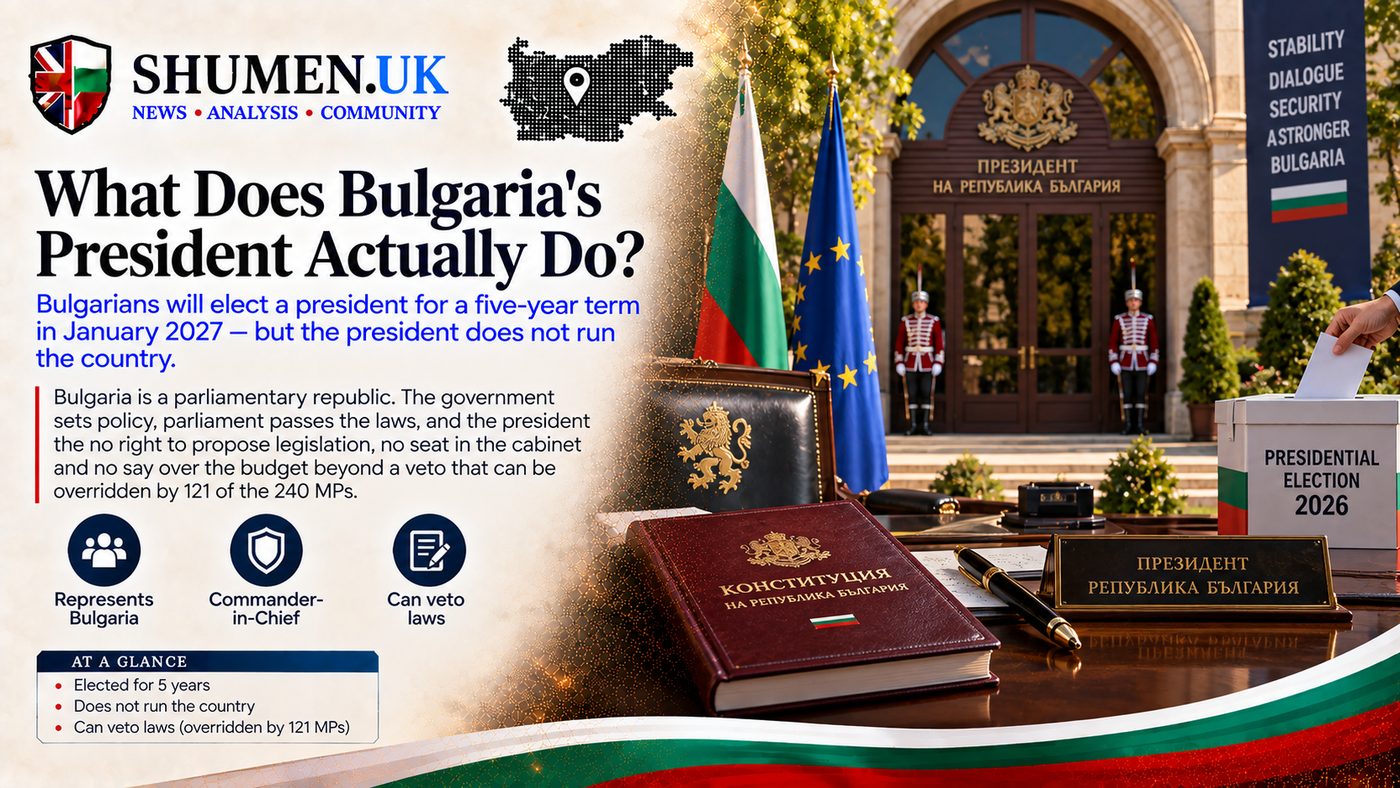
Bulgarians choose a president on Sunday 25 October, but the winner will not be running the country. Under the constitution the state is a parliamentary republic, so policy comes from the cabinet under the prime minister, laws come from parliament, and the president can neither introduce a bill nor sit in the cabinet. The everyday lever over legislation is a veto, and a simple majority of 121 MPs in the 240-seat National Assembly overrides it.
That makes the post sound decorative, and it is not. When parliament cannot agree on a government, the president hands out the mandates to try, and if they all fail it is the president who dissolves parliament, calls the snap election and names the caretaker cabinet that governs in the meantime. By Novinite's tally, twelve of Bulgaria's governments since 1990 have been caretaker ones, seven within the past five years. If you hold only a British passport you cannot vote on Sunday, but one of the office's quieter powers does reach expats, and it is further down.
Three Mandates, Then a Caretaker
After a parliamentary election the president invites the largest group in parliament to try first, and the next largest to try second. The third can go to any group the president chooses, the one real piece of discretion in the sequence, and it has decided governments before. If all three fail, parliament is dissolved and a caretaker cabinet runs the country until the next vote.
Britons will recognise the principle, if not the paperwork. At Westminster the King asks whoever can command a majority in the Commons to form a government, by unwritten convention and usually with little ceremony. Bulgaria has written the order down.
Most decrees need the countersignature of the prime minister or a minister. The exceptions are the decrees with political weight: appointing a caretaker cabinet, dissolving parliament, calling elections, returning a law and handing out mandates.
The "House Book" and the Fight Over Who Can Be Caretaker
Through most of the post-communist years, naming a caretaker was a short stopgap between elections. After 2021 it became routine. Voters were sent to the polls for parliament eight times in five years. Every failed parliament handed Rumen Radev the job of appointing yet another caretaker, and the cabinets led by Galab Donev and Stefan Yanev governed for long periods, signing off energy contracts and defence decisions with no parliamentary majority behind them.
Parliament answered on 20 December 2023, when four parties, among them GERB and We Continue the Change, amended the constitution to take away the president's free choice. A caretaker prime minister must now come from a short list: the Speaker, the central bank governor or a deputy, the National Audit Office's chair or a deputy, and the Ombudsman or a deputy. Bulgarians nicknamed it the "house book" (домова книга, DO-mo-va KNEE-ga), after the ledgers of residents once kept in apartment blocks. Anyone who has registered an address here will appreciate the national fondness for a good ledger.
The list has survived two court challenges. In July 2024 the Constitutional Court overturned most of the 2023 package but divided evenly, six judges to six, on the caretaker clauses, so they stood. Radev, joined by two groups of MPs, tried again in July 2025 and lost when six judges, one short of the seven needed, found the rules unconstitutional. The effect has been plain. In 2024 Radev was obliged to name Dimitar Glavchev, the Audit Office chair, long associated with GERB. In February 2026 Iliana Yotova, by then in the presidency, said ten of the eligible officials had said no before Andrey Gyurov, a suspended BNB deputy governor at the time, accepted.
The politics have flipped since. Radev is now prime minister and commands a majority of his own, and on 24 August he said his government would seek to give the president back a free choice of caretaker. Nothing has been formally tabled, so for now the list is the law.
The Quiet Powers That Reach Expats
The president decides who is granted, restored or stripped of Bulgarian citizenship, deals with asylum, signs pardons for convicted criminals, and can cancel state debts that cannot be recovered. By long tradition these powers pass to the vice president by decree. A presidential commission reviews requests, but its members are anonymous and the reasons behind individual pardons are rarely made public, so critics now want the process opened up.
For British applicants the practical point sits at the end of the process. Citizenship by naturalisation is acquired by presidential decree, and our Bulgarian citizenship guide stresses that a Justice Minister's proposal, or a message that your file has reached the approval stage, is not the decree. Plan around the decree, not the email. The flip side is that the presidency itself stays closed to you: candidates must be Bulgarian citizens by birth.
The Rest of the Job
The president is commander-in-chief, chairs a security advisory council of government, parliamentary, military and intelligence chiefs (it cannot decide anything, but being summoned sends a political signal) and appoints four of the Constitutional Court's twelve judges. Beyond that, the office can petition the court to declare a law unconstitutional, a sharper tool than the veto. Foreign policy belongs to the cabinet, so the prime minister, not the president, usually sits at European Council summits.
It also hands out state decorations, renames towns and villages, calls local elections and referendums once parliament has agreed to them, and delivers the New Year's Eve address. Bulgarians use the presidency's street address, 2 Dondukov in the centre of Sofia, as shorthand for the institution, much as Britons say Downing Street. Impeachment exists on paper, needing 161 votes of 240, but has never got anywhere: Ataka could not even put its 2013 motion against Rosen Plevneliev on the agenda.
Sunday, the Runoff and January
President and vice president run as a single ticket. A ticket wins outright only with more than half of the valid votes on a turnout above 50 percent. Otherwise the top two meet in a runoff a week later, on Sunday 1 November, where the higher vote wins whatever the turnout. No president has yet won at the first attempt. With turnout expected below 40 percent, Novinite treats a runoff as all but certain. Ballots have included a "none of the above" box since 2016. The winner takes office in January 2027 for five years and can be elected only twice.