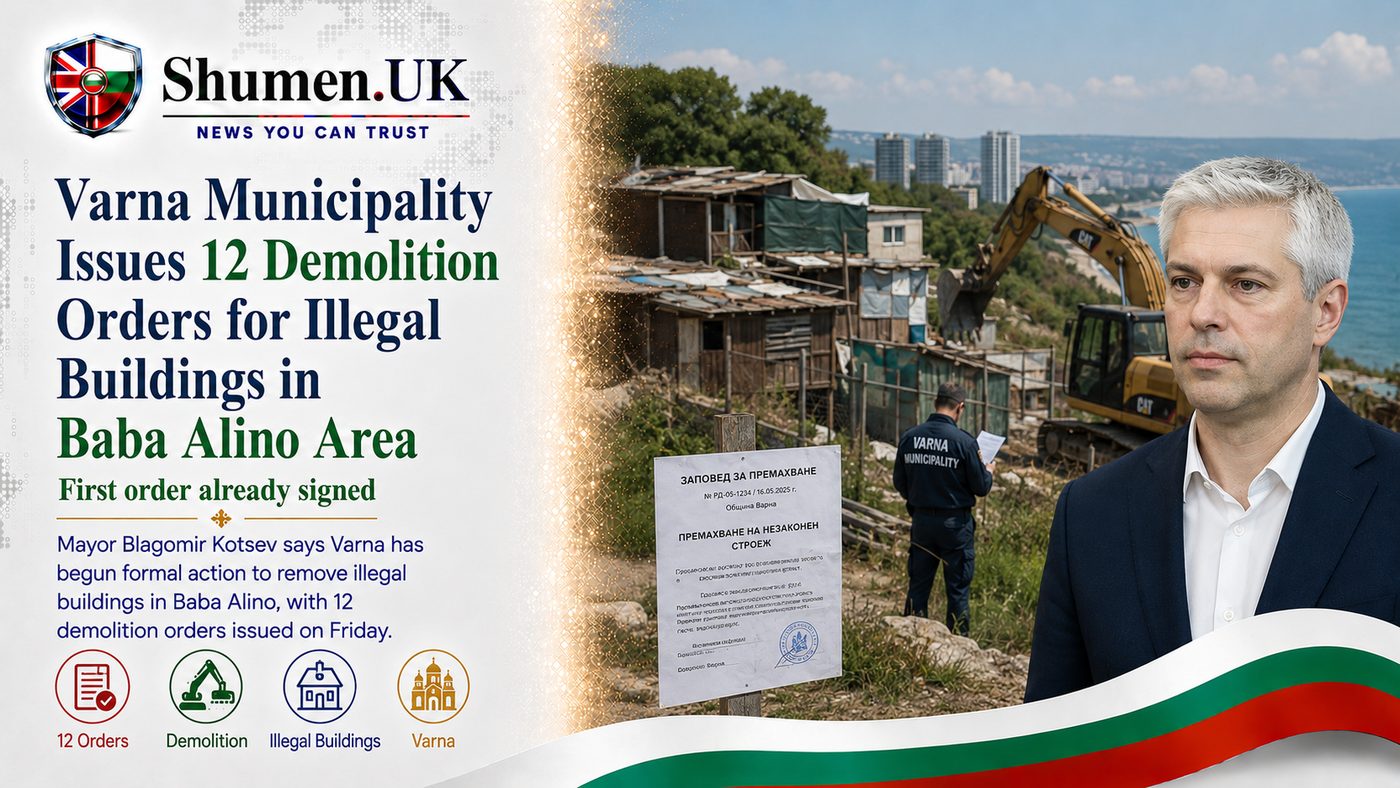
Varna has started pulling apart one of its most contested developments. On Friday 19 June, the municipality issued twelve demolition orders against illegal buildings in the Baba Alino area, and Mayor Blagomir Kotsev confirmed he had already signed the first.
Anyone who has driven the back roads behind the Varna resorts knows the type: a cluster of brand-new blocks standing where a field used to be, finished, shuttered, and somehow already the subject of a court file. Baba Alino is that, on a larger scale.
The targets are multi-family residential blocks, four apartments to each building, owned by Forest Club, a company belonging to Oleg Nevzorov. All of them are currently empty, which spares the municipality the one complication that makes these cases genuinely ugly: people living inside.
The case rests on the paperwork
Construction at Baba Alino was carried out on the basis of four tolerance certificates, the Bulgarian documents used to legalise an existing structure. According to Kotsev, those certificates did not match the actual locations of the buildings. They referred to entirely different plots.
That mismatch is the municipality's opening. Kotsev said the administration had deliberately taken its time so the orders would hold up in court. "The municipality spent sufficient time preparing these orders so that they would be legally precise and able to withstand judicial review," he told a briefing. Translated from official Bulgarian into plain English: they expect to be sued, and they would rather win.
Twelve orders, with more to follow
Friday's batch is a start, not the whole job. Kotsev said new cases would be processed every week until every structure deemed illegal in Baba Alino is covered by the procedure.
He also called for closer work with the Regional Directorate for National Construction Control, after inspections turned up illegal engineering infrastructure inside the Forest Club complex. The list, as Kotsev set it out, includes unauthorised transformer stations, water-supply networks, catchment facilities and utility connections. Those fall under the construction-control authorities rather than the municipality, which is why he wants the two institutions moving together.
How the demolition process works
Under the procedure as the municipality has described it, an owner served with a demolition order has 14 days to challenge it in court. If the order stands, the owner then has 60 days to remove the building voluntarily. Fail to do that, and the municipality can carry out the demolition itself, then pursue the investor behind the project for the cost.
Treat those timings as the administration's account of the process rather than independently confirmed legal gospel: the exact 14-day and 60-day windows come from the municipality's own framing of the case, not from a separately verified legal source. And because any owner can take an order to court, the real timetable could stretch well beyond those headline figures. A demolition order signed this week does not mean a building comes down this year.
Kotsev also flagged that private owners inside the complex might later seek compensation. His position was blunt: any such claims should be directed at the investor, not at Varna Municipality.
What it means for British buyers
Baba Alino is a cautionary tale for anyone buying into a new-build complex on the Bulgarian coast, and that includes a fair number of British expats around Varna and the resorts. The warning sign here was not the finish or the price. It was the documentation: certificates that, on inspection, described a different piece of land.
There is no clean UK parallel to reach for, the two countries build their planning-enforcement systems differently, so this is best understood as a Bulgarian process on its own terms rather than a familiar one in translation. What does carry across is the basic discipline. Anyone buying property in Bulgaria should treat the construction paperwork, the building permit, the act of completion and any tolerance certificate as the first thing to verify, not the last. Those checks, ideally run through an independent Bulgarian advokat rather than the seller's recommended lawyer, are inexpensive set against the price of a flat, and Baba Alino is a fair illustration of what they are for. Our guide to buying property in Bulgaria walks through the documents that actually matter and the checks worth making before you sign.
None of this is a verdict on the owners, who keep the right to contest the orders in court, and may well do so. But the case is a tidy reminder that in Bulgaria, as anywhere, a building is only as legal as the paper underneath it.