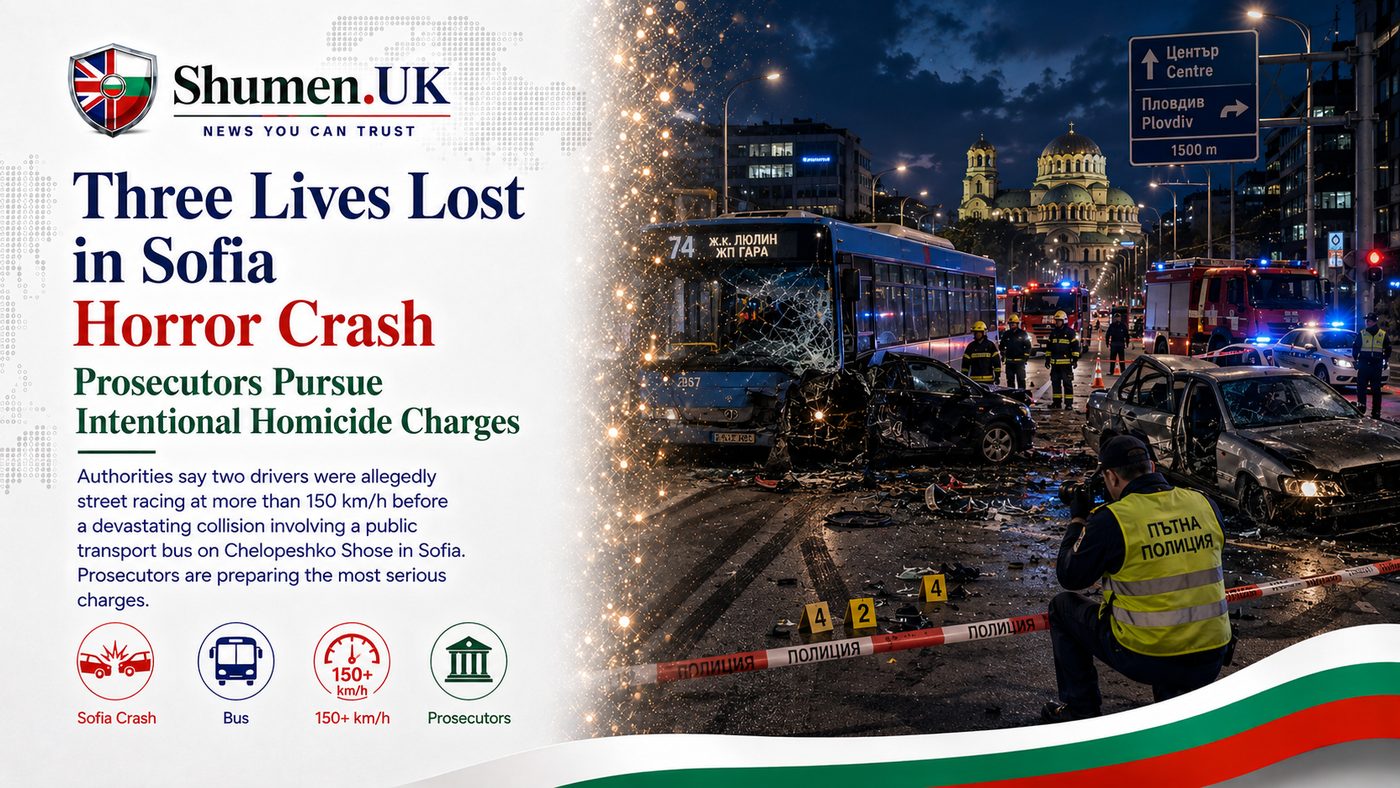
Sofia City Prosecutor's Office is preparing the heaviest possible charges against two drivers who, investigators say, turned Chelopeshko Shose into a racecourse on the evening of 5 June 2026. The result was three deaths, a public transport bus flipped onto its side, and one car burning on the roadway. Anyone who's waited for the Number 11 bus along that stretch will know how busy it gets in the early evening.
Prosecutors intend to charge both men with causing death in a traffic accident with intent. The allegation is that they organised an illegal street race and were travelling at speeds exceeding 150 km/h when the collision occurred.
What Happened on Chelopeshko Shose
According to Deputy City Prosecutor Angel Kanev, the two cars were chasing each other. One vehicle struck the bus with such force that it pushed the vehicle sideways and overturned it. There was no visible braking distance at the scene.
"At this point, the drivers of the two cars are definitely at fault," Kanev said. "The driver of the public transport bus is definitely not at fault and did what was necessary to prevent the traffic accident."
One of the vehicles caught fire immediately after impact. Had firefighters from the Kremikovtsi station arrived one minute later, Kanev said, the fire could have spread to the overturned bus, potentially killing dozens. The crew extinguished the flames and evacuated trapped passengers from the wreckage. Kanev announced plans to recommend official recognition and awards for the entire team.
Two people died at the scene. A third victim later died at St. Anna University Hospital. According to Novinite.com, the man had sustained a fractured skull, traumatic amputation of one leg, severe pneumothorax, and multiple other injuries. Doctors fought to save him but his condition proved incompatible with survival.
Hospital Response and Injuries
Authorities identified 14 people involved in the crash: three drivers and eleven passengers. Ten ambulances were dispatched. Hospitals across Sofia received multiple casualties.
According to the source report, three young men were admitted to Pirogov University Hospital's Emergency Department. The Military Medical Academy activated emergency protocols and assembled specialist teams. Among the injured were two 15-year-old boys with relatively minor injuries and a seven-year-old child who was examined at Pirogov and discharged.
The Investigation and Licensing Questions
Prosecutors plan to extend the detention of both drivers for 72 hours and will seek permanent custody. Investigators are collecting blood samples, DNA material, and fingerprints from all occupants of both vehicles, according to the source material.
Initial roadside tests returned negative results for alcohol and drugs, but prosecutors ordered further laboratory blood testing because some substances cannot be detected through standard screening devices.
Investigators are also examining conflicting statements about who was driving one of the vehicles. "Two persons from one car were tested because they are arguing about who exactly was driving," Kanev explained.
According to Bulgarian National Television as reported by Novinite.com, both drivers held licences issued in the Czech Republic and had never completed driver training in Bulgaria. Sources indicated one obtained his licence last year, the other two years earlier. Kanev noted that some of the drivers appeared to lack sufficient competence behind the wheel.
Chelopeshko Shose's Reputation
According to the source material, Kremikovtsi District Mayor Liliya Donkova stated that although she had not personally witnessed illegal races in the area, speeding was a common problem. Accidents frequently occur along the entire stretch of Chelopeshko Shose, she said, blaming the road's long straight sections for encouraging dangerous driving. She also highlighted enforcement difficulties: the district has only one patrol car for the entire region.
Following the crash, local authorities intend to submit a new request for raised pedestrian crossings and speed bumps. Residents had previously submitted a petition for a raised crossing at the intersection where the crash occurred, but the proposal was rejected by the transport commission because it did not comply with existing rules.
Road safety expert Diana Rusinova from the European Center for Transport Policies described the crash as evidence of broader institutional failure, criticising insufficient enforcement and questioning the circumstances surrounding the drivers' foreign licences. She also pointed to infrastructure deficiencies near the crash site, including poor visibility, vegetation obstructing signs, and a bus stop located dangerously close to traffic lanes.
Police investigators continue collecting evidence and interviewing witnesses. Chelopeshko Shose was temporarily closed from the Kazichene junction to the exit of the Chelopechene neighbourhood, with traffic redirected through Botunets.
Legal Precedent
The charges being prepared recall another high-speed crash case in Sofia. In April 2026, Sofia City Court sentenced 21-year-old Viktor from the Fakulteta neighbourhood to 20 years in prison under a strict regime and banned him from driving for 23 years. Viktor had struck a public transport bus while driving at more than 165 km/h at the intersection of Vazkresenie Boulevard and Konstantin Velichkov Boulevard, killing a respected physician.
The investigation into the Chelopeshko Shose tragedy remains active. Authorities say they will continue until all circumstances surrounding one of Sofia's deadliest recent road accidents have been fully clarified.
What This Means for British Expats
For British expats driving in Bulgaria, this case underscores the serious legal consequences of traffic offences. Bulgaria takes fatal crashes seriously, particularly those involving illegal racing or reckless driving. The precedent of 20-year sentences demonstrates the courts' approach.
The revelation that both accused drivers held Czech-issued licences without completing Bulgarian driver training raises questions about cross-border licensing standards within the EU. British drivers in Bulgaria should ensure their licences meet all local requirements and understand that enforcement, while sometimes inconsistent, can be severe when accidents occur.
Roads like Chelopeshko Shose, with long straight sections and inadequate enforcement capacity, present real risks. Local knowledge matters: if residents say a road is dangerous, it probably is.