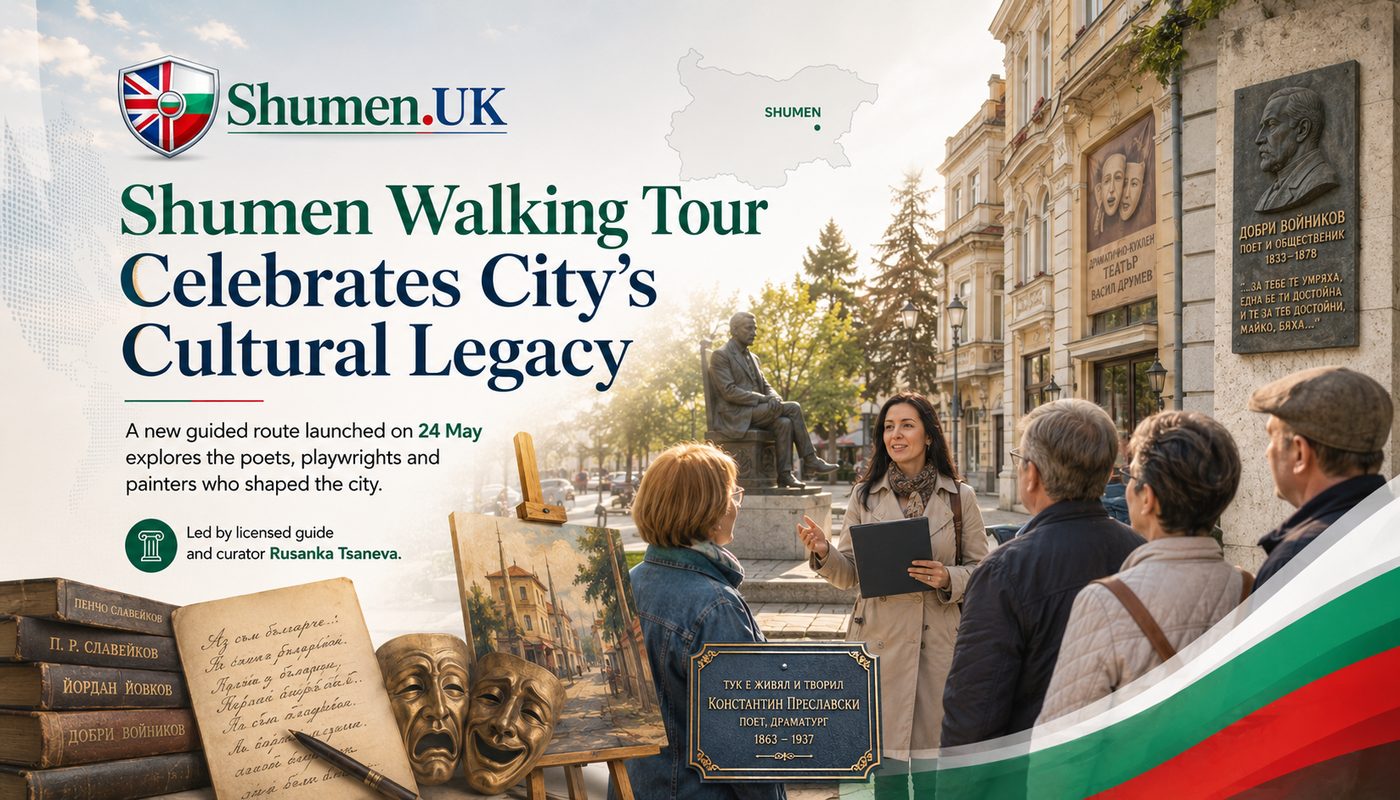
For the British expat or the curious traveller, Shumen often presents itself as a city of monuments and breweries. However, a new initiative from the Municipal Enterprise for Tourism is attempting to peel back the layers of the city’s more delicate cultural skin. On 24 May, a date Bulgarians revere as the Day of Culture and Literacy, a guided pedestrian tour was launched to celebrate the poets, playwrights, and painters who turned this regional hub into a cultural powerhouse.
Led by licensed guide and curator Rusanka Tsaneva, the walk is less a brisk march and more a "deep exploration" of Shumen’s intellectual history.
The Birth of Bulgarian Theatre (With a Caveat)
The tour begins at Dobri Voynikov Square, a location that bears a memorial plaque claiming 1856 as the definitive birth of Bulgarian theatre. While historians might enjoy a spirited debate over precise dates and regional rivalries, for Shumen, this is gospel.
"We can be proud that we have the first Bulgarian production," Tsaneva noted, though she was quick to point out the local irony: despite this early start, Shumen didn't actually have a dedicated theatre building until the late 1950s. The figures at the heart of this movement are:
Dobri Voynikov: The "father of Bulgarian drama." A teacher, musician, and playwright who essentially dragged Bulgarian theatre into the modern era.
Vasil Drumev: A heavyweight of the National Revival. Not only a pioneering playwright but a clergyman and politician who served as Prime Minister.
Beyond the Usual Suspects
While most locals know the names on the street signs, Tsaneva’s goal is to introduce figures that many have heard of but few have actually read. The tour shines a spotlight on Anna Karima, a formidable writer and founder of one of Bulgaria's first equality societies, who fought tirelessly for women’s right to university education.
Another focal point is Stiliyan Chilingirov, often dubbed "the last revivalist." Despite his prolific output of novels and children’s poetry, he remains a somewhat ghostly figure in modern memory, known mostly because the Regional Library bears his name. The tour aims to put some meat on those historical bones.
Practicalities for the British Visitor
While the initiative is a welcome addition to Shumen's tourism portfolio, there are a few "Balkan pragmatisms" to keep in mind.
Schedule & Duration: The source material is delightfully vague on how long the tour actually takes or its full weekly schedule. It is highly recommended that you pop into the Shumen Tourist Information Centre to confirm times before setting off.
Language: As with many regional initiatives, the default language is Bulgarian. British visitors should enquire beforehand whether English-speaking guides are available for specific dates.
Physicality & Safety: There are no specific details regarding crowd management or the physical demands of the route. Expect a standard urban walk, but do enquire if you have specific accessibility requirements.
Why It Matters
For those of us living here, these tours offer more than just facts; they provide the "why" behind the city. Understanding the struggle for a theatre building or the fight for women’s education in the 19th century changes how you view the statues you pass every day. It transforms Shumen from a collection of concrete and stone into a living map of the Bulgarian Enlightenment.
FAQ: Shumen Pedestrian Art Tour
How much does the tour cost?
The tour is currently advertised as free to attend, part of the municipality's drive to promote cultural tourism.
Where exactly does it start?
The meeting point is Dobri Voynikov Square, moving toward the Vasil Drumev Dramatic Theatre.
Is the 1856 theatre date definitely accurate?
It is the date inscribed on the local memorial plaque. However, as with many "firsts" in history, it should be viewed as a point of local pride rather than an undisputed global fact.
How can I find out if there's a tour today?
Since the full schedule isn't published in the primary source, your best bet is to contact the Municipal Enterprise Tourism, Public Events and Attractions in Shumen or visit the Shumen Tourist Information Centre.
Will I need a translator?
Most likely. Unless a specific English-language tour has been arranged, the depth of literary and historical detail provided by the curators is best navigated with a Bulgarian-speaking friend or by checking for English-speaking guide availability in advance.