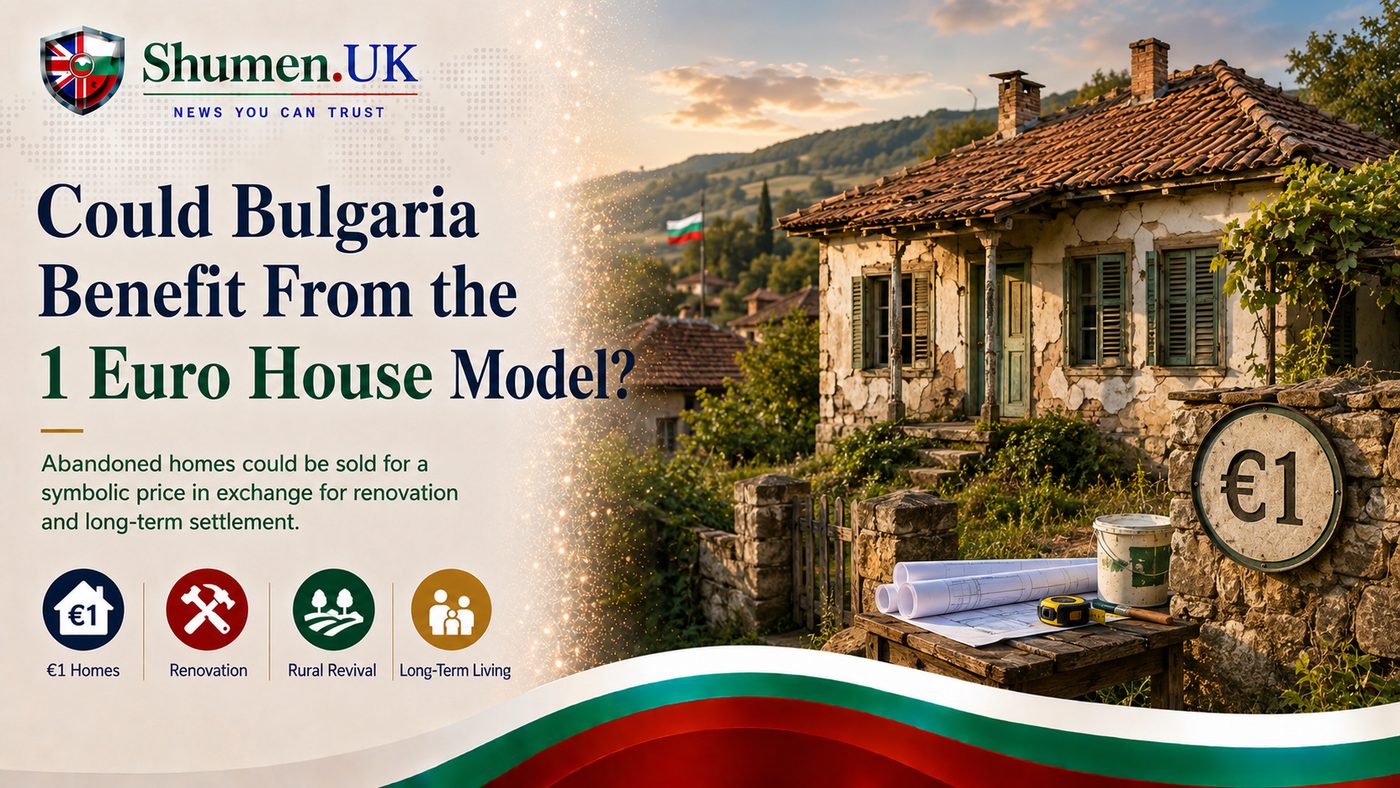
Bulgaria is considering whether the '€1 house' model could help reverse rural depopulation in some of its emptiest regions. The concept is straightforward: local governments sell abandoned properties for a symbolic price, often just one euro, in exchange for buyers committing to renovate the home and settle in the area long term.
It is important to note that this is currently a proposal being discussed by economists and regional planners, not an operational programme. No Bulgarian municipality has officially launched the scheme, and the claimed benefits have not been independently verified through government announcements, case studies, or data from similar European schemes.
The model has appeared in parts of Italy and other European countries facing population decline, though no independent case studies or detailed coverage of successful implementations were found in available sources. Economists and regional planners quoted in a single source report see the scheme as more than a social experiment, arguing it could stimulate demand for construction services, increase employment, generate tax revenue, and encourage tourism and small business development in villages that have been haemorrhaging residents for decades.
For Bulgaria, the model could be particularly relevant in the Rhodope Mountains (a forested mountain range straddling the border with Greece), Northwestern Bulgaria, and Strandzha, where long-term demographic collapse has left many villages with more abandoned houses than occupied ones. Anyone who has driven the potholed roads winding through the Rhodope villages this spring can see why the infrastructure question matters as much as the price on the door.
Renovation Costs Can Be Substantial
The symbolic price hides the actual commitment. According to the source report, buyers must typically invest between €20,000 and €60,000 in renovations, and local governments would be expected to enforce construction deadlines and ownership regulations. These cost estimates and enforcement mechanisms have not been verified through independent Bulgarian government sources or detailed data.
Experts warn that without strict administrative oversight, buyers may fail to complete renovations or meet residency requirements, leaving the initiative symbolic rather than transformative. The optimistic promise of tourists arriving just as the internet finally reaches the village is one thing. The reality of enforcing that infrastructure investment is another.
Infrastructure Remains the Critical Question
Without reliable roads, internet access, healthcare facilities, and public services, even renovated villages may struggle to retain permanent residents. Economists note that the model would only work in Bulgaria if combined with broader regional development policies, including infrastructure investment, tax incentives, and active strategies to attract new populations. These statements have not been independently corroborated outside the single source report.
Analysts suggest the scheme might attract foreign buyers, remote workers, and digital nomads looking for lower living costs and rural lifestyles, potentially turning restored villages into tourism destinations or mixed international communities. Whether that vision survives contact with Bulgarian village roads in February remains to be seen.
What This Means for British Expats
British nationals considering rural property investment or relocation as remote workers should be aware that the '€1 house' model is not a shortcut to cheap Bulgarian living. The renovation costs are real, the infrastructure gaps are real, and the administrative enforcement mechanisms are still untested in Bulgaria. The scheme may offer genuine opportunities for those prepared to commit significant time and capital to a long-term project, but it is currently only a proposal, not an operational programme.
For British expats already living in Bulgaria, the initiative reflects the country's ongoing struggle with rural depopulation and may create new travel destinations in restored villages if the model succeeds. For now, though, it remains a concept rather than a functioning scheme.
The Proposal Remains Speculative
While the model may appear to offer a simple solution to rural decline, its long-term success ultimately depends on whether abandoned areas can be transformed into sustainable local economies rather than symbolic real estate projects. That transformation, in turn, depends on infrastructure investment and administrative capacity that remain uncertain. All claims about the model's benefits, costs, and regional relevance derive from a single source and have not been verified by external reports or official government data.