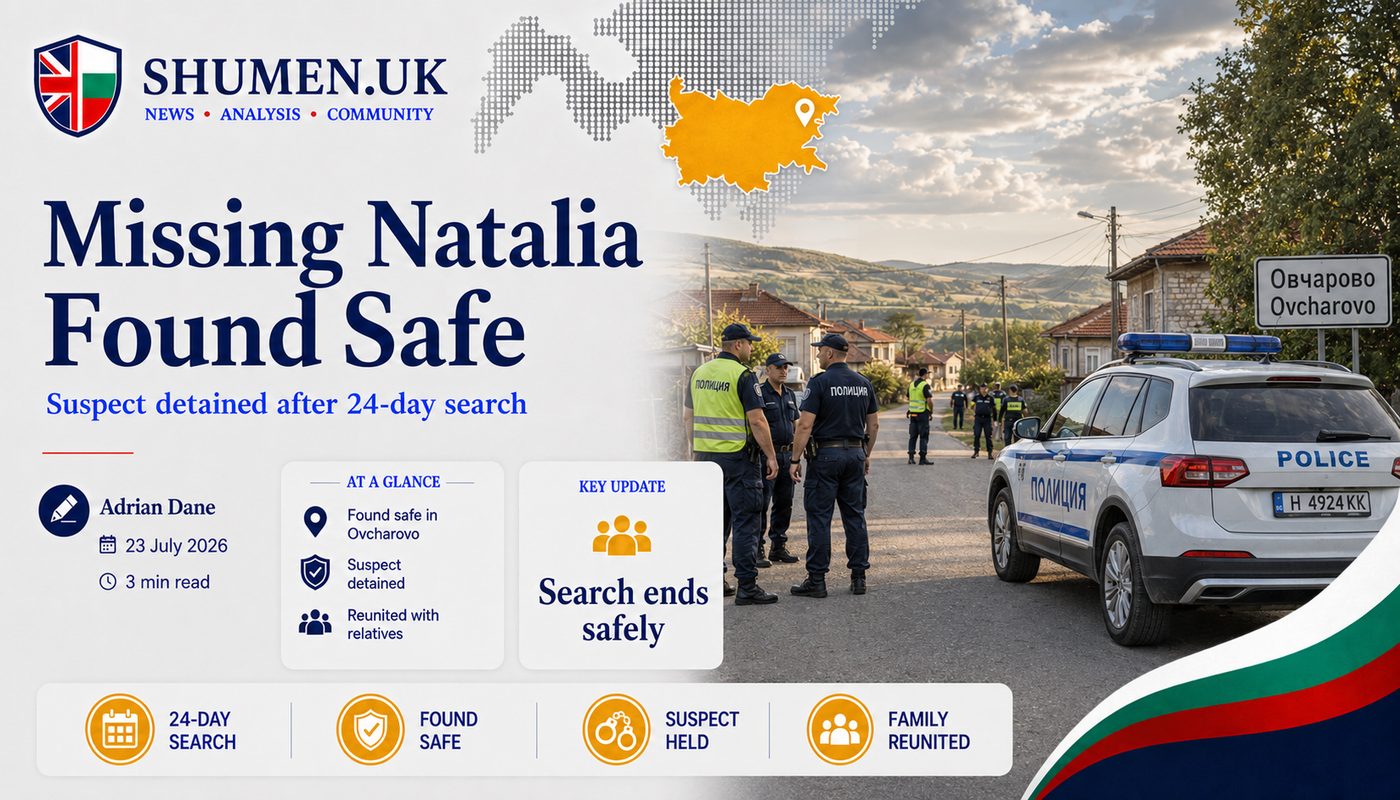
Eleven-year-old Natalia, missing for 24 days after allegedly being abducted by her stepfather, was found safe shortly after midnight on Thursday in the village of Ovcharovo in the Shumen region. The suspect, 40-year-old Asen Simeonov, was detained roughly 50 metres away as he allegedly attempted to break into a commercial premises in the village.
Interior Minister Ivan Demerdzhiev announced the find on Facebook, thanking Interior Ministry staff, volunteers and local authorities for their part in the search. "Natalia is safe and her relatives hugged her. The efforts paid off," he wrote. "When we act as one, success is a fact."
Natalia has already been reunited with some of her relatives and was found to be in good overall physical condition when medical staff examined her. She remains under police protection while specialists complete a medical and psychological assessment before she is fully reunited with her family.
A Search That Ended Metres From Where It Started
The operation concluded when officers carrying out covert surveillance in Ovcharovo spotted Simeonov walking through the village shortly after midnight. Police from the regional directorates in Shumen and Varna carried out the arrest.
Senior Commissioner Georgi Gendov, head of the Shumen Regional Directorate of the Interior Ministry, said Simeonov was detained at around 12:10am while allegedly attempting to break into a commercial establishment. "The wanted Asen Simeonov was located and detained minutes after midnight," Gendov said. "Immediately after his detention, about 50 metres away, Natalia was found."
Junior Police Inspector Yordan Kairyakov, who took part in the operation, said the suspect did not resist arrest. "We asked him where Natalia was and he said she was nearby. About 50 metres away, near some bushes, Natalia was found with two backpacks," he said.
Twenty-Four Days Between Konstantinovo and Ovcharovo
Natalia disappeared in the early hours of 30 June from Konstantinovo, a village in the Varna region. According to her mother, Simeonov assaulted and tied her up before forcing the girl to leave with him under threats. Relatives said he had previously cared for Natalia but had become aggressive after drinking.
The search grew into one of Bulgaria's largest recent operations. The national AMBER Alert system was activated on 1 July, followed by BG-Alert notifications sent to phones in three regions on 3 July. Police, state institutions and hundreds of volunteers combed an area stretching roughly 100 kilometres across the municipalities of Varna, Dalgopol, Dolni Chiflik and Provadia. For three weeks the case dominated conversation in kafenes and Facebook groups across the search area; by Wednesday night, most people following it had resigned themselves to a long wait for any confirmed trace, which made the overnight breakthrough all the more abrupt.
Police believe Simeonov spent much of the three weeks hiding in sunflower and corn fields and moving along the Varna to Sofia railway line to avoid detection. Investigators have also linked him to several thefts and robberies committed while he was on the run.
What Happens Next
Commissioner Gendov said Simeonov claimed his motives were personal and likely connected to his relationship with Natalia's mother. He is expected to be transferred to the Regional Directorate of the Interior Ministry in Varna as the investigation continues. Authorities said Simeonov has been known to police since 2016 and has committed 13 crimes in the Shumen region.
Natalia's half-sister, Petya, was among the first family members to see her. "The moment she saw me, she started crying. We calmed down. She's fine. She's apparently fine," she said. Petya added that she noticed no visible injuries and that Natalia told her they had travelled on foot before reaching the village where they were found.
What This Means for British Families in the Area
Ovcharovo sits within the wider Shumen region, this site's home patch, which is why a case that began 100 kilometres away in Varna province ended up closed out by Shumen police. For British parents and grandparents settled in the villages between Varna and Shumen, the practical takeaway is the alert system itself. BG-Alert is Bulgaria's EU-mandated cell broadcast system: when activated for a missing child or another civil emergency, it pushes a message directly to phones in the affected area, in Bulgarian, reaching compatible handsets on any network within that area. It is worth knowing what that message looks like on your handset before the day it matters, rather than mistaking it for spam.
There is also a resource worth knowing before it is needed rather than after. Bulgaria's missing-children line runs on 116 000, the same harmonised number used for this purpose across the EU. It is free to call from any Bulgarian number and staffed around the clock, and it exists for exactly the situation the Natalia case began with: a family who does not yet know which office to call first. It sits alongside, not instead of, the AMBER Alert and BG-Alert mechanisms already covered here. 116 000 is where a family or a concerned neighbour starts a report, and the broadcast systems are how the search then reaches everyone else.
The case now moves into Bulgaria's pre-trial process, which typically means a detention hearing before a regional court within days of an arrest. Anyone who has needed a solicitor for a Bulgarian criminal or family matter, including custody disputes, will recognise the next steps; the legal guide covers how instructing a Bulgarian advokat works for residents unfamiliar with the system.
Investigators have not disclosed further detail on the medical and psychological assessment now under way, and Novinite's report of 23 July, on which this account draws, does not say when a full family reunion is expected.