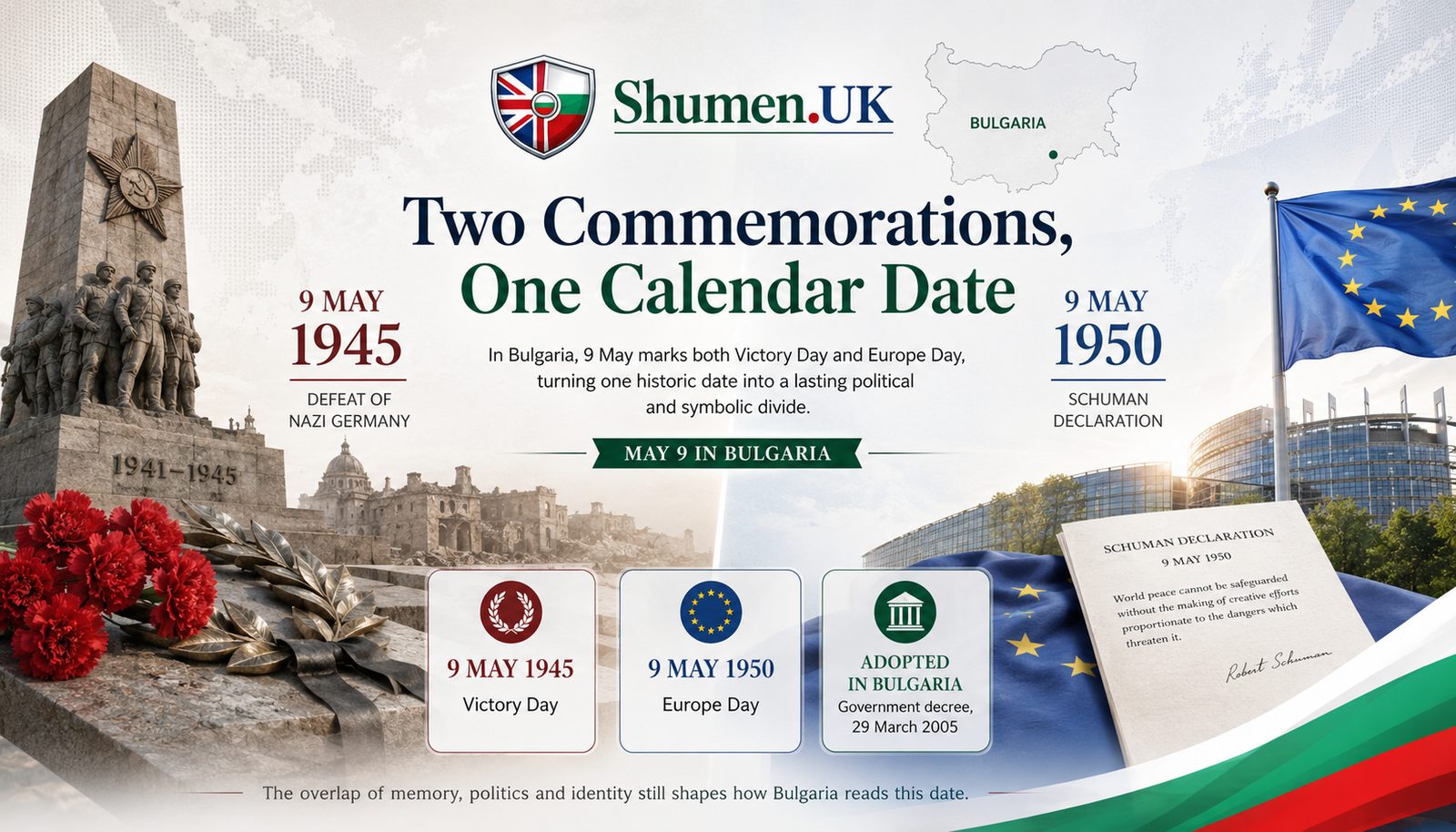
Two Commemorations, One Calendar Date
May 9 in Bulgaria is a day of double vision. For some, it is Victory Day, marking the defeat of Nazi Germany in 1945. For others, it is Europe Day, celebrating the peace and unity born from the ashes of war. The dates are not accidental: the idea of a united Europe emerged directly from the Second World War's devastation. But in Bulgaria, the overlap has long ceased to be a historical curiosity and become a political fault line.
On 9 May 1945, in the Berlin suburb of Karlshorst, Nazi Germany signed its second and final capitulation, ending hostilities in Europe. For the Soviet Union and its allies, the date became an official holiday, celebrated with military parades and nationwide rejoicing. Post-war Bulgaria followed suit.
Five years later, on 9 May 1950, French Foreign Minister Robert Schuman proposed the creation of the European Coal and Steel Community, pooling strategic resources to make war "not only unthinkable but materially impossible". The Schuman Declaration laid the foundations of today's European Union. In 1985, EU leaders designated May 9 as Europe Day, and Bulgaria officially adopted it by government decree on 29 March 2005, shortly before signing its accession treaty.
Unlike Western Europe, where Europe Day has largely displaced the military commemoration, Bulgaria has no common reading of what the date means. The political classes are split, and the symbolism cuts deep.
A Complicated History
Bulgaria's position complicates the narrative. Although initially an ally of the Third Reich, the country switched sides after the coup of 9 September 1944, and its army took part in the final phase of the war against Nazism. The 1947 Paris Peace Treaty, however, treated Bulgaria as a defeated nation, a fact that still fuels disputes over whether May 9 is even "our" victory.
In contemporary politics, Victory Day is tied to Russophile sentiment and nostalgia for the Soviet era. Pro-Russian organisations stage Immortal Regiment marches, while Russia's embassy and cultural centres promote the narrative of the Red Army as liberator. Officials accuse Bulgarian authorities of "reformatting" the holiday, a charge that carries weight in certain circles.
On the other side, Euro-Atlantic-oriented politicians and citizens raise the EU flag and stress that the true victory is the peace and unification that followed. In 2015, President Rosen Plevneliev declined the invitation to the Moscow parade in order to attend a conference in Poland, a decision that was symbolic as much as diplomatic.
The Political Battleground
The division is not only historical. It is a convenient tool for political mobilisation. Political analysts Parvan Simeonov and Strahil Deliyski note that the polarised groups are vocal minorities, yet they set the agenda in the media and institutions. The majority of Bulgarians do not need this type of polarisation to define themselves. Economic inequalities, the analysts suggest, are often "packaged" in cultural-identity frames, making society susceptible to division.
Precise public opinion data on how Bulgarians feel about May 9 commemorations is not readily available, but the pattern is clear: loud voices on both sides dominate the public sphere, while most people get on with their lives.
Russia's war in Ukraine has sharpened the contradictions further. The symbolism of May 9 has become an even hotter front. Honouring the historical victory can easily be interpreted as support for contemporary Russian aggression. Celebrating Europe Day can be read as a rejection of one's own history. It is an uncomfortable tightrope, and few seem interested in walking it.
Toward Reconciliation
The two dates are inextricably linked. Without the victory over Nazism, there would have been no ground for the European project. As presidents and politicians often say: "If there had been no May 9, 1945, there would be no May 9, 1950." It is a convenient phrase, though not everyone agrees on what it means in practice.
The challenge facing Bulgarian society is to develop a nuanced mindset that allows the war's victims to be honoured without turning that commemoration into a tool for modern-day propaganda. Only then can May 9 become a day of reconciliation rather than division.
What This Means for British Expats
For British expats in Bulgaria, the date offers a window into the country's unresolved identity debates. The holiday's contested meanings reflect broader tensions over Bulgaria's place between East and West, tensions that shape everything from daily politics to cultural life.
If you are in Bulgaria on May 9, you may encounter very different public moods depending on where you are and who you are with. Some gatherings will emphasise Soviet-era memory and the Red Army's role. Others will stress European unity and the peace that followed the war. Both are part of Bulgaria's story, even if the two narratives rarely meet.
Understanding why May 9 still divides Bulgarians helps make sense of a country still negotiating its history. It is not a question that will be resolved quickly, and it is one that touches on how Bulgaria sees itself, and how it relates to both Russia and the West. For British people living here, that context is worth knowing.