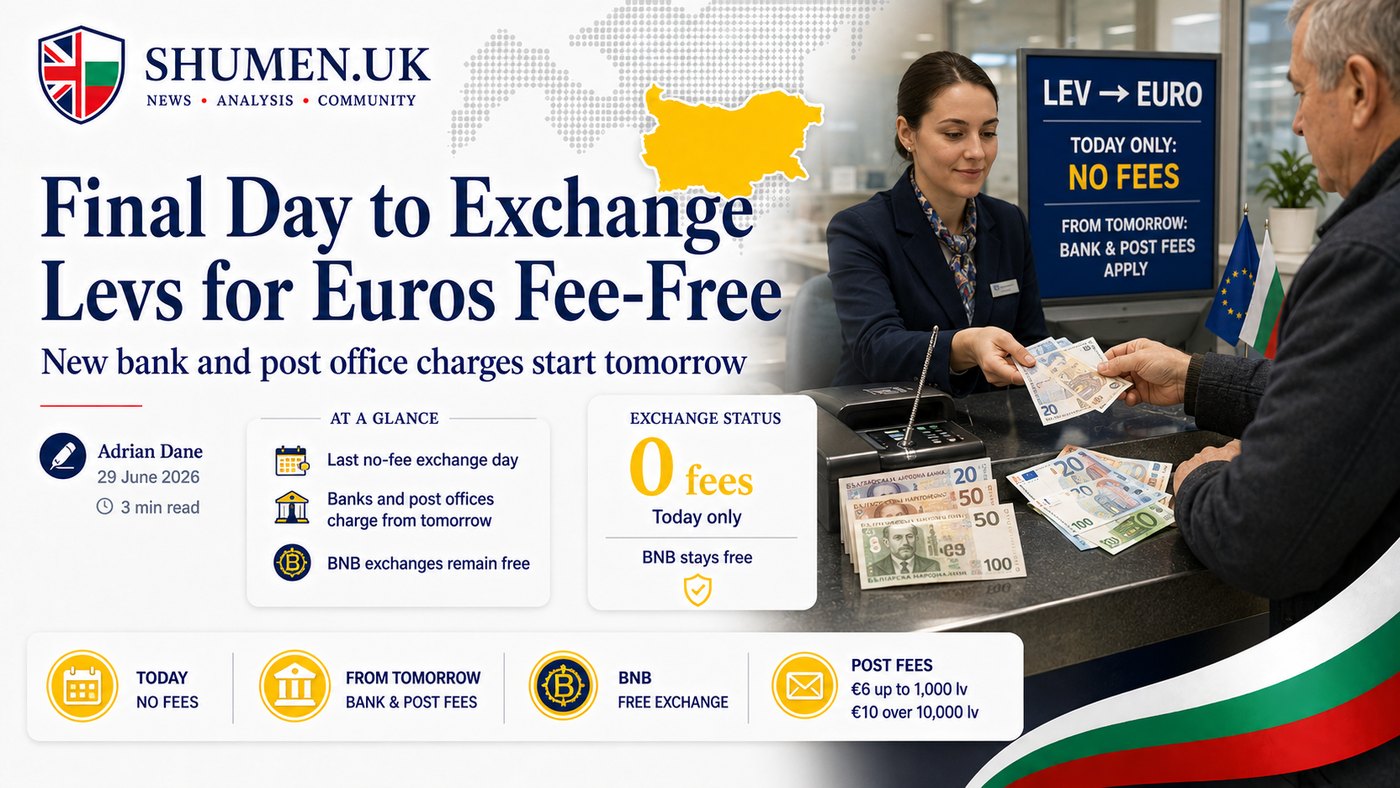
Today is the last day British expats and everyone else in Bulgaria can swap leftover leva for euros without paying a fee. From tomorrow, 1 July, commercial banks and Bulgarian Post both start charging for the service, and only the Bulgarian National Bank (BNB) will keep exchanging cash free of charge, with no limit and no end date.
The change closes the generous phase of the euro changeover. Bulgaria adopted the euro on 1 January 2026 and the lev stopped being legal tender, but cash does not vanish overnight: households have spent the first half of the year carting old banknotes and coins to the counter. From tomorrow that errand costs money almost everywhere it is convenient to do it.
What the fees actually are
Bulgarian Post has published a flat tariff. Exchanging up to 1,000 leva (about €511 at the fixed rate of 1.95583 leva to the euro) will cost 6 euros, and the largest transactions, those above 10,000 leva (about €5,113), will cost 10 euros. Commercial banks have not been handed a single national figure: each will apply the fees set under its own pricing policy, so what you pay depends on which bank you walk into.
The one institution holding the old deal open is the BNB, which will go on exchanging any amount, free, indefinitely. Plamen Minchev, who runs the post office in the village of Gradevo in the Blagoevgrad region, was keen to stress that local branches will still have cash on hand after the deadline. "Without a prior request, amounts up to 1,000 leva can be exchanged," he said, adding that tourists are also welcome. The fee, though, applies from tomorrow regardless of how smoothly the counter runs.
Most of the leva are already in. A stubborn slice is not
Roughly 93% of the leva that were in circulation had been handed back by May, according to the latest official figures. That still leaves around 2 billion leva, on the order of €1.02 billion, sitting outside the BNB's reserves: in drawers, in safes, in the backs of wardrobes, and in the small change nobody bothered to bank.
Minchev's account of the campaign matches what anyone who queued in January saw. "It was extremely busy in January. February and March were also very busy," he said. "After that, interest calmed down and remained at a relatively constant level until the end of the period." In the final week, he noted, some people were still swapping large sums, 8,000 to 9,000 leva (roughly €4,090 to €4,600) in places, while the steady traffic stayed at amounts up to 1,000 leva.
The flat fee bites the small swappers hardest
There is a quiet sting in the new tariff that the announcement does not spell out. Because the post office fee is a flat 6 euros rather than a percentage, it barely registers on a 1,000-leva swap (around 1.2% of the value) but turns punishing on a small one. Hand over a coffee tin of coins worth 40 or 50 leva and the 6 euro charge can swallow a fifth or more of what you came in with.
That matters because of the very trend Minchev singled out. "It is striking that people are increasingly bringing small denomination banknotes and coins for exchange," he said. The people most likely to be caught by the flat fee from tomorrow are exactly the ones now turning up with handfuls of stotinki. Anyone who still keeps a jar of coins on the kitchen windowsill, and plenty of households quietly do, has until the post office shuts this evening to turn them into euros for nothing.
What This Means for British Expats
If you have a stash of old leva, a holiday float, a property deposit you kept in cash, or simply the coins that never made it to the bank, today is the cheap day to deal with it. After tonight your options narrow to three:
- The BNB, which stays free and unlimited but runs from far fewer counters than the commercial banks or the post network, so it is only convenient if you live near one or are willing to make the trip.
- Your commercial bank, which will charge a fee set by its own pricing policy, so it is worth asking what that fee is before you hand anything over.
- Bulgarian Post, at the fixed 6 to 10 euro tariff above, which stays the practical option in towns and villages without a bank branch.
None of this is a deadline to panic over. The leva do not expire tomorrow, and the BNB route never closes. But the free, walk-in convenience of doing it at your local bank or post office ends today, and for small amounts the flat fee can cost more than the change is worth. Our money and euro changeover guide tracks the practical detail of the switch as the rules settle.
One reassuring note from Blagoevgrad: despite the volume of cash processed, authorities reported no counterfeit banknotes detected in the region during the campaign.