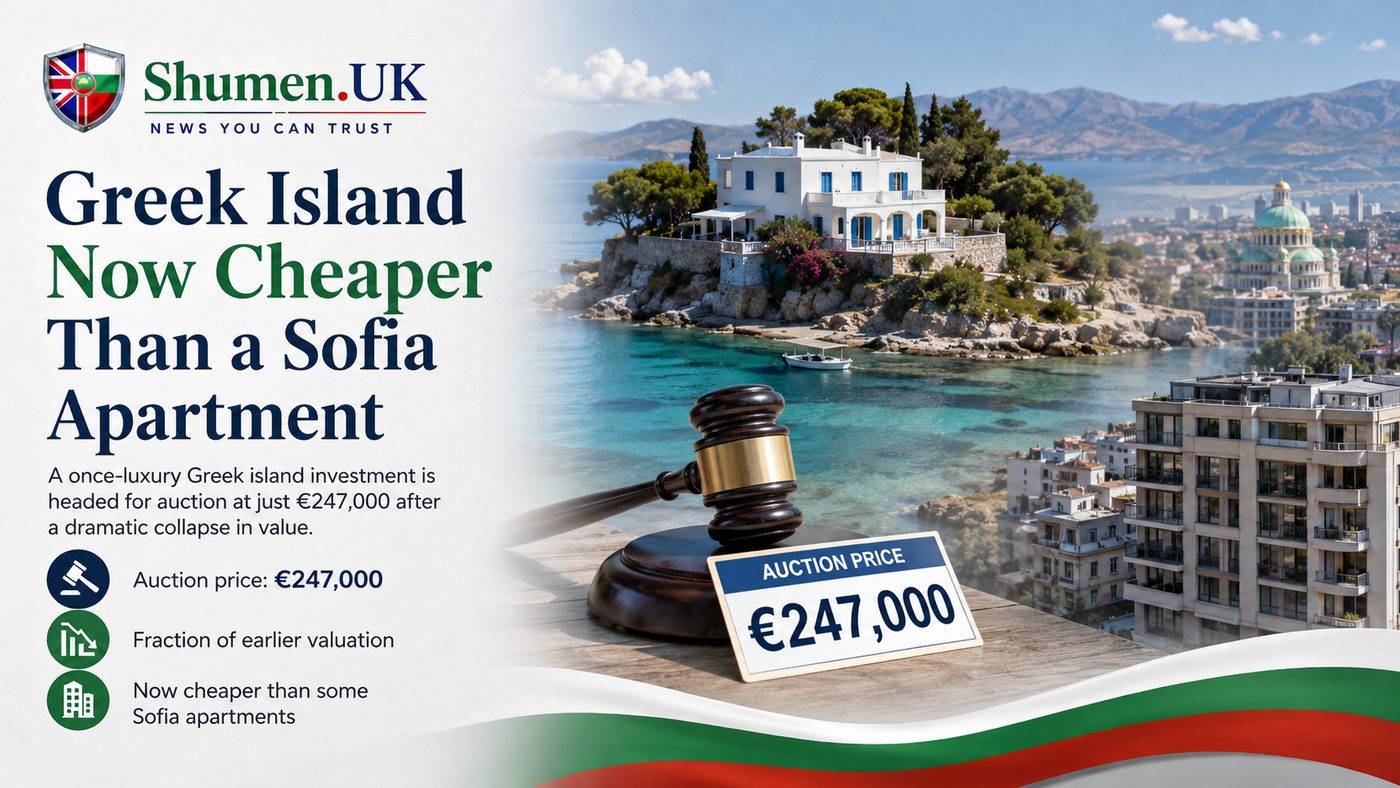
A small Greek island once marketed to international buyers as a high-end development opportunity is headed for auction on 13 November 2026 at a starting price of €247,000. The figure is a fraction of its earlier €8 million valuation, and the collapse is driven entirely by EU environmental protections that prevent most commercial construction.
Makri, part of the Echinades archipelago in the Ionian Sea, was previously promoted by real estate agencies as a prime site for a five-star resort and private villas. That pitch has proven unsellable. According to Greek Reporter, the island is now offered at a starting price comparable to a modest apartment in Sofia or a small residential property in Athens, though this comparison has not been independently verified against current market data.
Why the Price Collapsed
The steep drop reflects strict environmental regulations rather than a sudden loss of appeal. A significant portion of Makri is designated as private forest and falls within a Natura 2000 protected zone.
Natura 2000 is an EU-wide network of protected areas established to conserve habitats and species. Properties within these zones face legally binding restrictions on construction and land use to preserve biodiversity. These rules apply across all member states and take precedence over private development plans, regardless of ownership or funding. The regulations are complex, strictly enforced, and carry serious penalties for non-compliance.
Under these restrictions, large-scale construction such as hotels or resort complexes is not permitted. The land can be used mainly for light agriculture or limited recreational purposes, with activities tightly regulated and subject to ongoing oversight. What was once marketed as a luxury investment has been reduced to an island where building options are minimal and commercial development is effectively impossible.
It's a stark illustration of how environmental policy can override commercial aspirations, however well-funded or enthusiastically promoted.
Previous Sale Attempts Failed
Earlier attempts to sell the island at higher prices, including an offer around €1.5 million, failed to attract buyers. The drastically reduced starting price reflects a forced reassessment of what the land can legally support, and quite possibly a seller keen to cut losses and move on.
Makri itself is less than one square kilometre in size, rising to a maximum elevation of 126 metres. Remnants of three small structures remain on the island: a chapel, a water cistern, and a modest house.
What This Means for British Expats
The comparison to Sofia property prices carries particular weight given recent housing affordability pressures in Bulgaria's capital. According to data from the European Trade Union Confederation and Eurostat, Sofia ranks among Europe's least affordable capitals for minimum wage earners, with rents rising nearly 10% in 2025 alone.
For British expats in Bulgaria or Greece considering property investments, the Makri case demonstrates how EU environmental policy can drastically affect real estate value and investment viability. Protected area designations under Natura 2000 are binding across member states and carry far more weight than any marketing brochure. Understanding these restrictions, and their practical implications for permitted land use, is essential for anyone weighing cross-border property decisions within the EU.
The former marketing of Makri as a luxury investment site, despite known environmental restrictions, highlights the gap between promotional material and regulatory reality. The auction outcome will reveal whether buyers see value in acquiring protected land with minimal development rights, or whether even this heavily discounted price fails to attract interest.
British buyers should approach such opportunities with careful due diligence on what can actually be built, not what promotional materials suggest might be possible. The regulatory constraints are real, legally enforceable, and not subject to negotiation.
The island belongs to the same archipelago as Oxeia, which was reportedly purchased by a Qatari royal figure (exact ownership details have not been independently confirmed). Local mythology links the Echinades islands to ancient legends, while the surrounding waters are associated with the historic Battle of Lepanto in 1571.