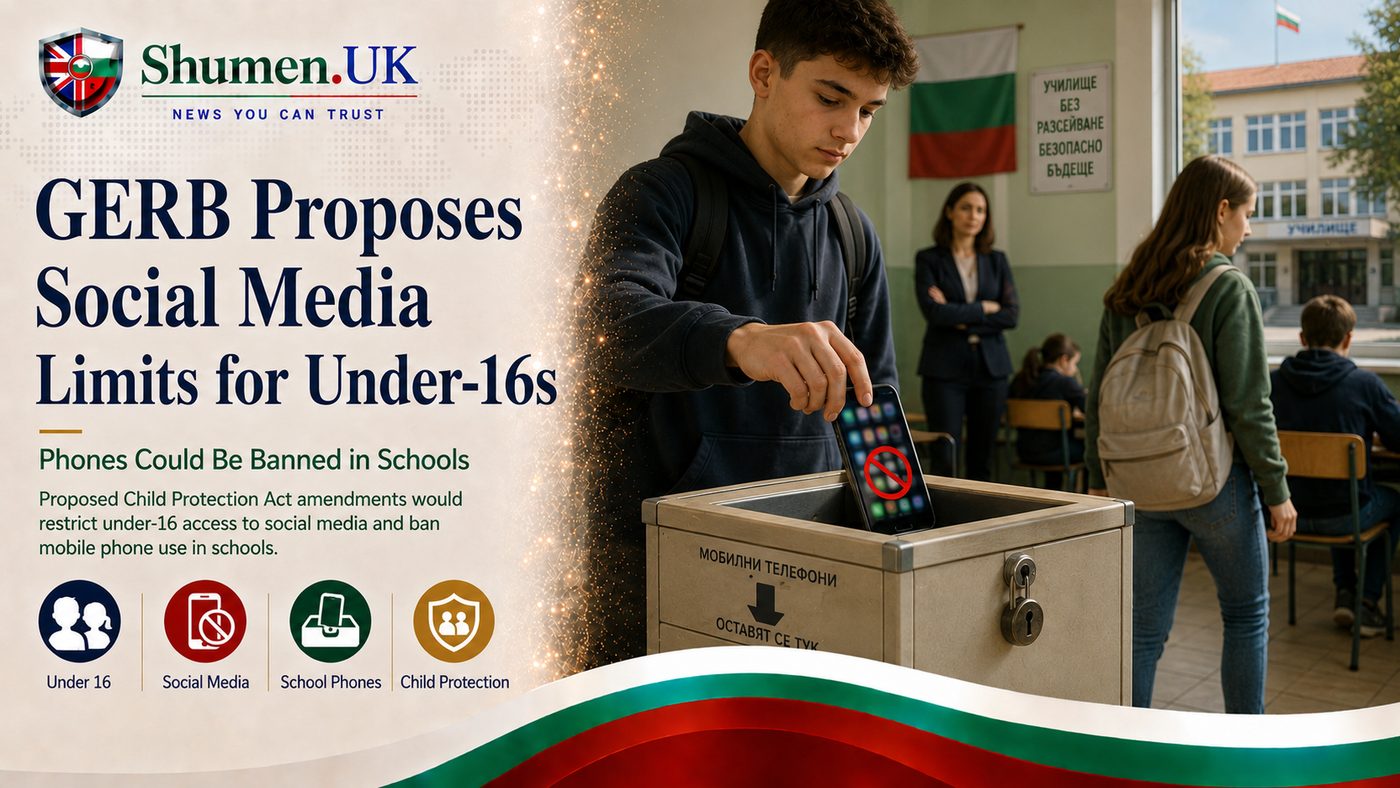
Bulgaria's ruling party GERB has proposed a sweeping overhaul of children's digital access, tabling amendments on 27 May 2026 that would restrict social media for under-16s and ban mobile phones in schools outright. The proposals, submitted to the National Assembly as changes to the Child Protection Act, are the most restrictive measures yet floated in Bulgaria on children's internet use and mark a sharp regulatory turn on technology in classrooms.
By Monday afternoon, the queue of parents outside Sofia's 27th School was buzzing about the new phone ban, some relieved, others dubious about enforcement. One British mother collecting her 14-year-old daughter summed it up: "We've been trying to get her off Instagram for months. If the law does it for us, fine. But good luck to the teachers policing this."
What GERB Is Proposing
The age restriction would apply to social media platforms and video-sharing sites. Access for children under 16 would be gated by age-verification technology permitting anonymous confirmation of a user's age during registration. Children aged between 13 and 16 could still access platforms, but only with explicit parental or guardian consent (according to GERB's proposal, this consent can be withdrawn at any time, though the mechanism has not been independently verified). The party cites growing evidence of negative effects on mental health, concentration, sleep, and developmental outcomes, alongside rising dependence on digital content among young people.
GERB's proposal states that the Minister of Innovation and Digital Transformation would issue enforcement regulations within six months of adoption, though this procedural detail has not been independently corroborated beyond the party's announcement. The practicalities of anonymous age verification remain contested internationally. Indonesia introduced a similar measure in early 2026, prompting technical and privacy complaints from both platforms and civil-society groups. Gabon instituted social-media age verification for under-16s in April 2026, though reports on its effectiveness have been limited.
The School Phone Ban
The second half of GERB's proposal is a blanket ban on mobile phones in schools. The party argues that smartphones lead to distraction, reduced concentration, and poorer educational outcomes, citing "a number of studies" without naming them directly. The wording mirrors concerns aired by education authorities across Europe. France banned phones in primary and middle schools in 2018, extended to some secondary schools in 2023. The Netherlands introduced a partial ban in January 2024, with schools permitted to set their own policies. The UK government issued non-binding guidance in February 2024 recommending phone-free school days but left enforcement to individual heads.
No detail has been provided on how GERB's school ban would be enforced in practice, whether it would extend to teachers and administrative staff, or what sanctions would apply to non-compliance. The proposal does not address smartwatches, tablets, or laptops, all of which are now common in Bulgarian classrooms for digital-learning programmes. It is not yet clear whether enforcement responsibilities would fall to head teachers, the Ministry of Education, or some combination of both.
What This Means for British Expats
British families with school-age children in Bulgaria would face immediate practical consequences if the amendments pass. Parents accustomed to coordinating school pick-ups or extracurricular schedules via WhatsApp or Messenger would need alternative arrangements. Children aged 13 to 16 currently active on Instagram, TikTok, or YouTube would require explicit parental re-consent under the new framework, assuming the platforms build the Bulgarian verification mechanism in the first place.
The social-media restriction applies to platforms, not to devices. A 15-year-old British child living in Bulgaria could still use a smartphone for calls, messaging apps not classified as social media, and offline functions. The practical boundary between a messaging app and a social network remains undefined in GERB's proposal. Signal, Telegram, and Discord all have social-sharing features but are not universally classified as social media under existing EU definitions.
The school phone ban, if enacted, would affect British international schools in Sofia, Plovdiv, and Varna alongside Bulgarian state schools. Most British international schools in Bulgaria currently permit phones on campus but require them to be switched off during lessons. A full ban would align Bulgaria with stricter European precedents but represents a significant shift from the permissive policies most Bulgarian schools have followed since the mid-2010s. Whether British international schools would face the same enforcement regime as Bulgarian state schools, and whether exemptions or special guidance might apply, has not been clarified.
How the Verification Would Work (In Theory)
GERB's proposal envisages creating a register of all social media platforms operating in Bulgaria, with oversight mechanisms and what the party describes as "significant penalties" for companies that fail to introduce or comply with the new requirements (the scale of those penalties and the mechanics of the register have not yet been disclosed).
The anonymous age verification GERB proposes sounds reassuring, but the technical reality is more complicated. Age verification typically involves government ID, facial estimation, or credit-card validation, all of which raise privacy concerns. If platforms do not store identity data after the check, the mechanism must still involve a trusted intermediary with access to that data during verification. Who that intermediary would be, how data protection would be assured, and whether the system would comply with GDPR are all unspecified. Bulgarian authorities have not yet published any technical specifications or privacy safeguards for the proposed system.
European digital-rights groups have repeatedly warned that age-verification systems create honeypots of sensitive personal data. A breach at a third-party verification provider could expose the identities of millions of children and their parents.
What Happens Next
The amendments are now before the National Assembly. GERB holds 69 seats in the 240-seat chamber and governs in coalition with the Union of Democratic Forces as part of the GERB-SDS alliance. The proposal would require a simple majority to pass at first reading, then a second vote after committee scrutiny. No timeline for parliamentary debate has been announced, so the measures' actual enactment and enforcement dates remain uncertain. Opposition parties have not yet issued formal responses, though Progressive Bulgaria and Continue the Change have historically backed digital-safety measures for children while expressing caution over enforcement mechanisms that could compromise privacy.
If the law passes, platforms operating in Bulgaria (including Meta's Facebook and Instagram, ByteDance's TikTok, and Alphabet's YouTube) would face a choice between building Bulgaria-specific age-verification systems or withdrawing services from users under 16 in the country. The latter has not happened in any EU member state to date, but the regulatory precedent does not yet exist for a national age gate of this kind within the single market.
The European Commission has not commented on whether GERB's proposal would conflict with the Digital Services Act or the EU's broader framework for online platforms. Similar national measures in France and the Netherlands have proceeded without Commission objection, though neither has yet implemented technical verification at the point of registration. Bulgaria's proposal, if enacted as written, would be the first in the EU to mandate anonymous age verification at the platform level rather than relying on user declarations or post-registration checks.
Research Gaps and Enforcement Unknowns
GERB's justification rests on claims about smartphone harm and social-media dependence. The party's press release references "a number of studies" and "increasingly serious negative effects" without citing specific research (this evidence remains attributed to GERB's claims and general studies, but independent corroboration and named studies are absent). Academic literature on screen time and adolescent mental health is extensive but contested. Longitudinal studies from the UK, US, and Nordic countries show associations between heavy social-media use and self-reported anxiety or sleep disruption, but causation remains difficult to establish and effect sizes are often small once confounding variables are controlled for.
The school phone ban carries its own unknowns. Bulgaria's education system has embraced digital tools unevenly. Urban schools in Sofia and Plovdiv have invested in tablets and interactive whiteboards, rural schools often lack reliable internet. A blanket phone ban could disrupt digital-learning pilots without addressing the underlying inequalities in technology access. Teachers' unions have not yet commented publicly, though informal reports from Bulgarian education forums suggest mixed views, with some teachers welcoming reduced classroom distraction and others warning that enforcement would fall unevenly on already stretched staff.
For British expats weighing a move to Bulgaria or currently resident with school-age children, GERB's proposal represents a clear if still theoretical shift in how children's digital lives would be regulated. The measures align Bulgaria more closely with France's restrictive approach and further from the UK's lighter-touch guidance model. Whether the amendments pass, and in what form, will determine whether that shift is rhetorical or binding.