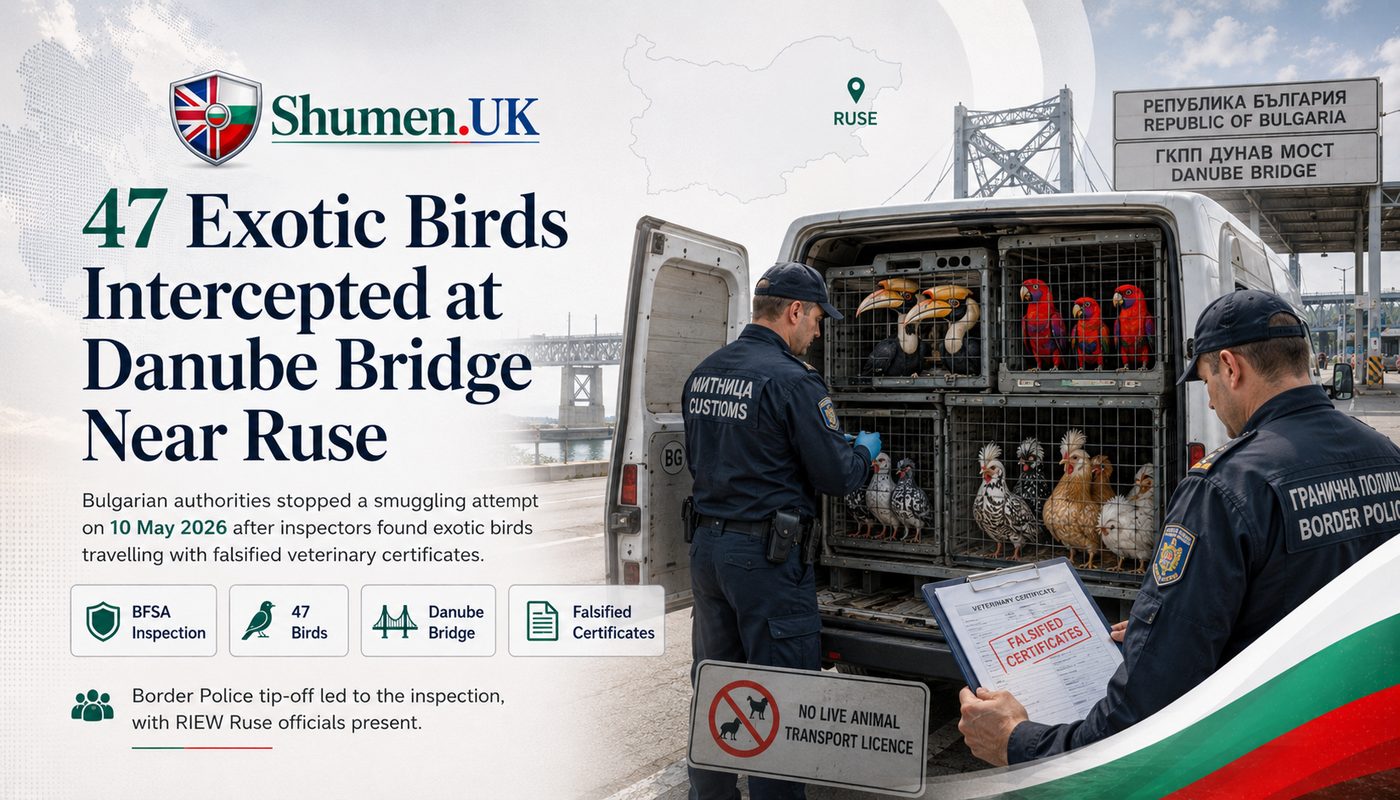
Seizure at the Border
Bulgarian authorities intercepted 47 exotic birds with falsified veterinary certificates at the Danube Bridge near Ruse on 10 May 2026. The Bulgarian Food Safety Agency (BFSA) stopped the smuggling attempt following a tip-off from Border Police, with officials from the Regional Inspectorate of Environment and Water (RIEW) in Ruse present during the inspection.
The birds were travelling in a van registered in Targovishte, northeast Bulgaria. The vehicle had no licence for transporting live animals. Inside, inspectors found 11 pairs of Blyth's hornbills (Rhyticeros plicatus), eight cardinal lories (Chalcopsitta cardinalis), 13 decorative pigeons, and four ornamental chickens.
Both the hornbill and lory species are subject to strict transport controls under the Convention on International Trade in Endangered Species (CITES), an international treaty regulating cross-border movement of threatened wildlife. The driver, a Bulgarian national, failed to produce the required registration documents or valid health certificates.
The Route and the Suspected Network
Investigators established that the birds had entered Bulgaria from Turkey, were transferred in a village near Shumen, and were being driven to multiple destinations in Central Europe. Authorities believe this may be part of a wider smuggling network and that the seized birds could represent only a portion of a larger shipment, though this remains under investigation and has not been confirmed.
The cargo's total value is estimated by authorities at several hundred thousand euros. A single Blyth's hornbill reportedly sells for around €10,000, while a breeding pair can exceed €25,000. These are estimated market values and can vary.
Where the Birds Are Now
The confiscated animals were taken to the Nature and Animals Protection Centre in Dobrich, northeast Bulgaria. Staff have fed the birds and report they are currently in stable condition. However, specialists warn that both hornbill and lory species are highly sensitive to stress, and their long-term survival is not yet guaranteed. Smuggled exotic birds often suffer high mortality rates due to the trauma of illegal transport, even after rescue.
The driver has been issued fines. The investigation continues.
What This Means for British Expats
British expats travelling through Bulgaria, particularly via the Danube Bridge crossing between Ruse and Romania, should be aware that border enforcement of wildlife trafficking laws is active and can cause delays. The Danube corridor is a known route for smuggling operations moving goods between Turkey and the EU.
For British expats involved in legal exotic pet trade or conservation work, the case illustrates how Bulgaria enforces CITES regulations within the EU framework. Proper documentation (including origin certificates and health clearances) is mandatory for transporting protected species. Falsified paperwork or unlicensed transport results in confiscation, fines, and criminal investigation.
The seizure also highlights ongoing risks in the illegal wildlife trade affecting the European market, which can have downstream impacts on UK buyers and conservation efforts. EU member states like Bulgaria are increasingly coordinating enforcement against transnational wildlife crime, with stricter checks at key border crossings.