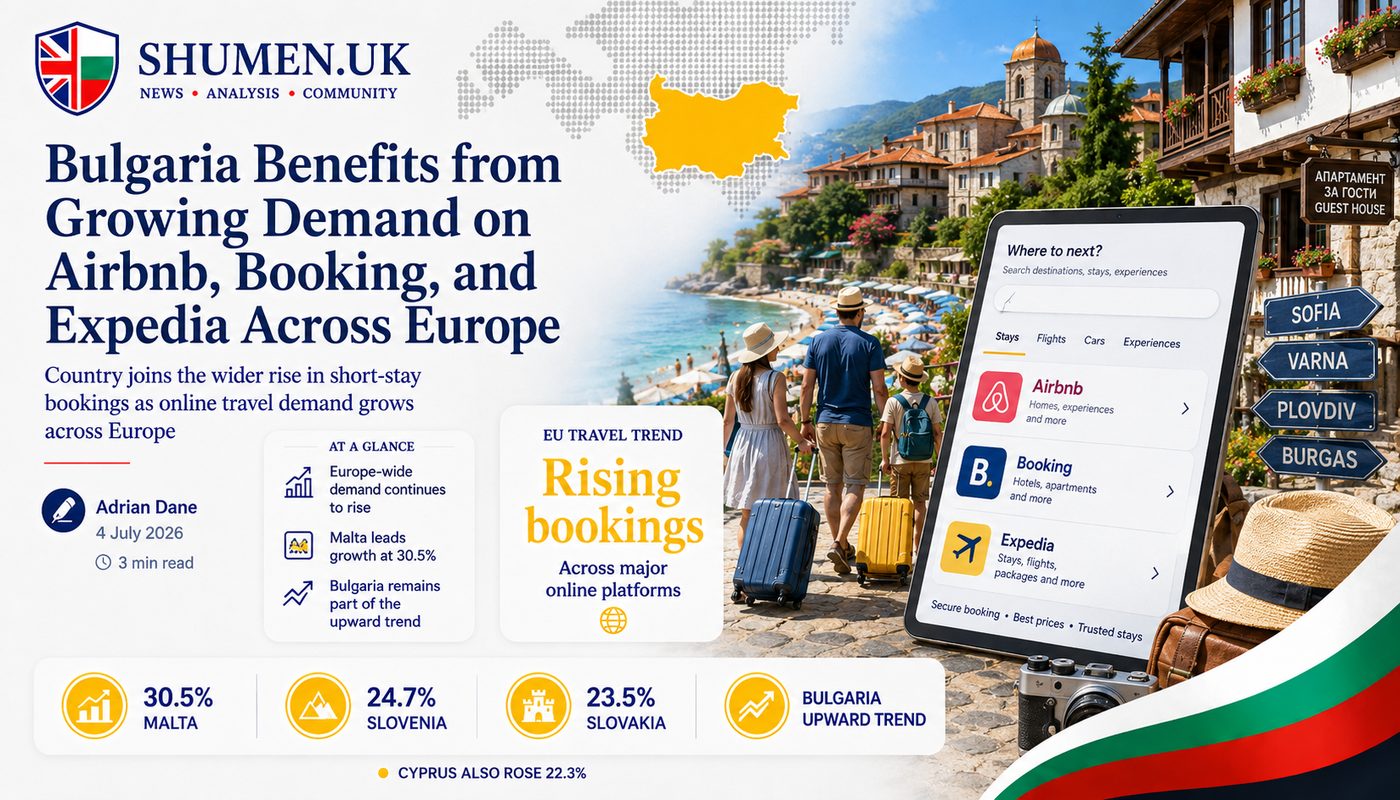
Europe's appetite for booking a stranger's spare flat shows no sign of cooling. Guests spent 144.3 million nights in short-term rentals booked through Airbnb, Booking and Expedia across the EU in the first quarter of 2026, according to Eurostat, up 9.7% on the same three months of 2025. Measured against the first quarter of 2024, the rise is a steeper 16.6%.
Bulgaria is part of that story, though not the headline of it. Growth was recorded in every single EU member state, and the country sits somewhere in the comfortable middle of the pack: contributing to the overall increase, benefiting from the platforms' popularity, but well behind the pace-setters. Eurostat gave it no standout figure of its own.
Anyone who lets a Black Sea apartment or a done-up village house already knows the booking calendar fills earlier every year. The numbers have simply caught up with the impression.
Where the Growth Actually Is
The fastest increases were nowhere near Bulgaria. Malta led the EU with overnight stays up 30.5%, followed by Slovenia (24.7%), Slovakia (23.5%) and Cyprus (22.3%). Double-digit growth also showed up in Finland, the Czech Republic, Ireland, Croatia, Greece, Germany and Italy. Even the giants kept expanding: Germany and Italy each posted growth of nearly 15%, while France and Spain managed more moderate but still positive rises.
The heaviest concentrations of guests remain, unsurprisingly, in the places that were already busy: the Canary Islands, Andalusia, the Ile-de-France around Paris, Lazio around Rome, and Alpine regions such as Tyrol and the Rhône-Alpes. The established hotspots are not being displaced; the market is simply getting bigger underneath them.
One note on the numbers themselves. Eurostat compiles them from data supplied directly by the booking platforms, and the coverage is not static: Tripadvisor left the arrangement at the end of 2024, so the current series rests on Airbnb, Booking and Expedia. It is a solid indicator of the direction of travel, not a full census of every let.
What It Means If You Host in Bulgaria
This is where the story stops being an abstract European statistic and starts landing on the doormat. A large number of British expats here let out a property, whether that is a coastal apartment bought as a bolt-hole or a village house restored over several summers. Rising platform demand is, on the face of it, the encouraging part: more guests looking, a longer season, the calendar filling sooner.
The less cheerful half is that the compliance floor for doing it legally has risen sharply, and 2026 raised it again. Short-term letting in Bulgaria is not treated as casual property rental. It falls under the Tourism Act as tourist accommodation, which means the property has to be categorised through the local municipality's tourism department before you take a paying guest. Every stay then has to be logged in ESTI, the national tourist information system, which has been mandatory for individual hosts, not just hotels, since 2019. On top of that sits a tourist tax set by each municipal council, currently somewhere between roughly €0.10 and €1.50 per overnight stay depending on where you are.
Then there is the tax authority. Under the EU's DAC7 rules, the platforms now hand Bulgaria's National Revenue Agency (the NAP) a full file on each host, earnings included, so rental income booked through Airbnb or Booking is visible to the taxman whether or not you declare it. And from 2026 a new set of EU-wide short-term-rental rules requires mandatory property registration and data-sharing between the platforms and national authorities, with non-compliant listings at genuine risk of being removed.
None of this is a reason not to host. It is a reason to do it properly, because the era of a quiet unregistered listing paying no tax is closing. Our guide to running an Airbnb in Bulgaria walks through categorisation, ESTI and the tourist tax step by step, and the taxes guide explains how the rental income is treated now that the platforms report it directly.
The demand, in other words, is real and rising. So is the paperwork attached to it. For a Brit weighing whether to put the spare apartment on Booking this season, the Eurostat numbers are the encouraging half of the picture. The categorisation form and the ESTI login are the other half.