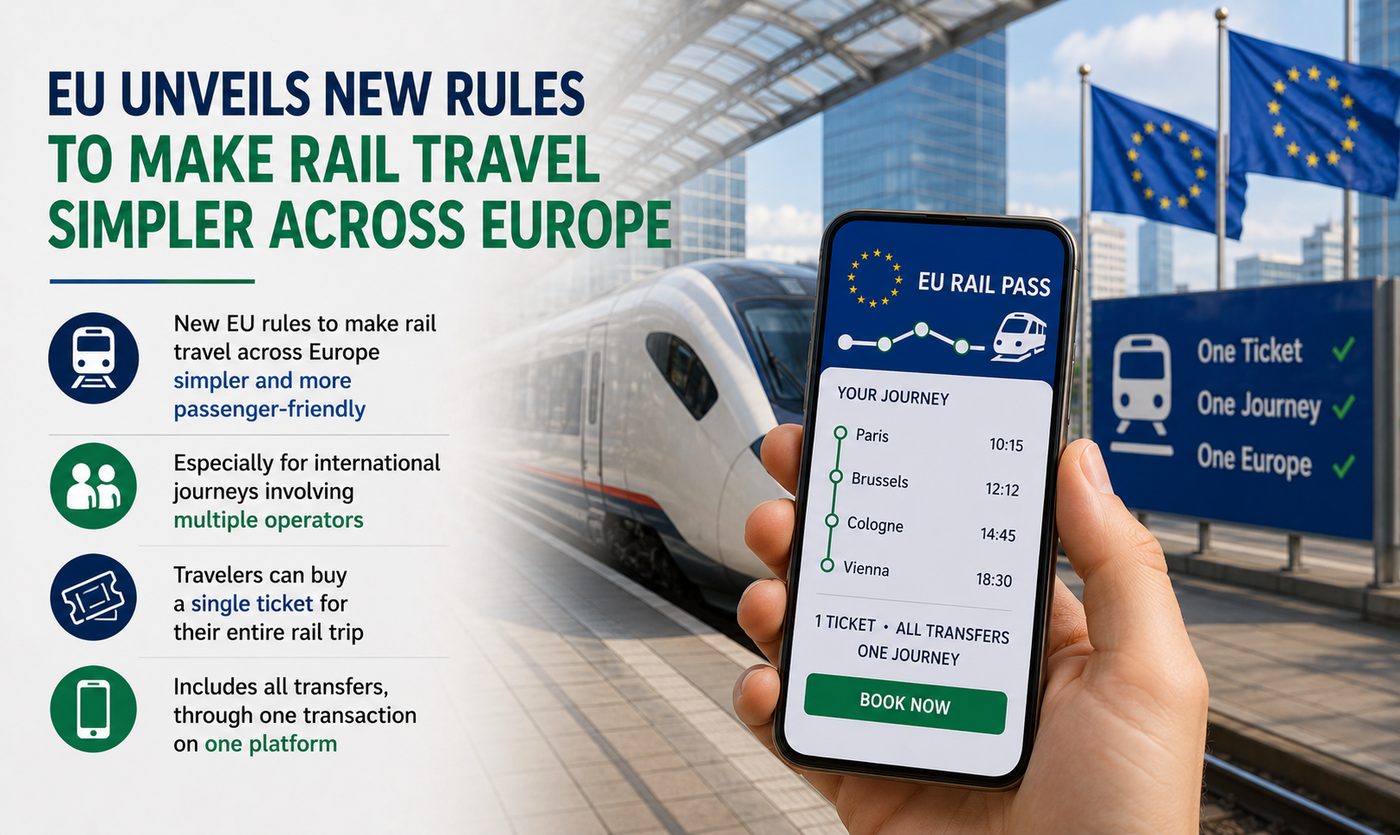
The European Commission has unveiled ambitious proposals to simplify rail travel across the bloc, imagining a future where passengers can book entire cross-border journeys through a single ticket covering multiple operators. However, before anyone starts planning a frictionless dash from Lisbon to Leipzig, a prominent caveat must be applied: these are merely proposals. They remain subject to the invariably protracted negotiations of the European Parliament and EU member states. There is no fixed timeline, nor is there any guarantee they will pass into law in their current, optimistic form.
What the Proposals Cover
Under the plan, travellers would purchase one ticket for trips involving several rail companies, acquiring automatic protections if delays or missed connections disrupt the journey. The proposals respond to a fragmentation in European rail ticketing that currently leaves passengers juggling separate tickets for different legs of the same route, a logistical chore that has long made multi-operator journeys more of an endurance test than a holiday.
Current EU rail markets remain fiercely guarded, with many ticketing systems owned by the railway operators themselves. According to Brussels, this structure limits the visibility of competing services and makes comparing international routes unnecessarily difficult.
Achieving a unified system, however, will require integrating the multi-operator ticketing systems of dozens of national railways. It is a staggering technical and operational challenge, requiring legacy domestic systems to communicate flawlessly across borders, which sets a rather high bar for practical implementation.
Passenger Rights and Protections
If a connection is missed during a trip booked as a single transaction, passengers would gain access to rerouting, reimbursement or financial compensation at no additional cost. Those affected by delays would receive alternative transport to their final destination or a refund for the unused portion of their ticket.
Passengers facing overnight disruption would be entitled to meals, refreshments and hotel accommodation. Brussels argues these measures would bring rail passenger rights closer to those already established for air travel, assuming one considers the current state of airline passenger rights to be the gold standard.
Transparency and Ticket Availability
The Commission is pushing for a rather uncharacteristic degree of openness from online booking platforms. Sellers would be required to display rail options neutrally, allowing travellers to compare routes by price, journey time and carbon emissions. Large railway operators would also be compelled to make their closely guarded ticket inventories accessible to independent booking platforms, a move designed to end the monopoly on visibility.
Rail companies would be obliged to release tickets at least five months before departure whenever timetables are finalised. Operators could still adjust pricing or introduce additional services later, but any new offers would need to appear in booking systems without delay.
What This Means for British Expats
For British expats, such as those of us navigating the continent from Bulgaria, the reforms offer the prospect of simplified travel and standardised compensation when venturing through other EU countries. Yet, the broader picture is more complicated. Post-Brexit, UK travellers sit squarely outside the EU passenger rights framework.
While domestic UK rail operates under retained legislation (with all the notorious reliability that entails), cross-border services connecting Britain to the continent, such as the Eurostar, now rely heavily on the international COTIF convention rather than direct EU oversight. Whether the UK will implement similar robust protections for cross-border journeys starting or ending in Britain depends entirely on future bilateral agreements or an appetite for UK-EU policy alignment. At present, neither appears imminent.
What Happens Next
The proposals now move to the European Parliament and member states for negotiation under the bloc's standard legislative procedure. Given the scale of the changes, significant amendments are expected during parliamentary debate.
Perhaps tellingly, there is a distinct absence of direct voices or initial reactions from the railway operators themselves, nor have passenger advocacy groups or national transport ministries yet weighed in. Furthermore, the proposals currently lack any detail on enforcement mechanisms or what penalties might apply to non-compliant operators. Operators are highly likely to resist requirements to open their ticket inventories or meet strict early-release deadlines.
"The goal is to make rail transport more accessible and convenient," the Commission noted, stressing that easier booking could encourage more people to choose trains over short-haul flights. Whether the European rail network can overcome its own operational complexities to deliver on that promise remains to be seen.