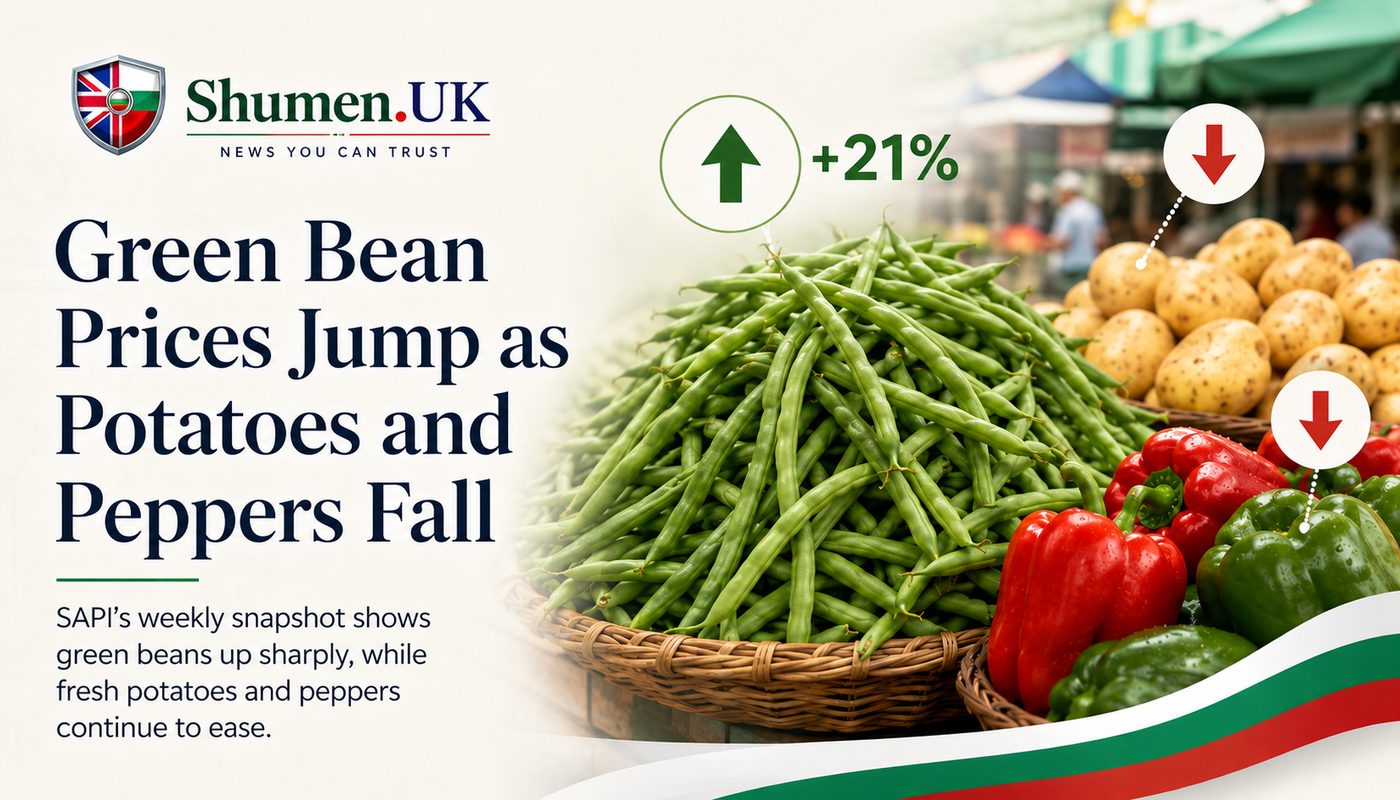
Green bean prices in Bulgaria jumped 21% in the week to 7 May 2026, while fresh potatoes and peppers continued a three-week decline, according to data from the System for Agro-Market Information (SAPI).
All figures are from SAPI's weekly monitoring of Bulgaria's 28 regions, excluding promotional prices. The data represents a weekly snapshot subject to typical seasonal fluctuations. Independent corroboration of these price trends is not available.
Green beans reached €4.25 per kilo as they entered the market for the first time this season. SAPI said the price reflected strong demand and limited supply, typical for a product launch, and that the figure was expected to fall in the coming weeks as the harvest increased. The 21% rise is a seasonal entry effect, not a structural problem. If you're shopping this week, consider waiting a fortnight before stocking up on green beans.
Fresh potatoes fell 12% to €3.40 per kilo, the third consecutive weekly decline. Since mid-April, the price has dropped 40%, from €5.63 per kilo to €3.40. Green peppers also fell for the third week in a row, down 6% to €4.40 per kilo. This is the time to buy.
Other Vegetable Price Movements
Lettuce rose 12% to €1.37 per item, marking the fifth consecutive week of increases. SAPI attributed the rise to demand outpacing supply during the transition from greenhouse to field production.
Greenhouse cucumbers increased 5% to €3.15 per kilo after three weeks of decline. SAPI described this as a local phenomenon, with supply down in some regions while field cucumbers had not yet entered the market in large quantities.
Cabbage traded at €1.17 per kilo, up 4%. The winter variety was depleted and the spring crop remained at an early stage. SAPI expected the price to move downwards in two to three weeks. Worth waiting for.
Leeks and celery leaves rose 4% each, to €0.52 and €0.57 per item respectively. SAPI said the movement was moderate and did not significantly affect household budgets.
Pickled vegetables fell 10% to €4.13 per kilo after the Easter peak. Cauliflower dropped 5% to €3.04 per kilo, courgettes fell 4% to €2.48 per kilo, and Tipov US bread declined 5% to €1.80 per kilo. Courgettes have now fallen 39% since week 16, when they traded at €4.06 per kilo.
Regional Price Gaps Driven by Supply Chains
The combined cost of eight basic products was around €20.38 in Shumen, Razgrad, Sliven, Yambol, and Burgas, the cheapest regions in the reference period. Razgrad and Shumen were among the cheapest regions for an eighth consecutive week.
The same basket cost around €38.26 in Plovdiv, Pazardzhik, Smolyan, Pleven, and Veliko Tarnovo, the most expensive regions. SAPI said the difference was not due to better quality, but to longer supply chains, more intermediaries, and lower shop turnover. This is a structural supply chain issue, not arbitrary pricing. If you're based near Plovdiv, it may be worth a day trip to Shumen for larger purchases (the savings are that substantial, and you'd get a nice drive out of it).
Tomatoes cost €2.85 per kilo in Ruse and Targovishte, and €3.92 per kilo in Sofia, Pernik, and Sofia Region. SAPI found the same tomatoes were 37% more expensive solely because of logistics and the number of intermediaries. Not quality. Just logistics.
Basic Staples Remain Stable
Prices for white bread (€1.53/kg), type 500 flour (€0.99/kg), cooking oil (€2.02/kg), size M eggs (€0.29 per item), size L eggs (€0.31 per item), chilled chicken (€4.37/kg), bottled fresh milk (€1.81/litre), and 400g yoghurt (€0.80 per item) were unchanged compared with the previous week.
Sugar fell 1% to €1.25 per kilo, salt dropped 2% to €0.55 per kilo, and potatoes declined 1% to €0.91 per kilo. Lamb remained stable at €16.29 per kilo, while boneless pork leg fell 1% to €6.56 per kilo.
SAPI found that 65% of all monitored products were unchanged during the week.
What This Means for British Expats
Seasonal production is working in favour of shoppers at the moment. Fresh potatoes are 40% cheaper than in mid-April. Courgettes are 39% cheaper. Aubergines fell 3% during the week and are more than 30% cheaper than at the Easter peak.
The basic basket of bread, eggs, milk, cooking oil, chicken, and potatoes showed no worrying trend.
The regional gap is larger than inflation, and this is where British expats in Bulgaria can make significant savings. Shoppers in Plovdiv or Pazardzhik pay almost double what those in Shumen and Razgrad pay for an identical basket, primarily due to longer supply chains and lower shop turnover, not product quality. SAPI advised comparing prices before buying, especially for larger purchases. For British expats, this means considering where you shop as much as what you buy. The difference is not trivial.
This is the time to buy cucumbers, peppers, courgettes, aubergines, cauliflower, and fresh potatoes, all of which are on a downward price trend. SAPI recommended waiting two to three weeks before buying cabbage and green beans, as their current price increases are seasonal and temporary. The green bean spike is a launch effect, not a long-term problem.
Lamb has been stable for a third week after the Easter peak. It is structurally expensive but is no longer rising. Imported grapes remain expensive because they are out of season, which SAPI described as normal and not a sign of manipulation.
To convert to sterling at current rates, €20.38 is roughly £17, and €38.26 is roughly £32. The regional basket difference is therefore about £15, which adds up quickly over a month of shopping. Worth factoring in if you're planning your weekly shop.
It is not yet clear whether broader macroeconomic or external factors (such as import costs or wider inflation trends) are influencing these movements. The data does not include information on how these price changes affect household affordability or food security beyond the price figures themselves.