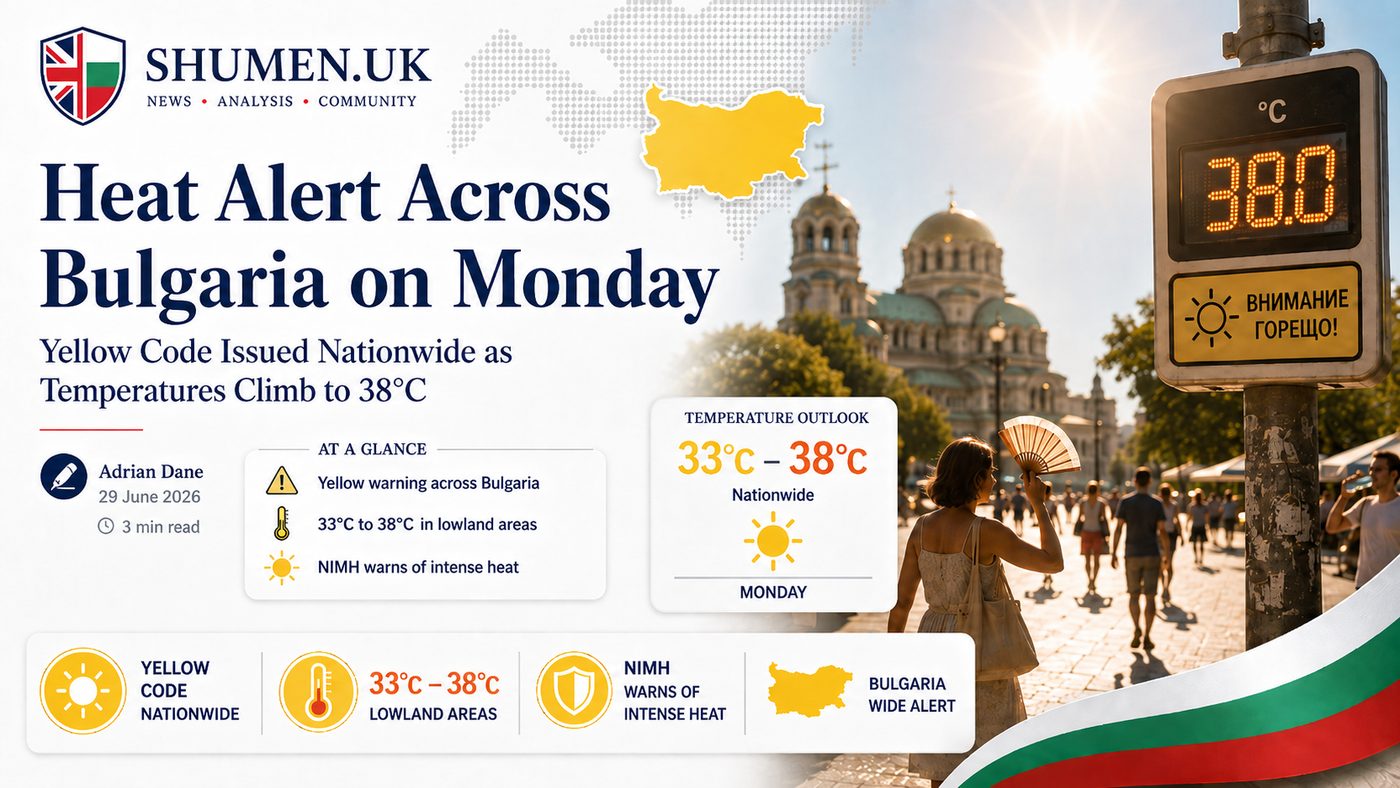
The National Institute of Meteorology and Hydrology has issued a yellow warning for dangerously hot weather across the whole of Bulgaria on Monday 29 June, with daytime temperatures in the lowlands forecast to sit between 33°C and 38°C. Sofia is expected to reach around 34°C under mostly clear skies.
It is the second day running under a heat alert. On Sunday the yellow code covered 14 regions, including Plovdiv, Stara Zagora, Haskovo, Ruse and Pleven; on Monday it goes nationwide. A light to moderate east-northeast wind will pick up in the east, the institute said, but it will offer only limited relief.
None of which will surprise anyone who has spent a Bulgarian summer here. By early afternoon the streets of most towns empty out, the shutters come down, and the only things moving in the open are the dogs and the tourists who have not yet learned the rhythm. The heat is not the gentle Mediterranean kind sold in the brochures; the Bulgarian summer is a hard, dry, continental one, and the lowlands take the worst of it.
What a yellow code actually means
The source does not spell this out, so it is worth doing. Bulgaria's warnings follow the pan-European Meteoalarm scale, which runs yellow, orange, red. Yellow is the lowest of the three operational levels. It means the weather is potentially dangerous but unlikely to be extreme: be aware, plan around it, and take sensible precautions, rather than treat it as an emergency.
In practice that is the right reading of Monday. Thirty-eight degrees in the Thracian plain in late June is uncomfortable and genuinely risky for the vulnerable, but it is not, by Bulgarian standards, exceptional. The institute's advice was simply to take care during the hottest hours of the day.
The bigger picture the alert leaves out
What a one-day national warning does not convey is that Bulgaria is now on the eastern edge of something much larger. Meteorologists, including the World Meteorological Organization, have described the late-June heat across Europe as record-breaking, with one analysis calling it the worst on the continent in modern records. The heat dome that pushed France and parts of central Europe into the low 40s has been shifting east, and forecasters have flagged the Balkans as next in line.
That context matters for reading the week ahead. Bulgaria's 38°C is the cooler eastern shoulder of a continental event that has hit 42°C and higher further west. It also means the heat is unlikely to break in a single afternoon, whatever Monday's relatively modest numbers suggest on their own.
What it means on the ground for British expats
For a Brit living here, the practical points are the familiar ones, and they are worth repeating because the people who come unstuck in a Bulgarian heatwave are usually the ones treating it like a warm day back home.
- The early afternoon is the danger window. Get errands, the pazar run and any outdoor work done before midday, and stay in the shade between roughly 1pm and 5pm.
- The lowlands are hottest. If you are inland on the plain, around Plovdiv, Stara Zagora or Haskovo, expect the top of that 33°C to 38°C range. The Black Sea coast and the mountains run several degrees cooler.
- Check on elderly neighbours. Heat is hardest on the old and the unwell, and rural Bulgarian villages skew elderly. A knock on the door costs nothing.
- Mind the electricity. Everyone reaches for the air conditioning at once, which is both a load on the grid and a line on your bill. Our health guide covers staying well in extreme heat and how the local system handles a heat-related emergency.
The wider lesson is the one this site keeps coming back to: Bulgaria is a country of four hard seasons, not a permanent sunshine holiday. Long, fierce summers are part of the deal, the same way the winters are. A nationwide yellow code in late June is not a freak event. It is the season doing exactly what it does.