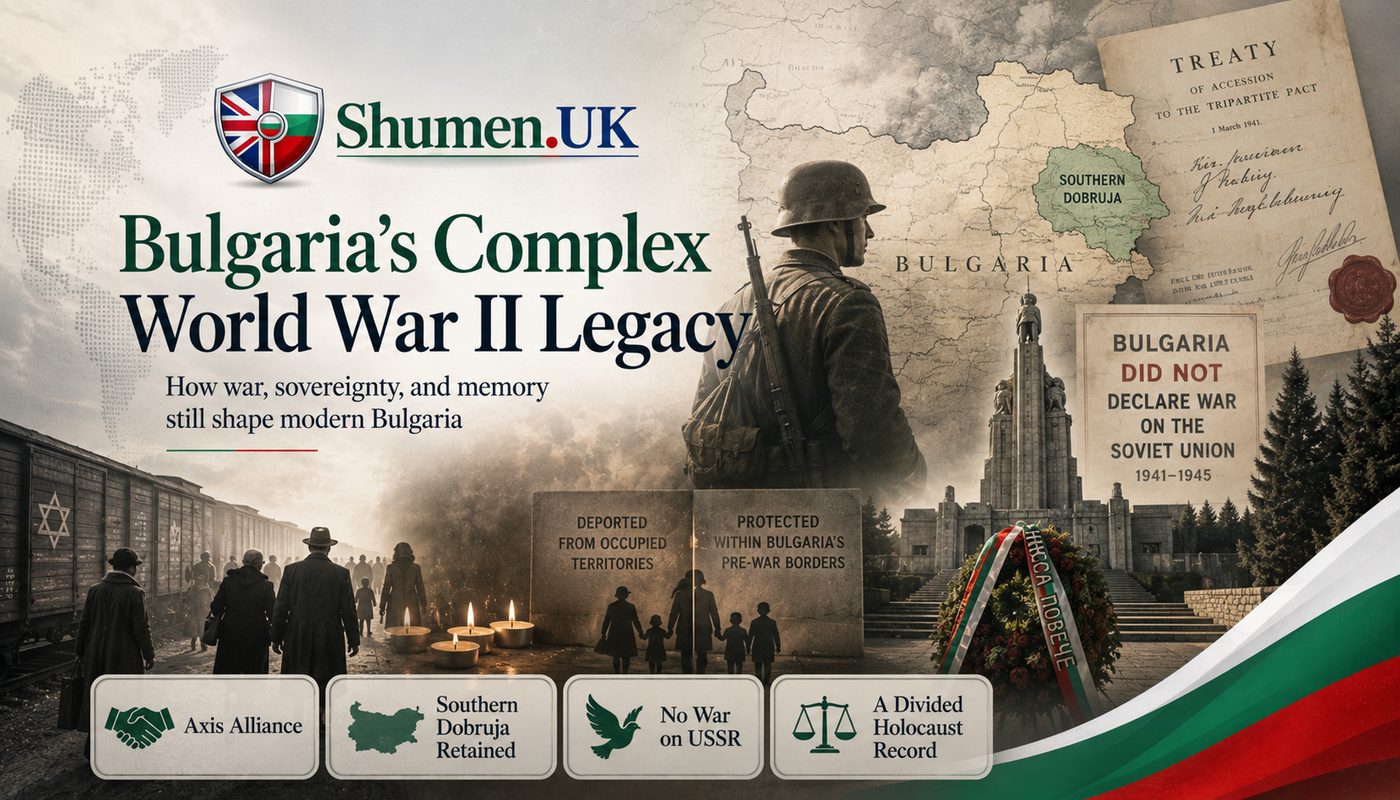
Bulgaria ended World War II on the losing side, signed a peace treaty as a defeated nation, and walked away with more territory than it started with. According to historical accounts, no other country that fought for the Axis can say that, though this claim remains subject to interpretation among historians. The question is how a small Balkan state with no military leverage managed to pull it off.
The Dobruja Question
The Treaty of Neuilly-sur-Seine in 1919 imposed severe territorial losses on Bulgaria, including Southern Dobruja, which went to Romania. For two decades, getting it back was the central goal of Bulgarian foreign policy. When Hitler began redrawing European borders in the late 1930s, Bulgaria saw an opening.
On 7 September 1940, the Treaty of Craiova returned Southern Dobruja to Bulgarian control under German pressure. Tsar Boris III regained a territory that generations of Bulgarians had considered rightfully theirs without firing a shot. From a Bulgarian perspective, that counted as diplomatic success.
Joining the Axis
The rest was harder. In March 1941, enormous German pressure forced the Bulgarian cabinet to side with the Third Reich. Bulgaria was economically dependent on Germany, geographically surrounded, and militarily outmatched. Joining the Axis was the price of survival.
What Tsar Boris III managed to do within those constraints is where the story becomes more interesting. Bulgaria joined the Axis but refused to declare war on the Soviet Union, a decision that infuriated Berlin. Bulgarian troops never fought on the Eastern Front. The Bulgarian officer class was mainly pro-German while the population at large was predominantly Russophile, and Boris understood that sending Bulgarian soldiers to fight Russians was a line the country would not accept.
The Jewish Question: A Complex and Contested History
The full picture here is complicated, historically contested, and deserves honest accounting. Bulgaria's wartime record on Jewish deportations remains one of the most debated and sensitive aspects of its WWII history.
Bulgaria did not deport Jews from its pre-war core provinces, but it did deport Jewish residents from the Greek and Yugoslav territories it occupied in 1941. In March 1943, Bulgarian police and military units carried out the deportation of 11,343 Jews from those occupied territories. Virtually all were murdered at Treblinka. This tragic fact stands alongside the protection efforts within Bulgaria's pre-war borders, creating a duality that continues to provoke debate among historians, survivors' families, and scholars.
Within Bulgaria's pre-war borders, something different happened. The planned deportation of Bulgarian Jews was scheduled for March 1943, but Dimitar Peshev, deputy speaker of the National Assembly, forced the government to cancel it. Forty-three members of parliament backed a resolution in defence of Bulgarian Jews, supported by many across Bulgarian society. In late May 1943, Tsar Boris III cancelled the deportation orders entirely. Boris died in August 1943 under disputed circumstances. Around 50,000 Bulgarian Jews survived the war. In the context of what was happening across occupied Europe, that stands as one of the more remarkable acts of collective resistance of the entire period.
This duality (deportations from occupied zones, protection within pre-war borders) remains a subject of ongoing historical debate, sensitivity, and differing interpretations.
The Exit
By 1944, Romania had switched sides and Soviet troops were at the border. Bulgaria scrambled to exit the war, declared neutrality, then declared war on Germany, then watched a communist coup take power almost overnight. But when the dust settled and the Paris Peace Treaties were signed in 1947, Southern Dobruja stayed Bulgarian.
Whether Bulgaria was truly unique among defeated Axis powers in retaining territorial gains is an assertion based on certain historical accounts and remains subject to interpretation. Other defeated nations (Hungary, Italy, Romania, Finland) faced different circumstances and outcomes, with some regaining small territories or retaining strategic areas depending on postwar negotiations. Bulgaria's retention of Dobruja stands as an unusual result of wartime diplomacy and postwar settlement, but the claim requires careful framing within comparative historical context.
Why This Matters for British Expats
For British expats in Bulgaria, understanding this history offers insight into how Bulgarians see their country's place in 20th-century Europe. The narrative of survival through diplomacy, the protection of Bulgarian Jews within pre-war borders, and the retention of Dobruja remain sources of national pride and identity. It also explains why discussions of World War II in Bulgaria often focus on nuance and complexity rather than straightforward Allied-versus-Axis framing.
You will hear this story. Bulgarians talk about it differently than the British talk about the war, and understanding why helps you make sense of local attitudes toward history, sovereignty, and great power pressure. It shapes how Bulgarians see themselves in relation to their neighbours and to larger powers, which influences everything from political rhetoric to cultural memory to public commemorations you might encounter living here.
The broader point is not that Bulgaria was heroic in any straightforward sense. It is that a small country with no good options managed, through diplomatic skill, popular resistance, and a fair amount of luck, to lose a war and still come out ahead. Most nations in that position lost everything. Bulgaria kept Dobruja, saved most of its Jews from deportation, and kept itself largely out of the bloodiest fighting of the century. By the brutal logic of geopolitics, that is about as good as it gets.