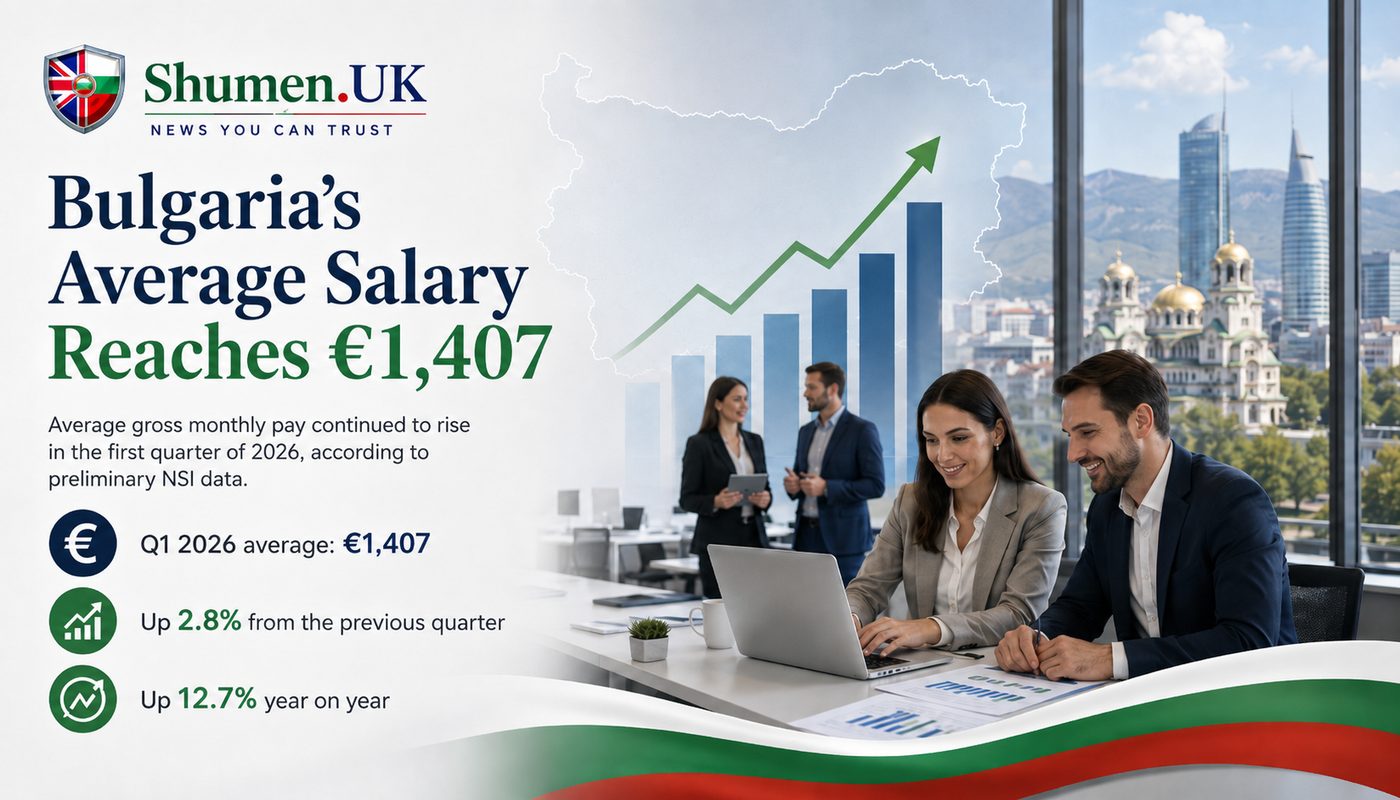
Bulgaria's average gross monthly salary reached €1,407 in the first quarter of 2026, according to preliminary data from the National Statistical Institute (NSI). That marks a 12.7% increase on the same period in 2025, and a 2.8% rise compared to the final quarter of last year.
The figures are preliminary and will be refined in later reports, but they indicate continued wage growth across most of the economy, even as the sectoral employment picture remains uneven.
Monthly Breakdown
Average earnings stood at €1,381 in January, dipped to €1,365 in February, then climbed to €1,475 in March. The March figure pushed the quarterly average above the €1,400 threshold for the first time.
Sectoral Wage Growth
Quarterly wage increases were strongest in financial and insurance activities (9.7%), agriculture, forestry and fishing (8.4%), and information technology, media and telecommunications (8.2%).
Over the full year, agriculture, forestry and fishing led with a 21.1% pay rise, followed by electricity, heat and gas production (19.1%) and other activities (18.9%).
The highest-paid sector remains information creation and dissemination, including creative industries and telecommunications, where the average monthly salary reached €3,176. Financial and insurance activities follow at €2,226, and energy production and distribution at €2,060.
At the bottom of the pay scale, hotels and restaurants continue to offer the lowest average wage at €870 per month. They are followed by agriculture, forestry and fishing (€981) and other activities (€1,014).
Public Versus Private
Public sector salaries rose 15.3% year-on-year in the first quarter, compared to 11.8% in the private sector. The faster pace of state wage increases suggests continued pressure on recruitment and retention in public services. Whether private firms will follow suit remains to be seen, though the gap rarely stays open for long.
Employment: Slight Rise, Mixed Picture by Sector
By the end of March 2026, 2.35 million people were working under employment and service contracts in Bulgaria, an increase of 9,800 (0.4%) compared with the end of 2025.
Quarterly employment growth was strongest in professional activities and scientific research and other activities, both up 2.7%. Hotels and restaurants added 2.3%, and construction grew by 2%.
Financial and insurance activities shed 1.4% of their workforce over the quarter.
On a year-on-year basis, total employment was down by just 400 people compared to March 2025. But the sectoral picture shows sharper divergence: manufacturing lost 14,600 jobs, agriculture, forestry and fishing shed 4,600, and administrative and support services dropped 1,600 positions.
In contrast, healthcare and social work added 12,600 jobs, the strongest annual gain in any sector. Construction also expanded, adding 2,900 positions.
In percentage terms, the sharpest annual declines were in agriculture, forestry and fishing (7.1%), followed by manufacturing and real estate activities (both 3.3%). The strongest percentage growth was recorded in healthcare and social activities (6.2%).
What This Means for British Expats
For British expats in Bulgaria, the wage figures offer context on the cost of local labour and the broader economic environment. If you employ staff or run a business here, public sector pay rises may put upward pressure on private sector wages, particularly in sectors already competing for skilled workers. That could mean higher costs, but it might also reflect a tightening labour market where good people are harder to find.
The manufacturing job losses suggest structural shifts in Bulgaria's industrial base, which could affect supply chains or business partnerships involving UK companies. Meanwhile, strong healthcare employment growth reflects ongoing investment in public services, relevant if you rely on Bulgaria's state health system or are considering work in the sector.
Bulgaria's wage growth remains strong by European standards, but the sectoral employment picture is uneven. The overall labour market is stable, but not uniformly so. For expats weighing business decisions or employment prospects, the data point to continued economic growth alongside sectoral churn, an environment that rewards agility more than it punishes caution.
Caveats and Context
This article relies on NSI data reported by a single source and does not explore the underlying causes of wage disparities or employment shifts. Some sector-specific figures carry medium confidence and would benefit from further official corroboration in future updates. The analysis of British expat relevance is based on general economic knowledge rather than direct interviews or expert quotes, which would require original reporting. Readers should treat the figures as indicators of trend rather than final conclusions, and note that short-term fluctuations in preliminary data can be revised.