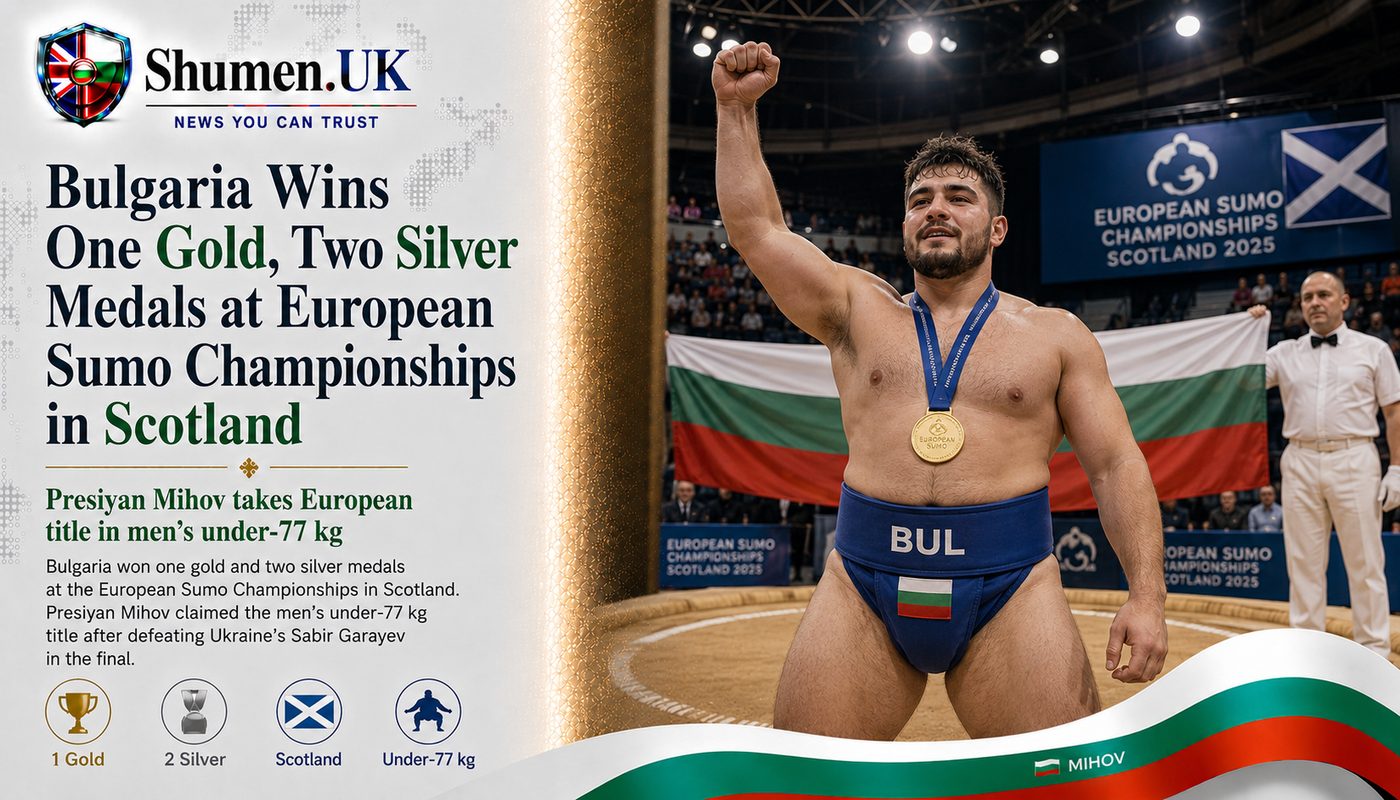
Bulgaria came away from the European Sumo Championships in Stirling with one gold and two silver medals, the Bulgarian Sumo Federation said, in a tournament that for the first time in the competition's history was staged on British soil.
Presiyan Mihov took the gold in the men's under-77kg category, beating Ukraine's Sabir Garayev in the final. It was his second European title: he first won the championship in 2023, then collected bronze at the 2024 and 2025 editions. The two silvers came from Georgi Anachkov, a debutant in the men's under-70kg division, and Stanislava Atanasova, runner-up in the women's under-80kg.
If sumo is not the sport you expected to see Bulgaria medalling in over a June weekend, you are not alone. It rarely troubles the conversation in a Shumen kafene, where football and volleyball do the talking. But the federation has quietly built a competitive bench, and Stirling was a decent weekend's work.
Mihov defends, and a refereeing error costs Kolev
Mihov's title was the standout result. Two European golds and two bronzes across four years is a genuine record at this level, and he saw off Garayev in the final to add the 2026 crown to the one he won in 2023.
Atanas Kolev, competing in the same under-77kg category, opened with a win over a Scottish wrestler before losing to Garayev, the same man Mihov would later beat. Kolev's tournament then ended on a sour note: the federation said a refereeing error denied him the chance to fight for bronze. Sumo bouts last seconds and turn on a single shove or slip, which leaves a referee's call very little room for a second look.
Two silvers, both lost to Ukraine
Anachkov made the men's under-70kg final on his championship debut, a strong showing, before going down to Ukraine's Dmytro Mykhniuk. Atanasova reached the women's under-80kg gold-medal bout and lost it to Ukraine's Daria Konstantinova.
There is a pattern the medal table on its own hides: every one of Bulgaria's three medal bouts was contested against a Ukrainian. Mihov beat one for gold; Anachkov and Atanasova both lost to one in their finals. Ukraine has become the side to beat in European sport sumo, and on this weekend's evidence Bulgaria sits right behind it.
Not everything went Bulgaria's way beyond the podium. Simeon Stankovich reached the bronze match in the men's under-115kg but lost to Hungary's Marcell Gyuricza. Mihail Melehov was still in medal contention in the under-100kg when an open head wound forced him to withdraw on medical advice. Several former champions in the squad, including Ivan Blagoev, Stilian Ivanov, Viktor Kostov and Mihaela Hristova, finished off the podium. The team was coached by Hristo Hristov and Nikolay Nikolov, with federation president Valeri Nikolov heading the delegation.
What "European sumo" actually is
The version on show in Stirling is not the professional sumo most people picture, the centuries-old Japanese ozumo with its salt-throwing ritual and its enormous full-time wrestlers. That game is run by the Japan Sumo Association, has no weight classes and does not admit women.
What Bulgaria competes in is amateur sport sumo, governed internationally since 1992 and built for the rest of the world. Wrestlers are split into weight categories, which is why the results read as under-70kg, under-77kg, under-100kg and so on. Women have their own divisions, added to the world championships in 2001. Nobody has to give up the day job for it. The ceremony is stripped back; the few brutal seconds of leverage and balance are the same.
Why Stirling matters for British readers
For once the geography ran in a British reader's favour. The championships were held at the University of Stirling, and the organisers, SumoScotland and the European Sumo Federation, billed it as the first time the event has ever come to Scotland, or anywhere in Great Britain. A Brit back in the UK visiting family this summer could, in theory, have watched their adopted country's athletes compete a short drive up the M9, which is not a sentence you often get to write about Bulgarian sport.
It is also a reminder that sumo is more accessible than its mystique suggests. Britain has run a national sumo federation since the mid-1980s, and the sport has been one of Scotland's faster-growing martial arts. You do not need to weigh twenty-five stone or move to Tokyo: the amateur divisions are exactly that, amateur, and split by weight. For a British expat who has got used to Bulgaria quietly excelling at sports nobody back home televises, Mihov's gold is a small and satisfying example of it.