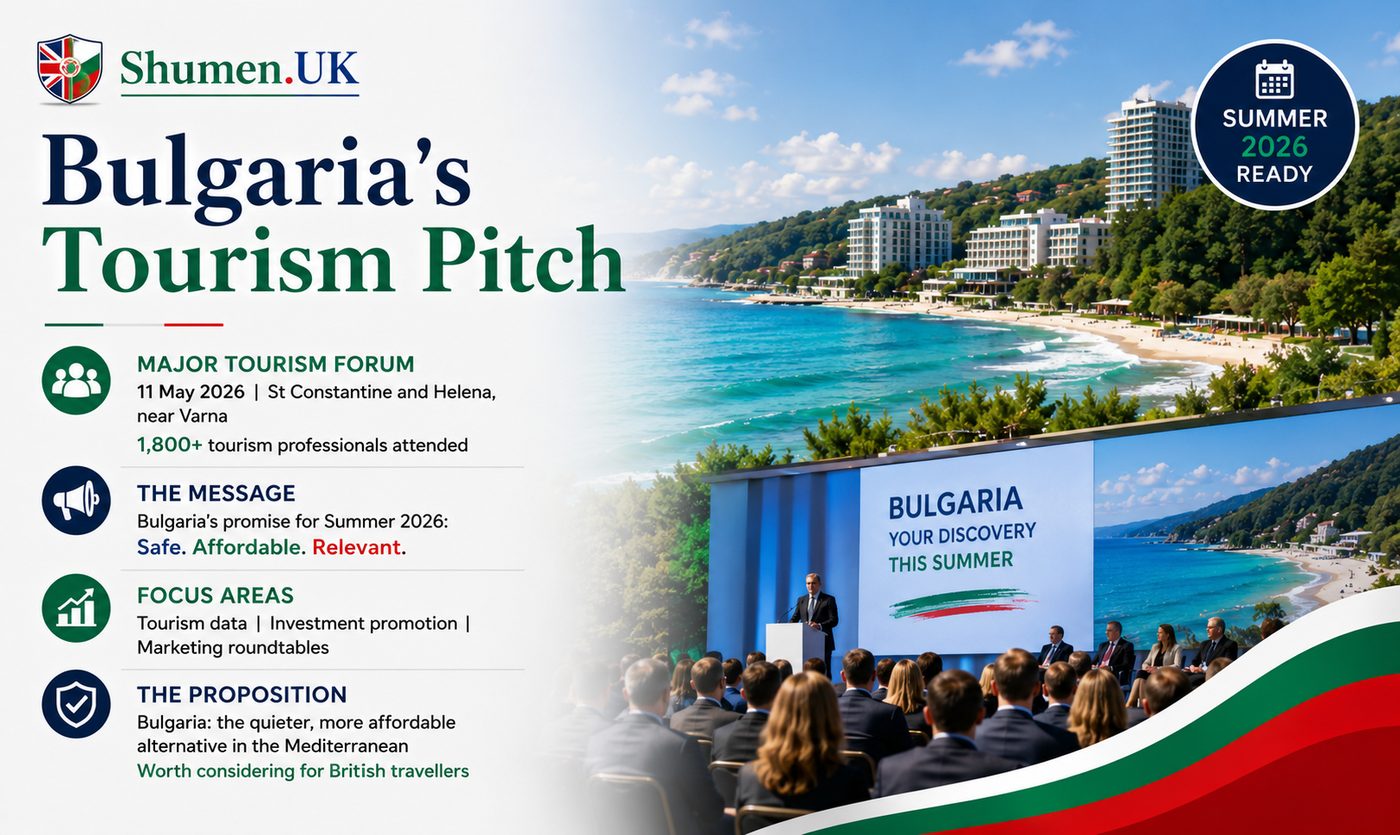
Bulgaria's Tourism Pitch
Bulgaria held a major tourism industry gathering on 11 May 2026, bringing together over 1,800 professionals to outline plans for the summer season. The forum, organised by the Bulgarian Tourism Agency at the St Constantine and Helena resort near Varna, drew tourism operators, government officials and business representatives from across Southeast Europe.
This article draws entirely from an official Bulgarian Tourism Agency report with an explicitly promotional perspective. No independent verification or third-party assessment is included. British travellers should verify all practical details independently before booking.
The event was promotional in nature. What emerged was a message that British travellers may find reassuring: Bulgaria is positioning itself as the quieter, more affordable alternative to its busier Mediterranean neighbours.
Whether that proposition holds in practice is another matter entirely.
The Official Message
Kiril Vulchev, the agency's director general, told attendees that Bulgaria's message for summer 2026 centres on three words: safe, affordable and relevant. The agency presented tourism data and organised roundtable sessions on investment promotion and marketing. Specific details about outcomes, funding commitments or implementation timelines were not disclosed.
Over 300 hosted buyers from Bulgaria and abroad attended, with discussions focused on how to position the country in a competitive regional market that includes Greece, Croatia and Romania. All three have more established international reputations, higher visitor numbers and, in most cases, better-developed infrastructure.
This is the agency's ninth such gathering since 2022. The format is now established: twice-yearly forums timed to the start of summer and winter seasons.
What Wasn't Discussed
Health and safety protocols for the 2026 summer season were not detailed at the forum. British travellers planning visits must verify current guidance directly from the Bulgarian Ministry of Tourism, Bulgarian health authorities, and UK Foreign Office before travelling. The source material contained no information on vaccination requirements, testing procedures, emergency preparedness measures or pandemic-related protocols.
This omission is worth noting. Large tourism gatherings and busy summer seasons carry inherent public health considerations, and the absence of procedural detail leaves practical questions unanswered.
Regional Competition
Bulgaria faces stiff competition. Greece remains the dominant force in Southeast European summer tourism, with decades of brand recognition and infrastructure investment. Croatia has carved out a premium position, particularly along the Dalmatian coast. Romania has been investing heavily in Black Sea resort development.
Bulgaria's pitch hinges on being more affordable whilst maintaining acceptable quality standards. Whether that proposition holds for British tourists accustomed to Western European service levels remains to be tested through the season.
The country does offer genuine value in places. Parts of the Black Sea coast remain relatively unspoilt compared to the concrete sprawl of Spain's costas. But infrastructure development in some areas still lags behind Western European standards. Road quality between major coastal destinations remains a particular weakness.
Infrastructure Challenges
Mario Smurkov, a deputy from Progressive Bulgaria, used the forum to argue that government institutions must take tourism infrastructure more seriously. He pointed specifically to road quality, noting that whilst flight connections matter, poor road links to neighbouring countries remain a barrier to attracting visitors to Bulgaria's Black Sea coast.
The observation is fair. Anyone who has driven the coastal route from Varna south to Burgas will recognise the issue. The roads exist. They simply aren't very good.
Denitsa Milosavlevich, director of aviation business development at Fraport Twin Star Airport Management (which operates the coastal airports), confirmed that Bulgaria has sufficient aviation fuel to ensure tourist flights during summer 2026. A reassuring statement, though one hopes it goes without saying.
British travellers should verify current flight schedules to Varna and Burgas airports directly with airlines. Routes exist but may be seasonal or limited compared to more established Mediterranean destinations.
Currency Simplification
One genuine convenience for British visitors: Bulgaria adopted the euro on 1 January 2026, replacing the lev. This simplifies transactions and removes one layer of holiday admin for UK travellers. No more mental arithmetic converting leva to pounds.
Mid-May weather forecasts showed temperatures ranging from 10°C to 26°C across Bulgarian cities, with coastal areas like Varna and Burgas experiencing milder conditions around 18°C to 23°C. Standard late spring conditions, in other words.
The Marketing Question
The forum included sessions on media involvement in tourism promotion, with representatives from Bulgarian National Television, Bulgarian National Radio and the Council for Electronic Media participating.
Gabriela Naplatanova, chair of the Council for Electronic Media, highlighted what she called the strategic importance of media in tourism development. Her point: negative news has immediate impact, whilst sustained positive coverage requires long-term commitment.
The statement is unremarkable but worth noting, given Bulgaria's track record of headline-grabbing tourism scandals involving overcharging, poor standards and the occasional safety incident. For Bulgaria to shift international perceptions, consistency matters more than promotional campaigns.
Details about the planned marketing campaign and tourism development initiatives remain prospective and have not been fully disclosed or realized. British travellers should treat official statements as intentions rather than implemented policy.
What British Travellers Should Consider
The forum's emphasis on safety and affordability may reassure some British visitors, particularly those seeking alternatives to pricier Mediterranean destinations. Bulgaria does offer value, and parts of the Black Sea coast remain genuinely pleasant.
However, infrastructure development in some areas still lags behind Western European standards. British travellers should:
- Research specific resorts carefully through recent independent reviews
- Verify accommodation standards independently
- Maintain realistic expectations about facilities and service levels compared to Greek or Croatian equivalents
- Check current health and travel guidance from UK Foreign Office
- Confirm flight availability and schedules directly with airlines
- Be prepared for language barriers outside major tourist areas, as English proficiency varies significantly
Environmental and Community Questions
Whilst the forum addressed investment and marketing extensively, discussions about environmental sustainability and community impact were less prominent in available reports. British travellers increasingly prioritise responsible tourism, and Bulgaria's ability to balance growth with environmental protection will influence its appeal to UK holidaymakers.
Local officials from Varna, Dobrich and other municipalities attended, with some emphasising the need for year-round tourism rather than summer-only focus. Snezhana Apostolova, deputy mayor of Varna with responsibility for tourism, stated that the city and country remain safe destinations deserving wider recognition.
Whether Bulgaria can maintain that reputation through a busy summer season, with all the pressures mass tourism brings, is the practical question.
Looking Ahead
The forum represented the agency's ninth tourism gathering of this type, with the organisation hosting two such events annually since 2022. The partnership with the European Spa Association and the Bulgarian Union of Balneology and SPA Tourism underscores the country's positioning in the health and wellness tourism segment.
For British expats in Bulgaria, the forum's discussions about infrastructure improvements and investment may signal gradual enhancements to facilities and services. Specific timelines and funding commitments remain unspecified, however.
The forum coincided with preparations for HealthXChange 2026, a European health tourism event scheduled to begin in Varna on 12 May. The Bulgarian Tourism Agency is listed as a primary media partner for that gathering, which focuses on sustainable health tourism.
The Bottom Line
British travellers considering Bulgaria for summer 2026 should weigh the country's affordability and relative quiet against infrastructure limitations in some areas. The Bulgarian tourism sector's stated commitment to quality and safety will need to be demonstrated in practice as the season progresses.
The forum presented an optimistic picture, as such events invariably do. The reality on the ground, once summer visitors arrive in numbers, will provide the actual test.
This information comes from the Bulgarian Tourism Agency, an official state body with a promotional remit. The source material did not include independent assessment or third-party verification of Bulgaria's tourism proposition. British travellers should consult current Foreign Office guidance and verify practical details independently before booking.