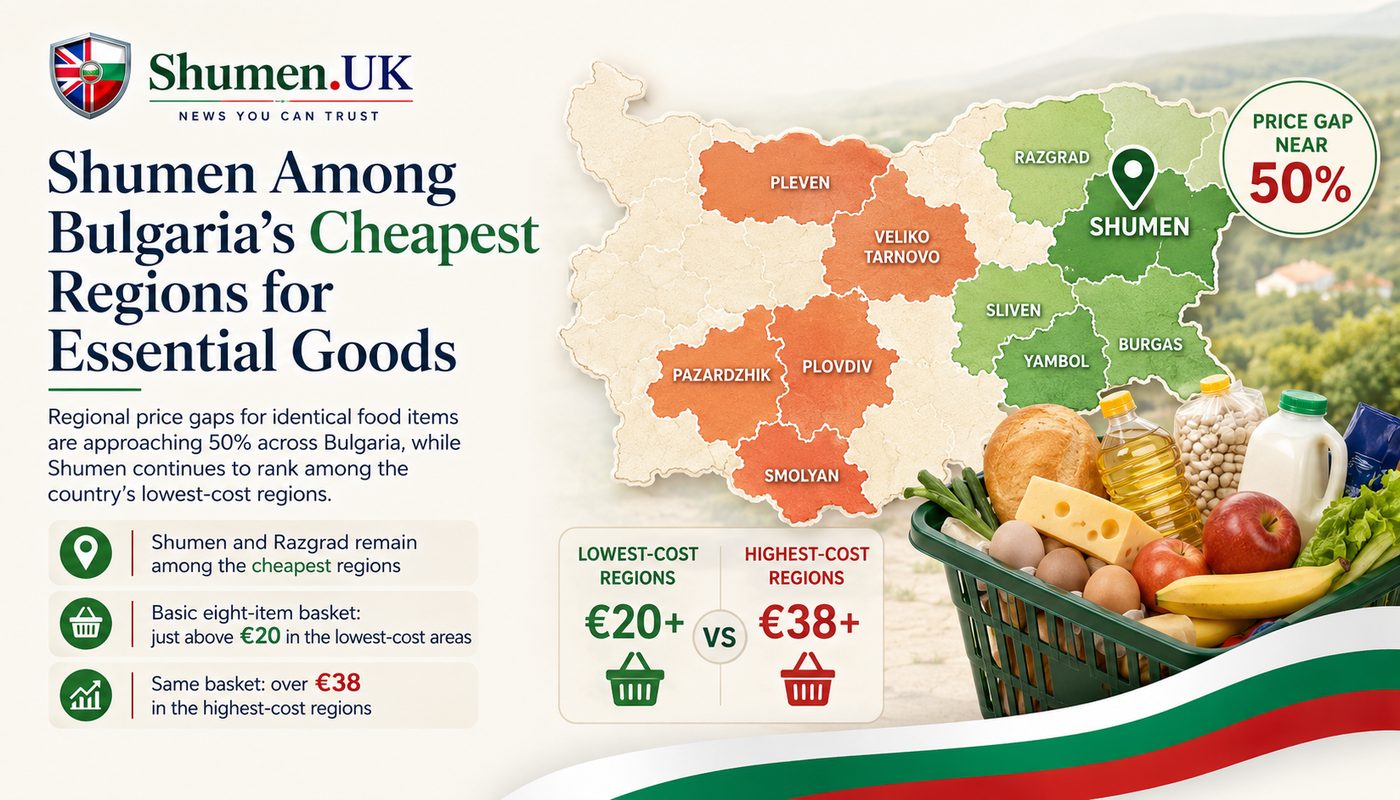
The cost of basic groceries in Bulgaria varies by as much as 50% depending on region, according to official data released for the first week of May 2026.
The Agricultural Market Information System, which tracks consumer prices across the country, found that an eight-item basket of essential goods costs just over €20 in the cheapest areas but exceeds €38 in the most expensive. In a single-currency country of nine million people, that is a remarkable spread.
Cheapest and Most Expensive Regions
Shumen, Razgrad, Sliven, Yambol, and Burgas recorded the lowest overall prices. Razgrad and Shumen have now held the top spots for eight consecutive weeks.
At the other end, Plovdiv, Pazardzhik, Smolyan, Pleven, and Veliko Tarnovo showed the highest costs for the same products.
The disparity is not down to quality differences. Officials attribute the gap primarily to longer supply chains and lower retail turnover in the more expensive regions, both of which push up final consumer prices. Whether these explanations fully account for a near-50% gap remains an open question, but they are the factors the government is citing.
Government Response
Deputy Prime Minister and Economy Minister Alexander Pulev told the parliamentary Budget and Finance Committee that controlling food inflation is a central policy objective. He said the government is preparing legislative changes to strengthen enforcement against unfair trading practices while staying within market principles.
The proposed amendments to the Law on Protection of Competition and the Law on Consumer Protection would increase the powers of sector regulators and significantly raise fines for violations. These are proposals, not yet law, and their real-world effectiveness will depend on implementation and judicial follow-through.
"We welcome these legislative amendments because they give the necessary tools to the government and the line ministries to wage an effective battle against galloping prices," Pulev said.
New Coordination Unit Planned
Pulev announced plans to create an interinstitutional coordination unit under the Council of Ministers. The body would bring together the Ministry of Economy, the Ministry of Finance (through the National Revenue Agency), and the Ministry of Agriculture and Food as permanent members, alongside other regulatory bodies.
The National Revenue Agency is expected to play a central role, collecting statistical data and facilitating cooperation between agencies.
According to Pulev, the structure would improve coordination between ministries and independent regulators. "We hope to maintain the same synchronicity, efficient and motivated, in order to protect the interest of the people without assigning blame to any participant in the process," he said.
Whether the new body will streamline enforcement or add another layer of bureaucracy is yet to be seen.
Central Registry and Digital Services
The legislative package also includes a central registry aimed at improving traceability along the supply chain. Authorities say the system would reduce administrative burden on businesses while enabling the development of digital consumer protection services through a unified platform.
Pulev noted that both the Commission for the Protection of Competition and consumer protection bodies would require additional resources to handle the expected increase in cases under the new rules. No detail was given on the scale or timing of that funding.
He expressed confidence that accompanying judicial reforms would ensure that regulatory decisions, including fines and proceedings, produce tangible outcomes. How effective Bulgaria's judicial system will be at enforcing economic regulations remains uncertain.
What This Means for British Expats
For British expats in Bulgaria, where you shop can make a substantial difference to your household budget. The data suggests shopping in Shumen, Razgrad, or Burgas could save nearly half the cost of the same basket compared to Plovdiv or Veliko Tarnovo.
To put this in UK context: regional price differences in Britain exist, but nothing approaching a 50% gap for identical goods. If you are planning a move or already living in Bulgaria, factoring location into your cost-of-living calculations is clearly worthwhile.
If you run a business in Bulgaria or are considering investment in retail or food distribution, the government's planned regulatory changes and the interministerial coordination unit may affect compliance requirements and enforcement activity in the near term. The direction of travel is toward stricter oversight, though timelines and implementation details remain unclear.