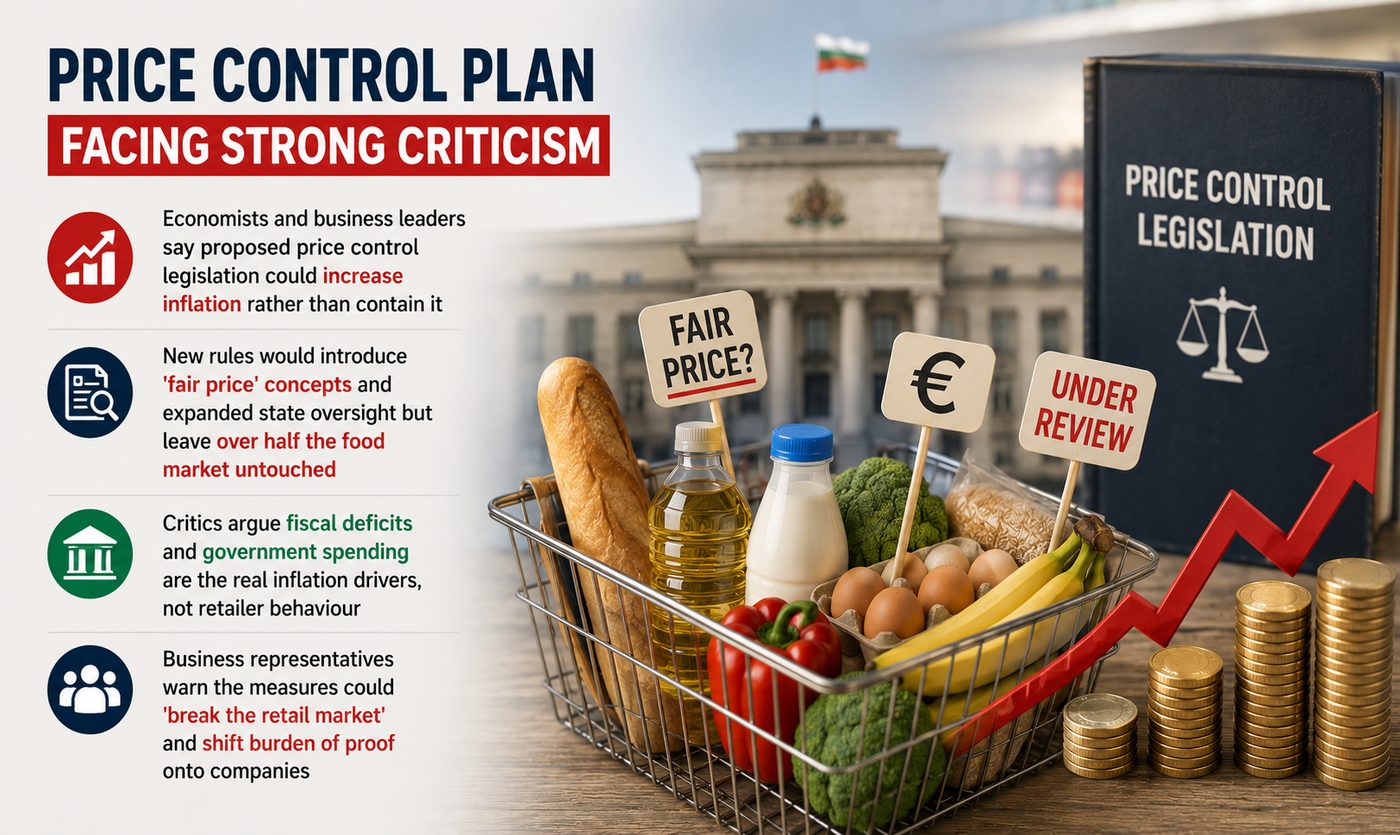
Bulgarian economists and business representatives are warning that proposed government price control measures could push prices higher rather than contain them, arguing that increased regulation and administrative burdens will ultimately be passed on to consumers.
The criticism centres on new legislative proposals concerning competition and consumer protection laws. The proposals introduce concepts such as 'fair prices', 'excessively high prices', traceability registers, and expanded state oversight over pricing practices. They also envision a new interdepartmental control structure tasked with monitoring the market.
What the Experts Say
Economist Adrian Nikolov questioned the government's actual goals during an appearance on Bulgarian television on 13 May. "This means an additional administrative burden on business, which will ultimately be included in the price of products. There is no one else to pay for it," he said.
Nikolov pointed out that the proposed rules largely target major retail chains while leaving a substantial part of the market untouched. "More than 50% of the food market (small shops and open markets) is not affected by these proposals at all," he noted.
He also argued that current inflation levels do not justify emergency-style intervention by the state. "We have about 6-7% annual inflation. This is not a crisis level. At 20% inflation, we did not have such headquarters, and now there is a feeling of a crisis that does not exist."
Health economist Arkadi Sharkov linked part of the current inflationary pressure to Bulgaria's euro adoption process, as well as broader geopolitical instability. "The euro is one of the reasons, not because it is a problem in itself, but because it creates conditions for rounding prices. The crisis in the Middle East and global economic processes also have an impact," he explained.
Sharkov said Bulgaria is unlikely to introduce rigid price caps similar to some temporary measures seen in Croatia after euro adoption. Instead, he expects the authorities to rely on indicative pricing mechanisms. "There will rather be a range in which prices are considered justified, rather than fixed values."
He also warned that food inflation could intensify further in 2027 because of accumulated global pressures and supply disruptions.
It's worth noting that the exact text and detailed provisions of the proposed legislation remain unavailable to external observers. All legal impact assessments are based on expert summaries rather than the draft bills themselves.
Fiscal Policy, Not Retailers
Both economists argued that government spending and fiscal policy are more significant inflation drivers than retailer behaviour. Nikolov warned that persistent budget deficits financed through debt stimulate inflationary pressure throughout the economy.
"If we maintain a high budget deficit and pour funds into the economy through debt, this is strongly pro-inflationary behaviour," he said.
Sharkov added that demographic trends and pension spending are likely to become increasingly serious long-term challenges. "The additional inflow of money leads to higher consumption and, accordingly, inflation. The big problem in the future will be pension costs."
'Absolute Nonsense'
Nikolay Valkanov, executive director of the Association for Modern Trade, delivered some of the harshest criticism of the government proposals, arguing that the measures are fundamentally incompatible with free market principles.
"None of the measures are anti-inflationary. On the contrary, many of them may have the opposite effect," he said in an interview with Bulgarian National Radio.
According to Valkanov, the bills would limit retailers' ability to offer discounts and undermine the role of private-label products, while also creating excessive state interference in pricing. "The goal is supposedly to control prices, but the opposite may happen," he warned.
He accused lawmakers of introducing vague legal concepts and effectively shifting the burden of proof onto businesses. "For the first time, the institute of guilt is being introduced. You have to prove that you are innocent. This is absolute nonsense," Valkanov argued.
He also questioned whether the Commission for Protection of Competition has the institutional capacity to handle the expanded responsibilities envisioned in the legislation. This concern reflects Valkanov's expert assessment rather than any official confirmation of capacity constraints.
Critics of the proposals say the measures fail to address the real causes of inflation: global energy shocks, fiscal expansion, and supply chain disruptions. Instead, they warn the changes could weaken competition, increase compliance costs, and disrupt the retail sector.
Valkanov was particularly blunt in his assessment of the likely outcome. "Today's bills will break the retail market," he said, adding that the economic consequences of the crisis in Iran have not yet been fully reflected in prices and may create further pressure in the months ahead.
What This Means for British Expats
British expats in Bulgaria should expect continued inflationary pressure regardless of whether these measures pass. Economists are warning that food prices could rise further in 2027 due to global supply disruptions and regional instability. These remain expert forecasts rather than confirmed outcomes, but they reflect the thinking of senior Bulgarian economists monitoring current trends.
The practical impact on daily life could be significant. With food and transport costs already driving Bulgaria's recent inflation spike to 7.1% in April 2026 (up from 4.1% in March), household budgets are already under strain. If the proposed price controls do pass and administrative costs get passed through to consumers as economists predict, British households in Bulgaria may see their grocery bills climb even if the stated intention is price containment.
British-owned businesses operating in Bulgaria may face additional compliance costs and reporting requirements, particularly if they operate retail outlets or supply chains. The shift in burden of proof (requiring companies to prove their pricing is justified under the new legal standards) could create particular legal uncertainty for foreign-owned businesses unfamiliar with Bulgarian regulatory practice. British business owners should watch for the final legislative text and seek local legal advice on compliance obligations if the measures pass.
Budget planning for British households in Bulgaria should account for ongoing inflation above 6%, with particular attention to food and transport costs. The euro adoption process may continue to contribute to price rounding and gradual increases in everyday expenses, though the full impact won't be clear until the currency transition settles.
British expats should monitor whether Parliament actually passes these proposals and, if so, whether enforcement follows the rigid or indicative path economists are debating. The coming months will reveal whether Bulgaria opts for heavy-handed price controls or a softer regulatory touch.