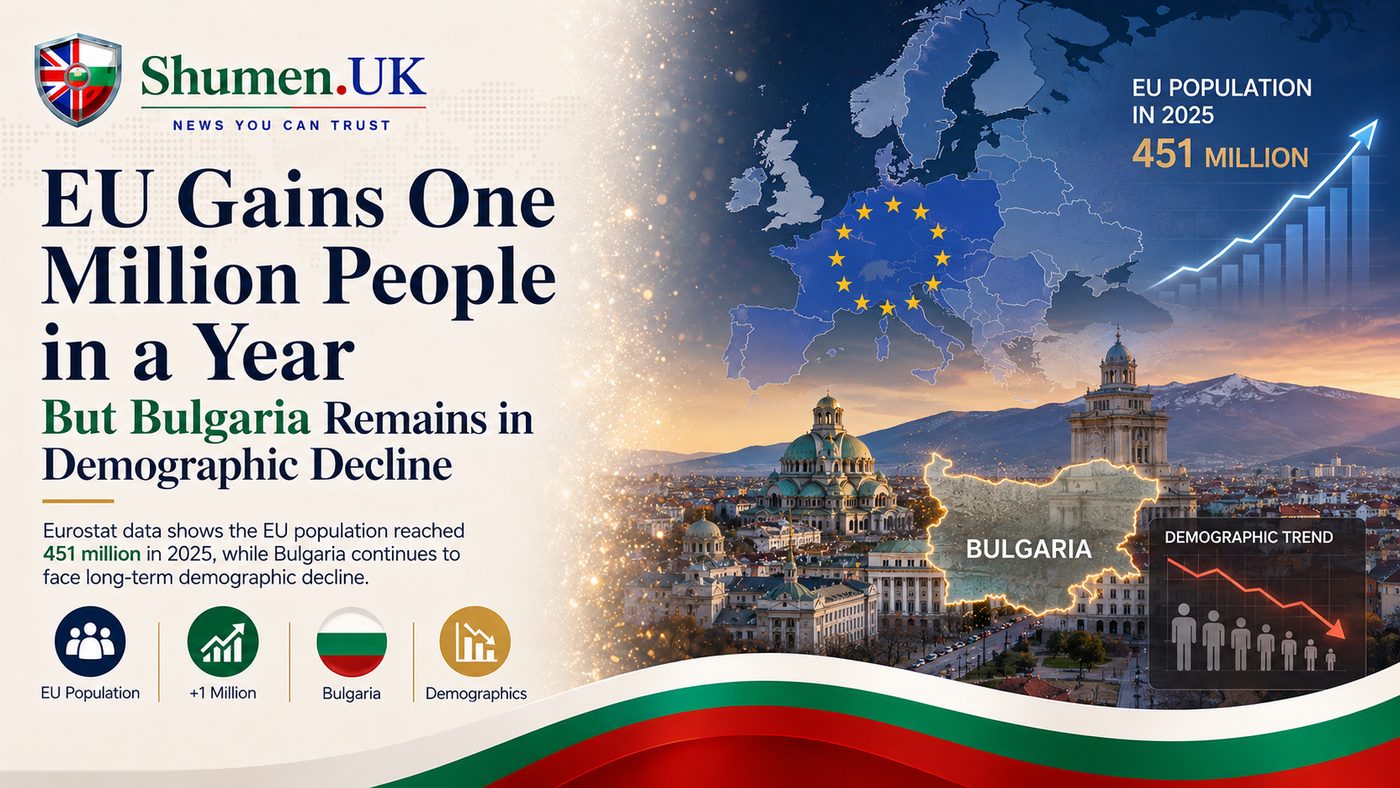
The EU Adds a Million, Bulgaria Loses Ground
The European Union's population stood at 451 million on 1 January 2025, an increase of around a million on the previous year, according to Eurostat data released on 21 May. That modest rise masks a widening split. Nineteen member states saw population growth over the two decades to 2025, eight recorded declines, and Bulgaria was firmly in the latter camp.
Between 2005 and 2025, Bulgaria posted one of the steepest relative population falls in the bloc. Only Latvia, Lithuania, Romania, and Croatia fared worse. In absolute terms, Bulgaria ranked third among countries losing people, behind Romania and Poland. The country's population has been shrinking for years, driven by low birth rates, emigration during the EU accession years, and an ageing demographic profile. Exact numerical breakdowns of the decline are not provided in the Eurostat figures.
Median Age Now Second Highest in the EU
Bulgaria's median age is now just over 49 years, the second-highest in the EU after Italy, according to Eurostat estimates. That figure has climbed sharply: the EU median age rose from 39.6 years in 2005 to 44.9 years in 2025. Italy leads at just over 49, but Bulgaria and Portugal follow closely (precise figures for Portugal were not disclosed in the source data).
The share of Bulgarians aged 65 and over has risen steadily, part of a broader EU trend. Across the union, 99 million people, or 22 percent of the total, are now 65 or older. People aged 80 and over account for 6 percent of the EU population, with Italy, Germany, Greece, and Portugal showing the highest proportions. Bulgaria has seen steady increases in both age brackets, a pattern that intensifies pressure on pensions, healthcare, and the shrinking working-age population.
Migration Patterns Leave Bulgaria on the Periphery
Nearly six million people moved into EU countries in 2024, about three-quarters of them from outside the bloc and the rest moving between member states. Spain, Germany, Italy, and France attracted more than half of all arrivals. At the other end, Slovakia, Latvia, Estonia, and Luxembourg recorded the lowest immigration figures.
Bulgaria saw relatively low inflows. Around 3.1 million people emigrated from EU countries in 2024. Spain, Germany, and France had the highest outflows, while Slovakia and Bulgaria recorded the lowest. That low emigration figure does not signal stability, though. It reflects limited population churn and a society that neither attracts newcomers nor sees large numbers leaving. Net migration into Bulgaria remains weak, and birth rates have not recovered.
Almost a quarter of children born in the EU in 2024 had mothers who were not born in their country of residence, up from 18 percent a decade earlier. Luxembourg, Cyprus, and Malta recorded the highest shares. Romania, Bulgaria, and Slovakia had the lowest. That gap highlights demographic stagnation in Eastern Europe, where inward migration and birth diversity remain minimal compared to Western counterparts.
What This Means for British Expats in Bulgaria
For British expats in Bulgaria, the demographic decline has practical implications, though these are consequences inferred from the data rather than formally measured. A shrinking, ageing population puts pressure on public services (healthcare, local infrastructure). Villages across the country are depopulating, which can mean fewer shops, slower administrative processes, and reduced public transport. On the other hand, depopulation keeps property prices low and reduces congestion, factors that make rural Bulgaria attractive to foreign buyers.
The low share of foreign-born mothers giving birth in Bulgaria suggests limited cultural diversity compared to Western Europe. British expats often find themselves in small, dispersed international communities rather than established expatriate enclaves. That can mean fewer English-speaking services and a steeper integration curve, though it also offers a more authentic Bulgarian experience.
Bulgaria's demographic trajectory is unlikely to reverse soon. The country's median age is rising faster than the EU average, and net migration remains negligible. That makes long-term planning more important for anyone settling here, particularly around access to health services and social care as the population ages.
Citizenship Grants Rose Across the EU
Nearly 1.2 million people were granted citizenship in EU countries in 2024, a 12 percent increase on the previous year. Syrians, Moroccans, and Albanians were among the most common recipients. That trend reflects the EU's ongoing diversification, though Bulgaria's share of citizenship grants remains low relative to its population.
Almost 10 percent of the EU population now lives in a member state other than their country of citizenship. About 3 percent are citizens of another EU country, and roughly 7 percent come from outside the bloc. Luxembourg, Cyprus, and Austria have the highest shares of foreign EU citizens. Malta, Estonia, and Cyprus have the largest proportions of non-EU nationals. Bulgaria's figures remain far below those levels, reinforcing its position as a low-immigration member state.
The Broader EU Picture
Germany remains the EU's most populous country with around 84 million residents, followed by France (69 million), Italy (59 million), Spain (49 million), and Poland (36 million). Together, these five account for roughly two-thirds of the EU total. Malta is the smallest member state by population with 574,000 inhabitants, followed by Luxembourg (682,000) and Cyprus (983,000).
The EU's modest population growth since 2005 has been heavily concentrated in Western and Northern Europe. Luxembourg, Malta, Cyprus, and Ireland posted the strongest relative gains. France and Spain saw the largest absolute increases. In contrast, Latvia, Bulgaria, Lithuania, Romania, and Croatia recorded the steepest relative declines.
The EU now has around 65 million people under 15, representing 14 percent of the total. Ireland has the highest share of children, Italy the lowest. Young people under 19 account for about 20 percent of the EU population, with Ireland, France, and Sweden showing the highest proportions and Malta the lowest.
The Demographic Divide Widens
The Eurostat figures confirm a widening demographic divide between Eastern and Western Europe. Countries like Bulgaria face shrinking populations and accelerating ageing, while Western states absorb most of the EU's immigration and see higher birth rates. That divide has implications for labour markets, political cohesion, and the distribution of EU funding.
For Bulgaria, the demographic retreat continues unabated. The latest figures show no sign of reversal. British expats and anyone weighing a move to the country should factor in the long-term consequences of living in a society where the population is both shrinking and ageing faster than almost anywhere else in Europe.