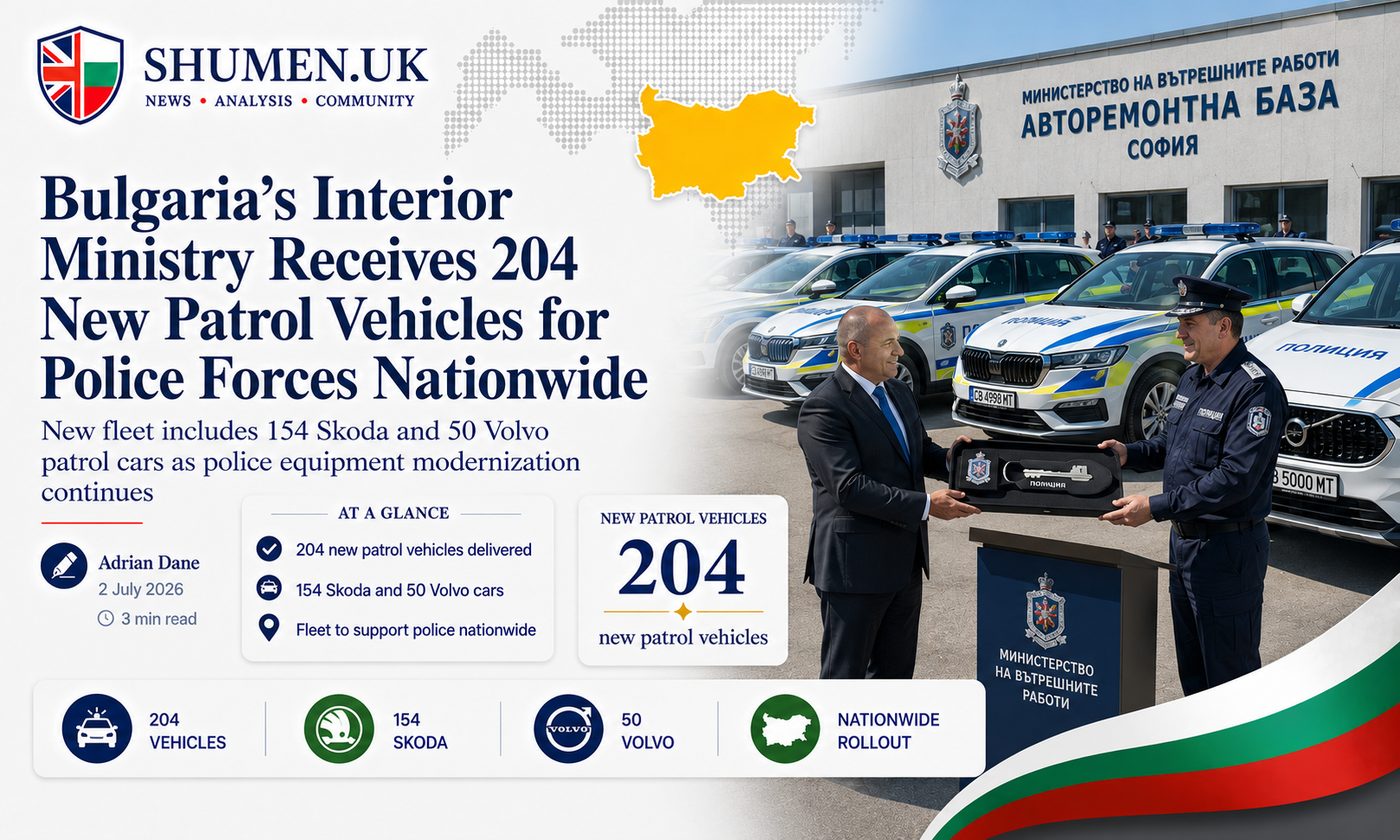
Bulgaria's Interior Ministry has taken delivery of 204 new patrol cars, and the detail that matters most for anyone behind a wheel here is not the badge on the bonnet. It is the camera on the roof.
The fleet, 154 Skodas and 50 Volvos, was handed over at the ministry's Auto Repair Base in Sofia and will be spread across regional police directorates for patrol work, territorial policing and, above all, traffic enforcement. Each car carries 360-degree cameras that, according to the ministry, automatically read number plates and flag any vehicle without valid third-party liability insurance or with an expired technical inspection. Officers can also process and collect traffic fines at the roadside.
For anyone who drives in Bulgaria, that is the part worth reading twice.
What the New Cars Can Actually Do
The ministry describes the fleet as a modernisation tool rather than a straight swap for worn-out cars. The equipment list, as the ministry set it out at the ceremony, includes:
- 360-degree surveillance cameras that automatically recognise number plates and identify vehicles running without valid third-party liability cover or with a lapsed roadworthiness certificate.
- Roadside fine processing, letting officers issue and collect penalties on the spot rather than sending paperwork later.
- Encrypted communications and next-generation TETRA terminals, which the ministry says keep patrols in contact even in areas with poor mobile coverage.
- SUVs within the fleet, intended to reach smaller and harder-to-access settlements.
The stated aim is faster response times, more visible policing and firmer enforcement against dangerous driving. That is the ministry's framing, and it is worth keeping the claim and the source of the claim separate: the capability is real, the promised improvement is a promise.
What This Means if You Drive in Bulgaria
Here is where the story stops being a press release and starts being practical. Two documents that Bulgarian drivers are already required to keep current are exactly the two the new cameras are built to check.
The first is Grazhdanska Otgovornost, the compulsory motor third-party liability insurance every registered vehicle must carry, with proof kept in the car and a valid sticker on the windscreen. The second is the annual technical inspection (GTP), the Bulgarian equivalent of the MOT, which most passenger cars must pass once a year. Drive without a valid inspection and you already risk a fine and penalty points, and your insurer can refuse to pay out or come after you if you have a crash while overdue.
None of that is new. What is new is the enforcement. Until now, a policy that quietly lapsed or an inspection you kept meaning to book could go unnoticed on a quiet road for weeks. A patrol car with plate-reading cameras changes that arithmetic: the check happens automatically as the car passes, with no need to pull you over first.
If you have ever driven the back roads to a village near Shumen, you will know that police presence out there has historically been more theoretical than actual. The SUVs and the promise of more rural patrols are aimed squarely at that gap, so the practical takeaway is simple. Keep your Grazhdanska Otgovornost and your GTP current, and keep the paperwork in the car. Our driving guide walks through both, along with the KAT rules on licences and roadside checks.
€64 Million, Trimmed to €33 Million, After Years of Delay
The Skodas are the first delivery under one of the largest procurement procedures the Interior Ministry has run. The original order covered 1,265 vehicles worth more than 126 million leva (about €64 million), later cut back to 681 four-wheel-drive vehicles worth around 65 million leva, roughly €33 million at the fixed rate. (Bulgarian officials still quote figures in leva; since the euro changeover on 1 January 2026, the sums that matter to a reader are the euro ones, and our money guide covers the conversion.) The 50 Volvos were bought separately, financed through Bulgaria's National Recovery and Sustainability Plan.
The bill was met mainly from the Road Safety Fund, which is filled by the fines drivers pay for traffic violations caught on camera. Under Bulgarian rules that money can only go on road-safety work: cameras, specialist equipment and enforcement vehicles. It is a neat loop, fines pay for the cameras that issue the fines, and the ministry acknowledges the fund's spending has drawn criticism before over whether it stuck to that purpose.
Getting the cars on the road took a while. The procurement began in 2023 and 2024 but stalled for months after car dealers filed appeals with the Commission for Protection of Competition, suspending the process and pushing back the fleet renewal.
A Fleet That Badly Needed Replacing
The delays landed on top of a genuine problem. Many police cars were more than 15 years old, some with over 400,000 kilometres on the clock, and police unions had warned repeatedly that the old vehicles broke down, cost a fortune to maintain and left officers unable to respond quickly or give chase. The Border Police were re-equipped earlier with 213 vehicles and 88 cameras.
Interior Minister Ivan Demerdzhiev, speaking at the handover, framed the cars as more than hardware. "These cars are not just technical means," he said. "They are intended for greater safety, for successful implementation in our fight against road traffic injuries, and for the presence of police officers in small settlements, something for which we are often criticised." Whether the extra visibility materialises on the roads around Shumen and elsewhere is the test that matters, and it is one only the coming months will settle.