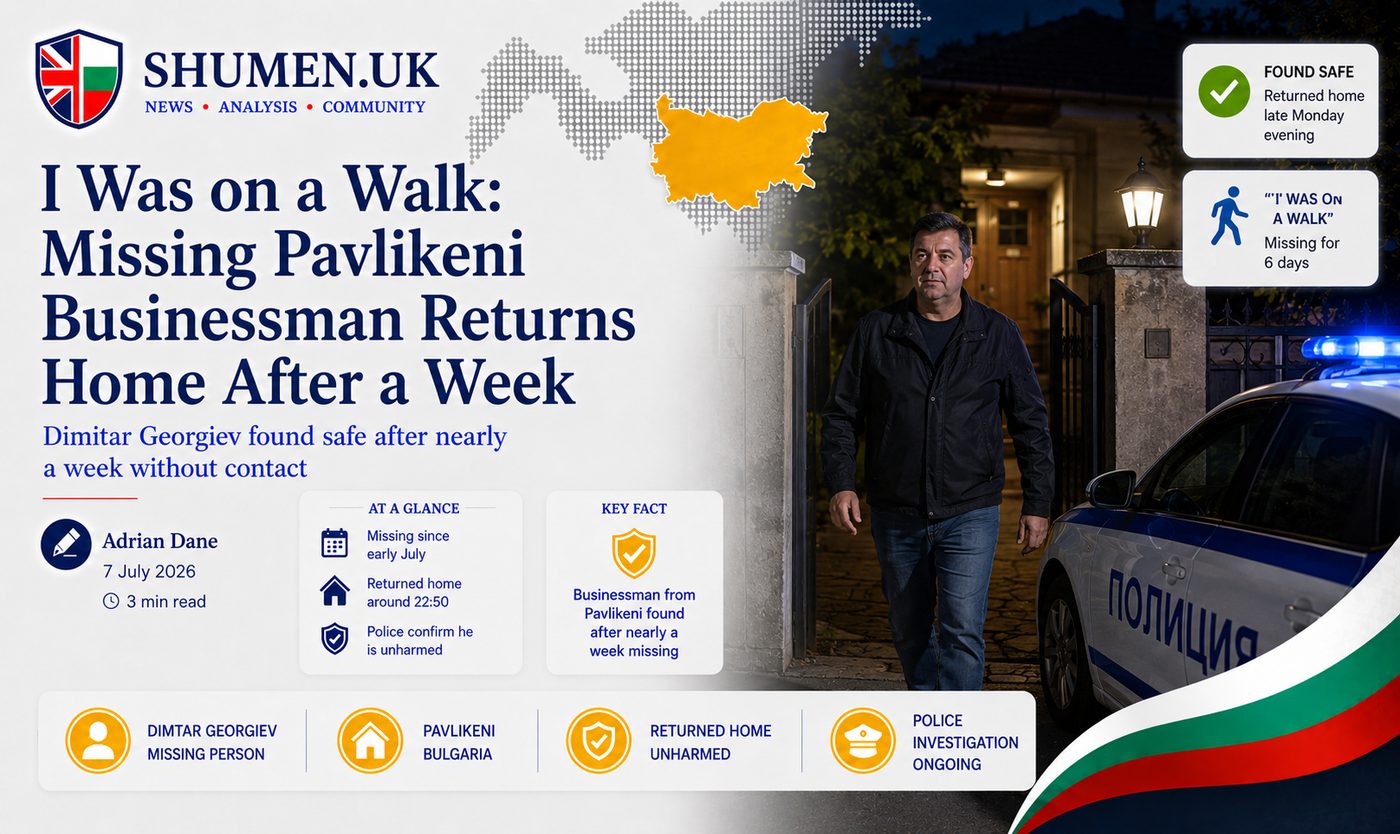
Dimitar Georgiev walked back through his own front door in Pavlikeni at around 10:50pm on Monday, six days after he vanished, muddy, tired, and largely unwilling to explain himself.
The 54-year-old manages a bakery in the town and disappeared on 9 July, after relatives said they could not reach him for several hours. His car was found parked near the bakery, and security cameras reportedly caught him walking on foot toward a wooded area beyond it. From there, according to Novinite, his trail went cold.
What followed was not a quiet local inquiry. Over a hundred people, police officers, gendarmes, volunteers, drone operators and divers, searched difficult terrain looking for him. Neighbours told bTV he turned up covered in mud and dirt but in generally good health. He reportedly told investigators he had been "on a walk" and had survived on wild fruit while deliberately staying away from anyone who might have seen him. Late July is genuinely prime foraging season in rural Bulgaria, plums and wild berries both, so the claim is not physically far-fetched. Why he chose to disappear for the best part of a week is a different question, and neither Georgiev nor the investigators quoted by Novinite have answered it.
A Timeline That Does Not Quite Add Up
Novinite's own report has a wrinkle worth flagging rather than smoothing over. It states Georgiev disappeared on 9 July, a Thursday, was missing for "nearly a week" and specifically "six days," and returned "late on Monday evening." The nearest Monday after a Thursday disappearance is four days later, not six. Either the disappearance date, the day of his return, or the six-day figure is off by a couple of days, and the report does not explain which. We are showing all three figures as reported rather than picking the one that sounds tidiest.
The Bakery Owner Being Questioned
Georgiev's reappearance came shortly after investigators questioned Paun Lazarov, the owner of the bakery Georgiev manages. Lazarov is the uncle of Lazar Kolev, the man convicted of murdering the Belneyski sisters, a separate and unrelated case in which Lazarov himself was a key witness and, in its early stages, a suspect. Novinite reports that Georgiev and Lazarov moved to Pavlikeni from Pazardzhik together more than two decades ago and have been business partners since, and that investigators also looked at the financial relationship between the two men during the search, including allegations of possible misconduct. Georgiev has rejected earlier suggestions from relatives that he might have been kidnapped. Novinite does not draw a direct causal line between the Lazarov questioning and Georgiev's return, only that one followed the other, and neither should we.
Could Georgiev Face Any Consequences?
Novinite's report ends on an open question: whether Georgiev might face legal consequences over the scale and cost of a search operation run by the Interior Ministry, and whether any investigation into his disappearance will follow. As of this report, authorities have not announced either way, and there is no confirmed detail on what such consequences might actually look like under Bulgarian law. That is a gap in the record, not something this piece can responsibly fill in.
What This Means for British Expats
If you are the sort of person who worries what would actually happen if you, a family member, or a neighbour went missing in a small Bulgarian town rather than a capital city, this case is oddly reassuring on that point: over a hundred personnel, drones and divers were deployed for one middle-aged bakery manager in a town of a few thousand people, not a high-profile case in Sofia. It is a useful data point against the assumption that provincial Bulgaria gets a slower or thinner response.
The other genuine takeaway is the closing legal question itself. If you ever find yourself the subject of, or a witness in, a Bulgarian police investigation, however it started, getting early advice from a Bulgarian advokat is worth doing before assuming a case is closed just because you have been allowed to go home.