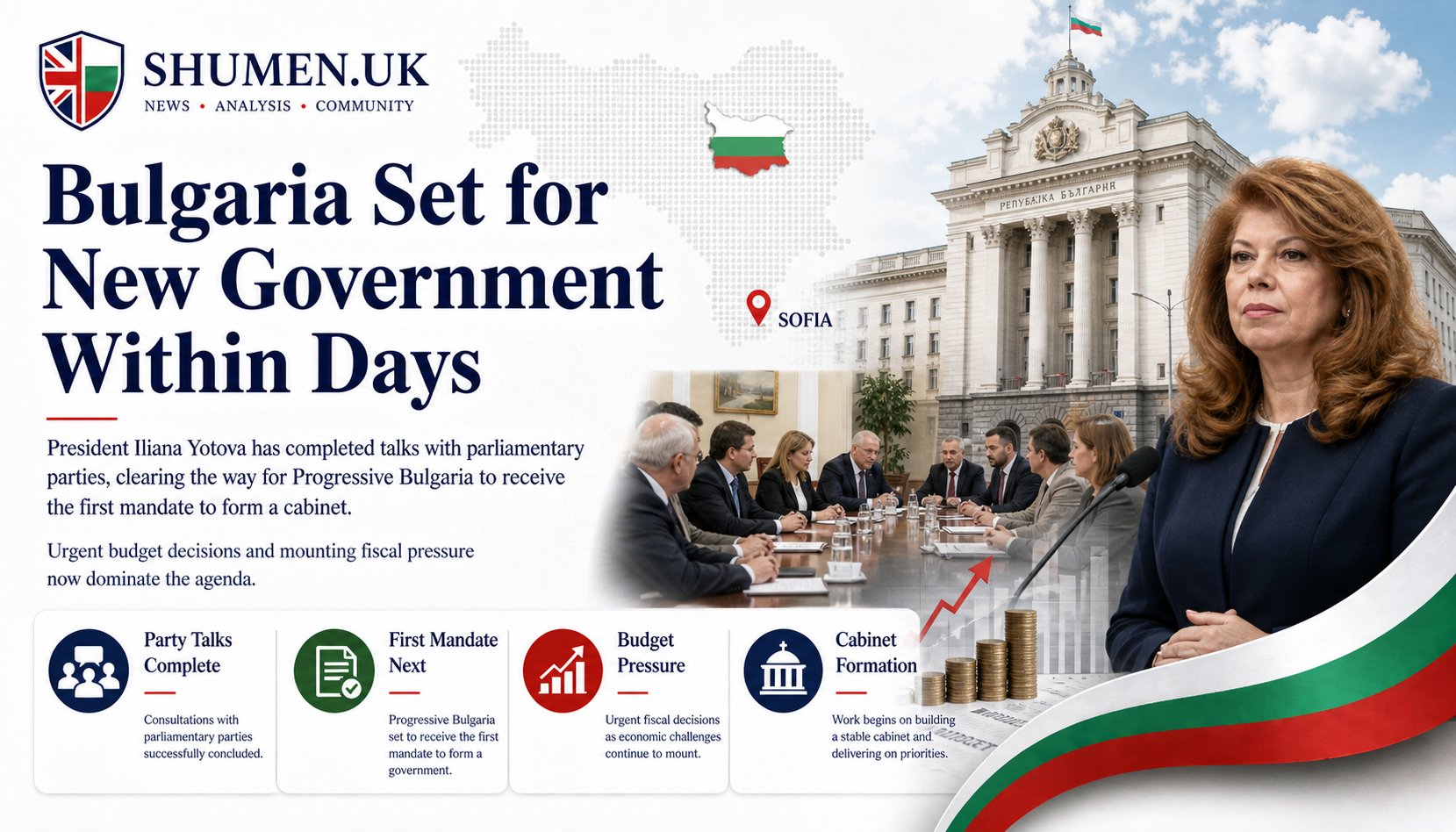
Mandate to Be Handed This Week
President Iliana Yotova completed her round of consultations with parliamentary groups on 5 May 2026, meeting representatives from Progressive Bulgaria, GERB, DPS, We Continue the Change, Democratic Bulgaria, and Revival. The talks form part of the constitutional process that follows elections, with Yotova set to hand the first mandate to form a government to Progressive Bulgaria in the coming days, though the exact timing has not been specified.
Anton Kutev, speaking for Progressive Bulgaria, said the party is ready to move quickly. "It is certain that by the end of the week there will be a government," he told reporters after the meeting. Preparations are already underway, he added, with priorities focused on tackling corruption, stabilising institutions, and addressing inflation.
Yotova emphasised the urgency. "The elections are over and from here the more difficult part begins," she said, pointing to the need for immediate decisions on the budget. Bulgaria is currently operating under two extended budgets, a situation she described as highly unusual and difficult for governance.
Fiscal Pressure and Debt Proposals
The consultations centred heavily on the country's financial position. Galab Donev, speaking during the discussions, acknowledged that the deficit has reached worrying levels. He proposed setting a new debt ceiling as one of the first steps, which would allow the state to guarantee payments for pensions, salaries, and social spending through the end of the year. The specific figures and legal conditions of the proposed ceiling have not been disclosed.
Donev also called for a restructuring of expenditures and renegotiation of elements within the recovery plan to secure delayed European funding. The proposals reflect the tight fiscal constraints facing the incoming government.
The suggestion to raise the debt ceiling drew sharp criticism from political opponents. Kornelia Ninova, former leader of the Bulgarian Socialist Party, accused the incoming coalition of abandoning its campaign promises. "This is not change, this is more of the same," she said, warning that new borrowing would burden future generations without addressing systemic inefficiencies.
Some opposition representatives also raised concerns about investor confidence, describing the debt ceiling proposal as potentially damaging if not accompanied by clear fiscal discipline. The political pressure to demonstrate a break from past governance patterns is considerable, particularly given Bulgaria's status as an EU member state where fiscal stability remains closely watched by both Brussels and foreign investors, including British businesses operating in the country.
Opposition Signals Constructive Role
Yotova held meetings throughout the day with GERB, DPS, Democratic Bulgaria, We Continue the Change, and Revival, all of whom signalled readiness to act as a constructive opposition. Representatives highlighted the importance of deficit reduction, fiscal discipline, and legislative reforms tied to European funding, though their planned concrete actions remain unclear at this stage.
Discussions also covered judicial reform and the dismantling of entrenched governance practices. The so-called "Borissov-Peevski" model, a term used to describe longstanding political influence and control issues within state institutions named after former prime minister Boyko Borissov and businessman Delyan Peevski, was repeatedly raised. Opposition figures warned they would react if commitments to dismantle it are not fulfilled, though no detailed plans or timelines for reform were provided during consultations.
The final consultation was with Revival, whose representatives used the meeting to call for a referendum on restoring the lev as Bulgaria's national currency. They argued that rising debt and inflation require a shift in policy direction. "We are heading toward a dangerous scenario," one representative said, urging the president to initiate a public vote.
Yotova responded cautiously, noting that such decisions must be taken at the appropriate time and within the broader political context. No formal referendum process has been initiated.
What Happens Next
With consultations complete, Yotova is expected to hand the first mandate to Progressive Bulgaria within days. Given the party's parliamentary majority, a government could be proposed and approved rapidly, possibly by the end of the week as Kutev indicated.
The incoming cabinet will face immediate pressure to pass a new budget, manage the deficit, and address concerns over both fiscal sustainability and institutional reform. For British residents, investors, and businesses in Bulgaria, the formation of a stable government matters: political uncertainty tends to rattle markets, delay reforms tied to EU funding, and complicate the investment climate. The extent to which the new coalition can balance fiscal discipline with reform commitments will shape Bulgaria's political and economic stability in the months ahead.