Bulgaria's government is considering whether to buy back the country's sole oil refinery, currently under Russian ownership but operating under special administration due to US sanctions. Deputy Prime Minister and Finance Minister Galab Donev told reporters on 18 May that any decision requires a detailed assessment of value, risks, and whether the state can actually manage such a complex industrial asset.
The issue is not yet on the government's formal agenda.
What's at Stake
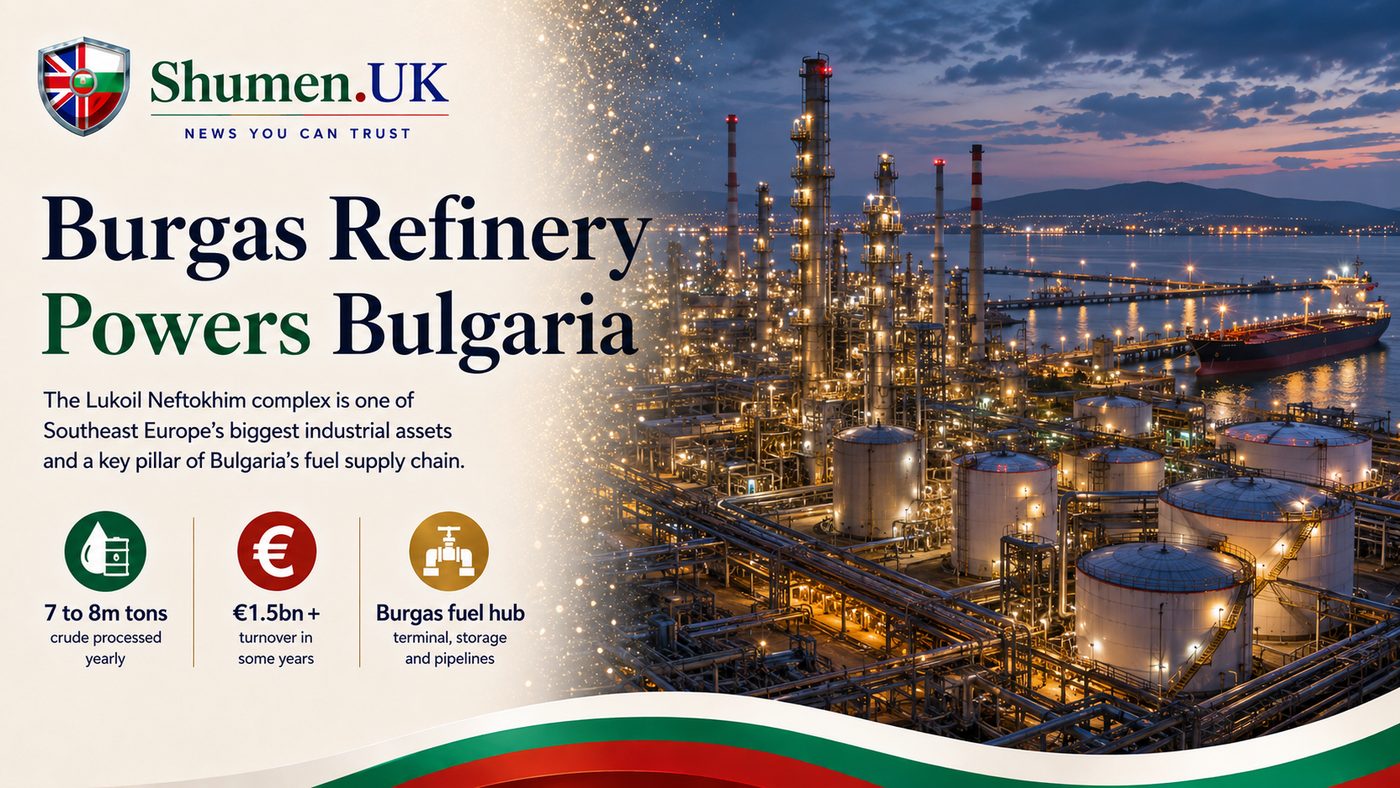
The Lukoil Neftokhim refinery in Burgas is one of the largest industrial complexes in Southeast Europe, processing 7 to 8 million tons of crude oil annually. The facility includes the Rosenets marine terminal, pipeline systems, storage bases, petrochemical production units, and its own power generation infrastructure. Public data shows annual turnover exceeding €1.5 billion in certain years, making it one of Bulgaria's most significant industrial assets and a cornerstone of the country's fuel supply chain.
Rumen Spetsov, the special commercial administrator appointed to oversee the refinery under sanctions, has valued the complex and related holdings at between $20 and 30 billion. This figure is Spetsov's estimate and has not been independently verified. He argues Bulgaria now has a "historic opportunity" to regain control of the asset, subject to political consensus and market-based valuation.
Sanctions Timeline
The United States has tightened restrictions on Lukoil progressively since 2022, following Russia's invasion of Ukraine. By late 2025, the US Office of Foreign Assets Control (OFAC) expanded its sanctions regime to include Bulgarian-linked operations, including the Burgas refinery and associated logistics structures. Washington introduced a temporary derogation allowing continued operations until the end of April 2026 to avoid immediate disruption to fuel supplies.
Bulgarian authorities responded by creating the mechanism of a "special commercial manager" to oversee strategic assets exposed to sanctions risk. Spetsov was appointed under this framework, with powers to represent and administer the companies under legal restrictions.
What This Means for British Expats
The refinery's future affects British nationals living in Bulgaria primarily through fuel supply security. The complex supplies a significant portion of Bulgaria's petrol and diesel. The government has emphasised that fuel reserves remain adequate (the refinery reportedly holds 90-day reserves), but ownership uncertainty adds a layer of risk to the country's energy infrastructure.
British businesses with logistics or supply chain operations in Bulgaria should keep an eye on developments. Any change in refinery ownership or management could affect fuel pricing, contract stability, and regional energy security.
Potential Buyers
Various international actors have been mentioned in public debate as potential buyers or partners, including global energy and investment groups such as Gunvor, Chevron, and Carlyle. No formal offers have been disclosed, and discussions remain at an early stage. The process is exploratory, not an active sale.
Donev stressed that any state acquisition must be preceded by a thorough evaluation, not only of the refinery's market value but also of Bulgaria's capacity to operate such a facility. "An assessment must be made, to see what the value is and what the benefits are that the state would have from this asset, can it manage it?" he said.
Broader Context
The debate over Lukoil Neftokhim reflects wider pressures on Russian energy assets across Europe. Several EU member states have faced similar dilemmas over strategic infrastructure tied to Russian ownership or capital, balancing energy security concerns with sanctions compliance and geopolitical alignment.
Poland, for example, has moved to nationalise certain foreign-owned energy assets in recent years. Lithuania dealt with a comparable situation when Russian ownership of the Mažeikiai refinery ended in the 2000s, eventually leading to private acquisition by a Western firm.
Bulgaria's approach, using a state-appointed administrator rather than immediate nationalisation, aims to maintain operational continuity while assessing longer-term options. Whether this leads to state ownership, private sale, or a hybrid structure remains uncertain.
For now, officials emphasise that no decision has been taken. Any move towards acquisition will require detailed financial analysis, legal review, and political consensus across a fragmented parliament.